
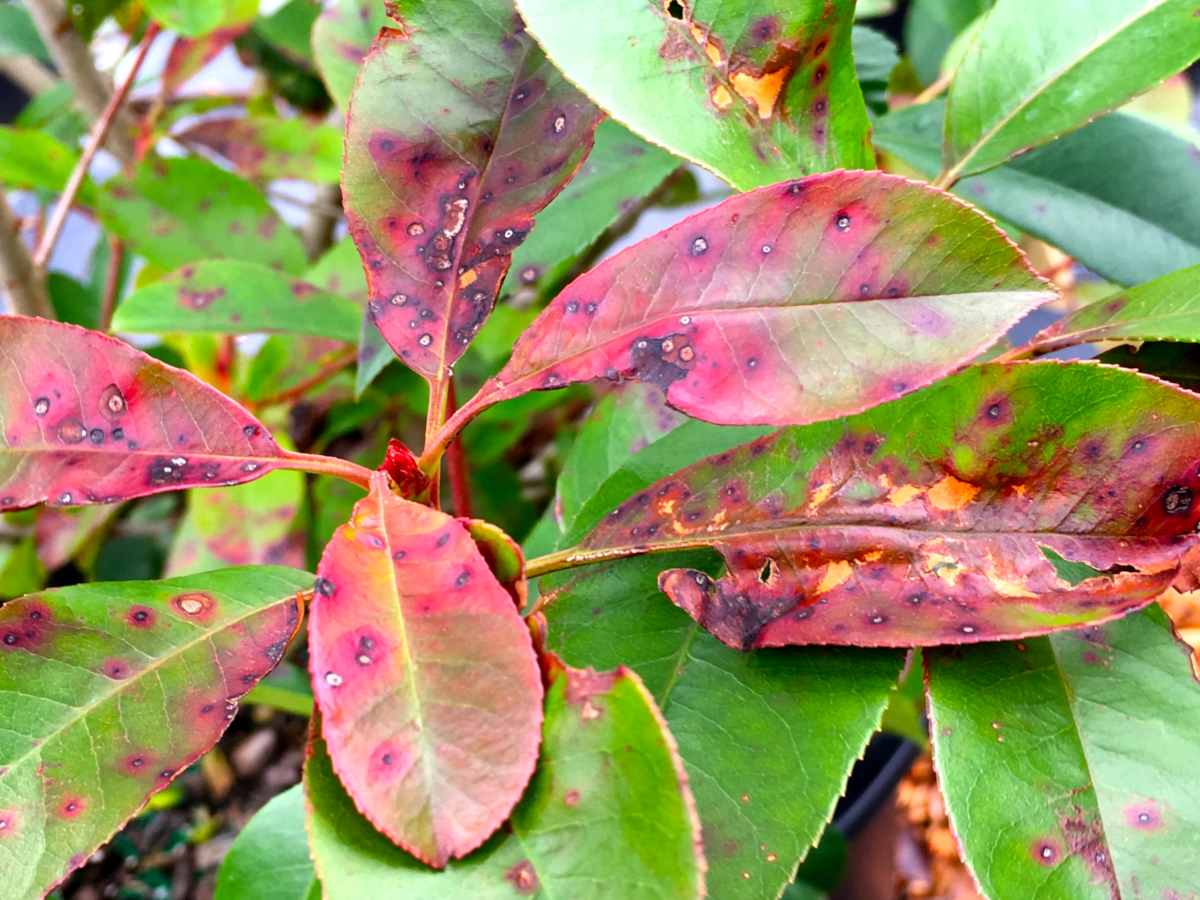
Small dark marks, much like tar spots, appear on photinia leaves and slowly spread until the foliage wilts and falls. Photinia leaf spot (Entomosporium maculatum) is rarely deadly, but it robs a hedge of its beauty; moisture is what drives it, so keeping the leaves dry and the shrubs airy keeps the damage minor.
Leaves are dotted with black spots that slowly spread until leaves wilt and fall off.
Little spots similar to tar spots appear on leaves.
This disease is rarely deadly, although it does lessen the beauty of your Photinia. Learn how to treat the disease and what causes it.
Note: some varieties of photinia naturally have spots: the ‘Pink Crispy’ has darker green spots all over, and the ‘Pink Marble’ has white variegation.
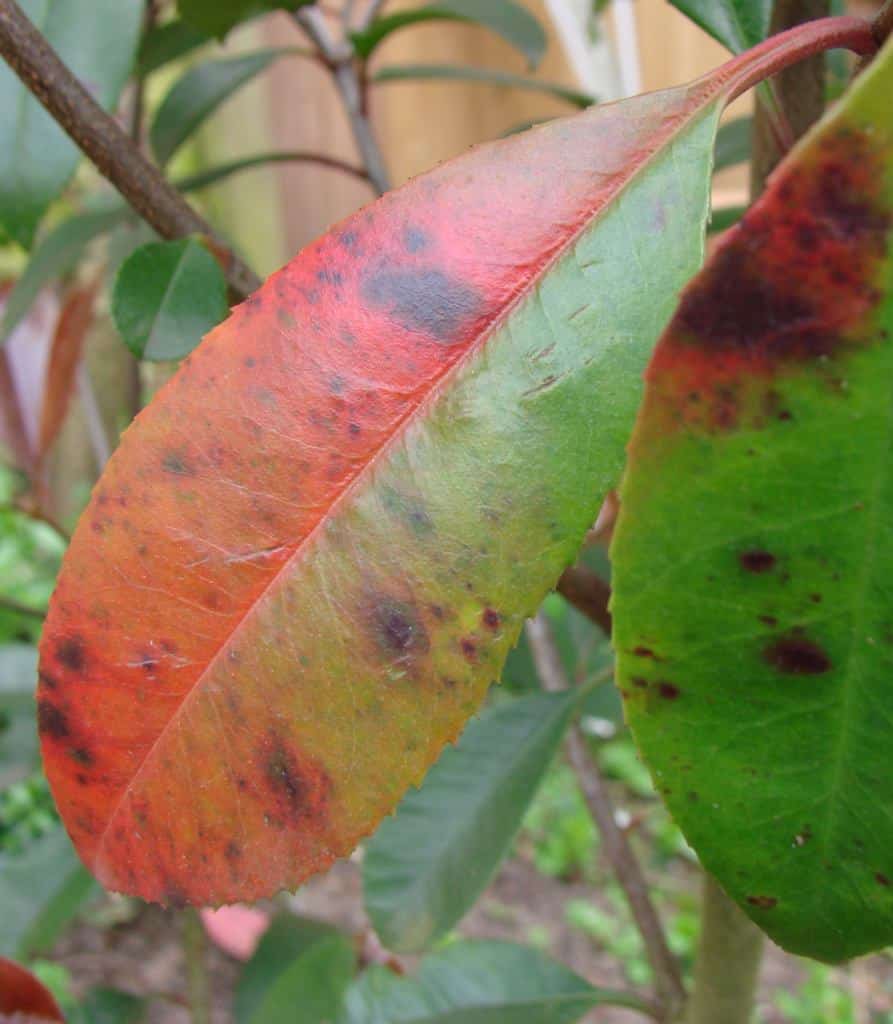
Since the fungus spreads through splashing water from shrub to shrub, you can prevent photinia leaf spot if you :
Once leaf spot disease has appeared:

A fungus called Entomosporium maculatum is what causes leaf spot on photinia.
It is a microscopic fungus that overwinters on twigs and leaves that have fallen on the ground. It is quite common and prefers to infect weak and stressed trees.
From all the photinia species, one of the most vulnerable varieties is the “Red tip” Photinia x Fraseri.
Entomosporium leaf spot is usually harmless in most climates, especially where summers are hot and dry. However, in moist climates with very wet spring and fall seasons, it may prove fatal to your photinia hedge.
Where leaf spot keeps coming back, the simplest cure is to plant something the fungus does not attack. Here are the alternatives the article puts forward, and what each one brings to a hedge.
| Shrub | Why gardeners pick it | Leaf spot |
|---|---|---|
| Holly | A long-standing favourite for hedging | Resists the disease |
| Yaupon | The North-American endemic counterpart of holly | Resists the disease |
| Escallonia, mock-orange, weigela, camellia | Flowers instead of coloured young shoots | Resistant alternatives |
| Silverberry | Silvery foliage, flowers of little note | No leaf spots |
| Spotted laurel | Evergreen leaves marked with yellow | Its spots are natural, not a fungus |
Mixing several of these with photinia in one hedge also slows the fungus down.
Photinia is a wonderful hedge shrub and it’s often grown as a hedge. When leaf spot appears, it’s time to check for alternatives that may also bring joy without the hassle of dealing with the disease.
This particular strand of leaf spot, Entomosporium, can directly infect other members of the Rosaceae family such as:
A favorite shrub that resists leaf spot is holly, as does its North-American endemic counterpart yaupon.
Beautiful flowering alternatives include Escallonia, Mock-orange, Weigela, Camellia and a host of other flowering-bearing hedge shrubs.
With unremarkable flowers but beautiful silvery leaves, silverberry also fills the spot… without leaf spots!
Spotted laurel is also beautiful, with built-in yellow spots on its evergreen leaves that don’t endanger the plant as a fungus would.
If you’re preparing cuttings from your favorite photinia, try to collect cuttings from specimens that aren’t infected to make sure the disease isn’t propagated, too.
Black spots on Photinia are caused by a fungus called Entomosporium maculatum, a microscopic fungus that overwinters on twigs and fallen leaves. The fungus creates light swelling on leaves that gradually changes color to brown, dark red, and ultimately black or gray, particularly affecting young leaves and new growth.
Spray Photinia with anti-fungal spray such as Bordeaux mixture at the end of winter or very beginning of spring, and then again at two-week intervals during the growing season, preferably just after rain or shower. Apply another spray in fall to protect against the disease.
The most common problem is Photinia leaf spot disease, caused by the fungus Entomosporium maculatum, which creates black spots that spread until leaves wilt and fall off. This disease is particularly prevalent in moist climates with wet spring and fall seasons, and the ‘Red tip’ Photinia x Fraseri variety is one of the most vulnerable.
Avoid pruning Photinia in summer, as this triggers new growth that the fungus will quickly colonize. Remove infected leaves by pruning them out once disease appears, and disinfect your pruning tools with methylated spirits or alcohol between cuts to prevent spreading the fungus.
Yes, Entomosporium leaf spot can spread to other members of the Rosaceae family including apple trees, pear trees, quince, Amelanchier, Cotoneaster, Pyracanthus, and Hawthorn. The disease spreads through water splash from leaf to leaf, so watering at ground level without splashing leaves helps prevent transmission.



Photinia leaf spot, when I was looking at this problem in my garden I was really dishearten for this reasons. I like this plant and it adds beauty to the garden. Thanks for valuable information.