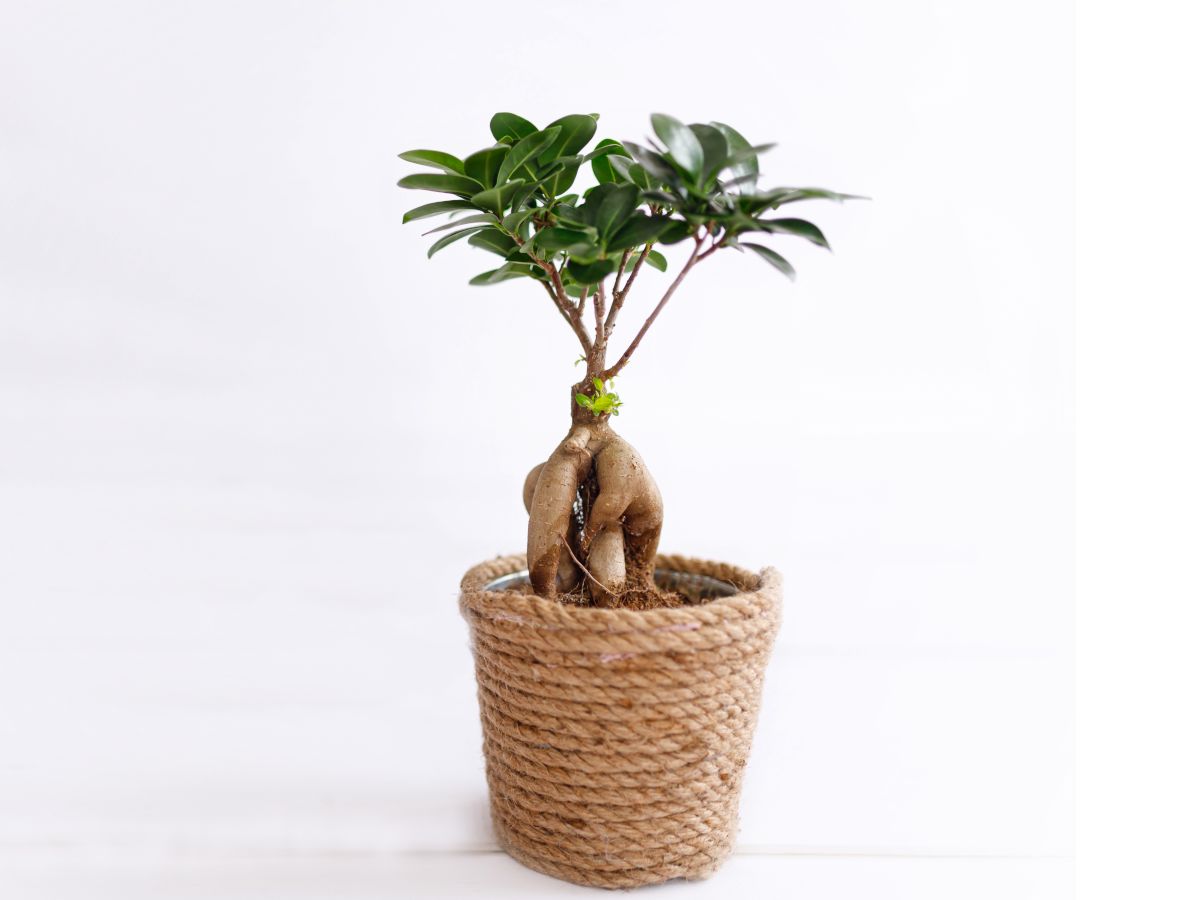
Very shiny dark green leaves crown a thick, bulbous stem that was once underground, dug out and replanted about 4 inches (10 cm) above soil level. That trunk is why Ficus ginseng (Ficus microcarpa) is sold as the beginner’s bonsai: get the watering right and it will live for decades.
| Name | Ficus ‘ginseng’ |
|---|---|
| Scientific | Ficus microcarpa |
| Family | Moraceae (mulberry family) |
| Type | indoor plant |
| Height | 8 to 40 inches (20 to 100 cm), up to you |
| Foliage | evergreen |
| Difficulty | easy |
| Watering | moderate |
| Exposure | lots of indirect light |
| Soil | indoor plant mix, well drained |
Stems grow directly from the large root, producing an amazing effect. It is easy to care for, and here is how to water and prune it – and when to repot it.
Although it is easy to care for, Ficus ginseng does require a little care. Watering, fertilizer and pruning give it all the chances it needs to live for decades.
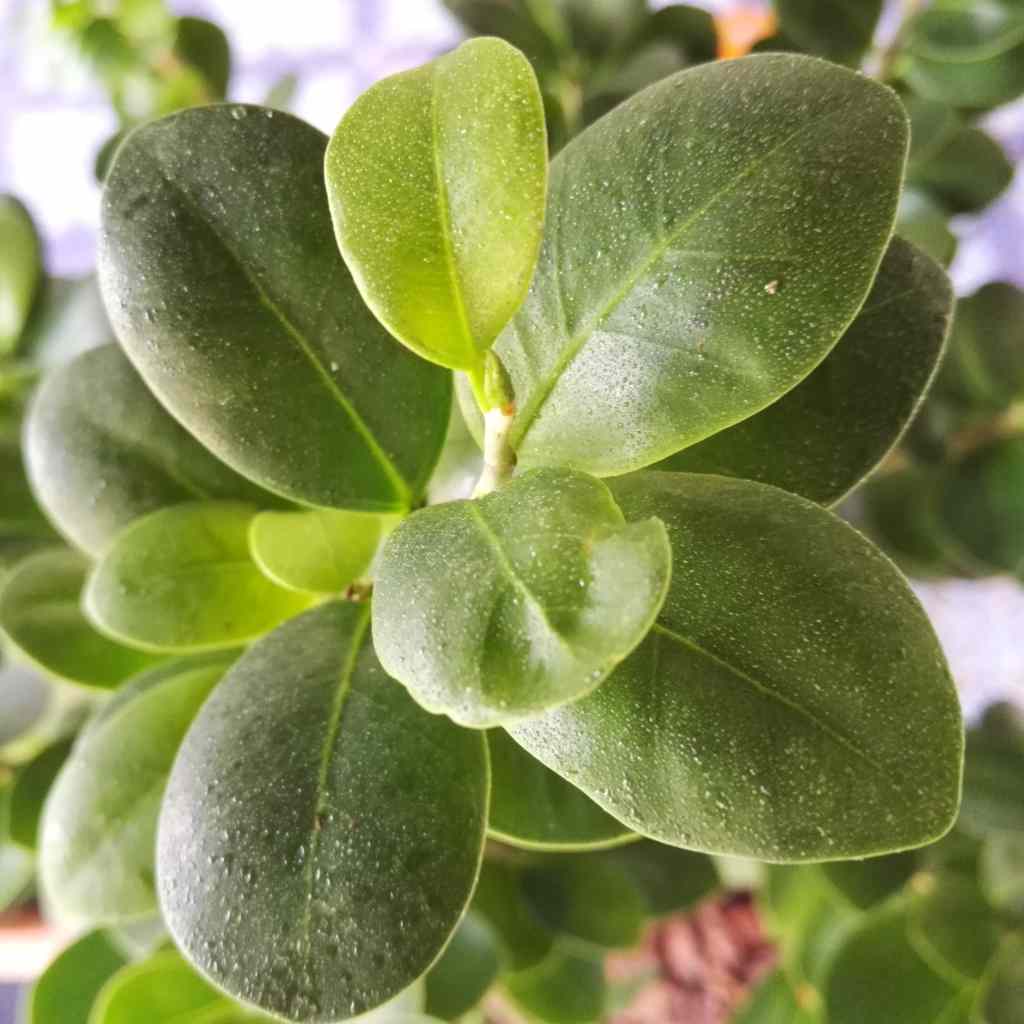
Ficus ginseng rarely ever bear flowers and fruits. In exceptional cases, if conditions are perfect, it might happen: you’ll get a tiny fig!
Ficus ginseng doesn’t require abundant watering. Don’t water a lot, and don’t water too often.

Your ficus ginseng will appreciate having its leaves cleaned often with a rag or a moist paper towel.
Ficus ginseng loves it when air moisture is high.
When you water, you can also provide fertilizer.
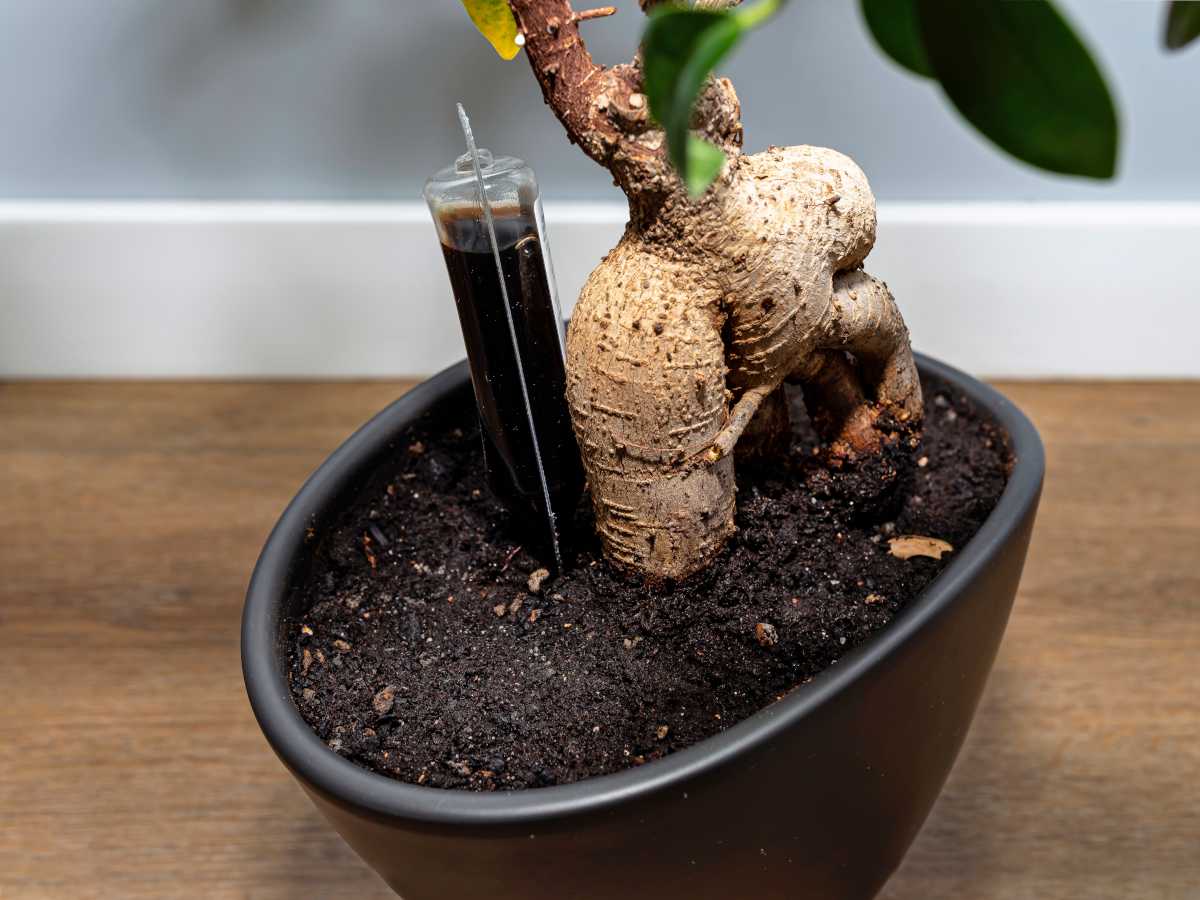
Do so twice a month in spring and summer, but stop in winter, in sync with lower temperatures.
What matters is that it’s balanced, meaning the “N-P-K” numbers are identical or close. If different, favor a mix with more nitrogen (N) and less phosphorus/potassium (P/K).
Never feed a ficus ginseng whose soil has gone dry.
Water first with plain water, then apply the diluted liquid feed to the already damp root ball, so the salts spread evenly instead of burning fine roots.
After repotting a ficus, wait until it pushes out new leaves before resuming fertiliser, because freshly cut roots are sensitive and can be burned by fertiliser salts while the plant is re-establishing.
Too much nitrogen pushes long shoots and oversized leaves that spoil the bonsai’s proportions, so feed less rather than more if you want the foliage to stay small.
If a whitish crust forms on the soil surface or pot rim, flush the pot through with plain water several times to wash out fertiliser salts.
If you consider your Ficus ginseng to be a bonsai, and that you want to keep its shape small, you’ll have to prune it regularly.
Snip new shoots off as they appear for the original shape to be preserved. Or, make it evolve to the shape you wish it to take.
Sometimes the Ficus ginseng comes with small branches grafted on a larger root.
Not only would the ficus change shape, grafted branches will be deprived of sap and die off. Grafted branches are small-leaved, and the root stock is a large-leaf variety.
It might be that your Ficus ginseng is simply watered too much, that it lacks surrounding moisture or light, or that it is set in a place full of drafts.
This is often caused by red spider mite.
This is usually due to mealybugs or scale insects to which the Ficus ginseng is very vulnerable, especially indoors.
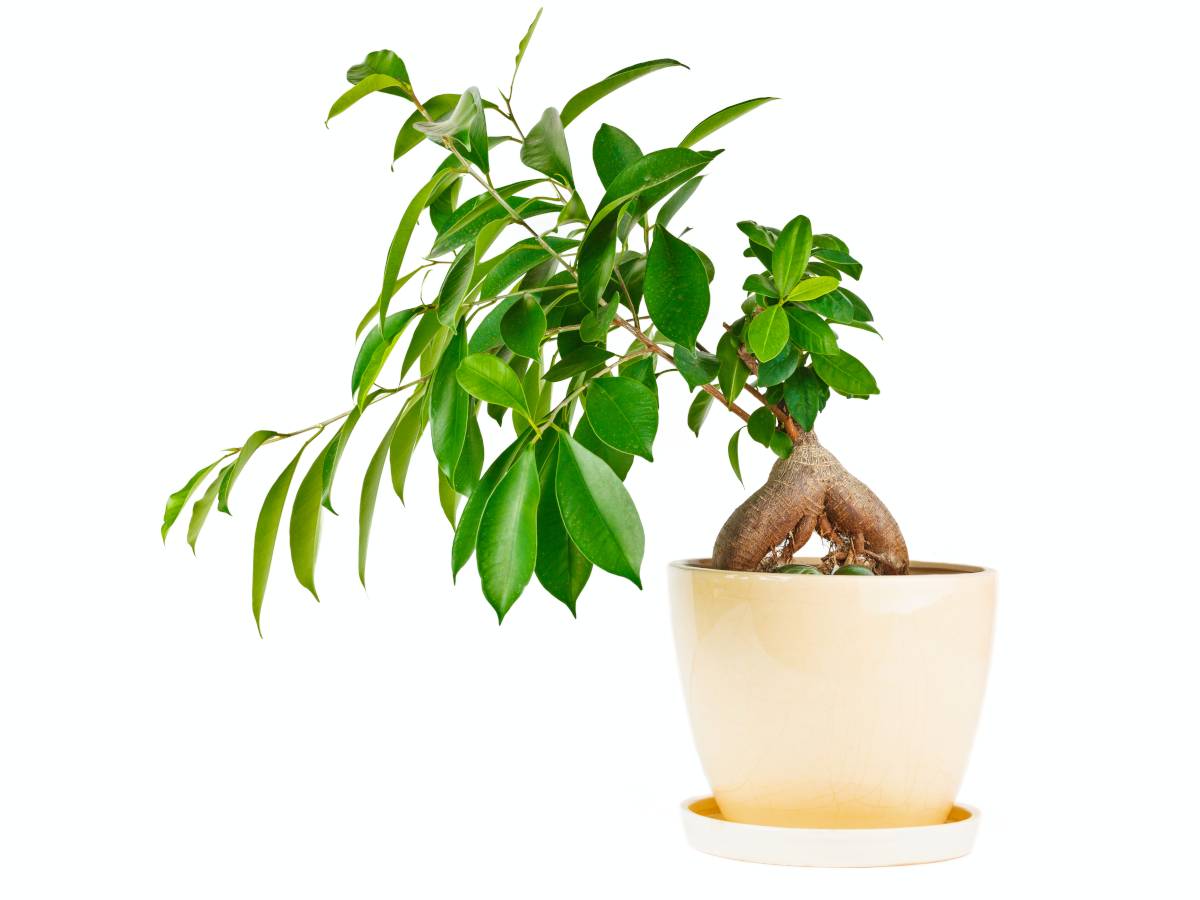
This is because the Ficus is grafted. The root part is from one type of Ficus, usually F. microcarpa. Branches tend to sprout from this root part called the “root stock”. Leaves are different from those higher up which belong to the “scion”.
Sometimes larger leaves appear because growth inhibitors had been sprayed on the plant while at the nursery. Growth inhibitors slow growth and reduce the size of leaves. When it wears off, leaves take on their natural size.
It doesn’t bear any leaves, starts off as a light-colored shoot but bark gradually appears.
Most trouble with this plant shows up on the leaves, and each symptom points to a different cause. Read across the table before you change anything about watering or position.
| Symptom | Likely cause | What to do |
|---|---|---|
| Leaves falling off | Too much water, too little light or air moisture, or drafts | Water only when the soil is dry, mist the leaves, and check the position: lots of light but no direct midday sun |
| Leaves turn yellow or spots appear | Red spider mite | Treat with organic mite killer sold in horticulture stores |
| Sticky white spots on the leaves | Mealybugs or scale insects | Deal with the scale insects; the plant is very vulnerable to them indoors |
| Larger, different leaves | Shoots from the grafted root stock, or nursery growth inhibitors wearing off | Snip root stock shoots off; to keep leaves small, defoliate completely when you prune, no more than twice a year |
| Leafless shoot under a twig or on the trunk | An aerial root | Nothing to correct: it starts light-coloured, then bark gradually appears |
Watering and position account for most problems, so settle those first.
Nearly every plant sold as Ficus ginseng is a form of Ficus microcarpa, and the named selections differ mostly in leaf size, colour and how fast they grow. Use the table to work out which one suits a small bonsai pot and which is really a full-sized indoor tree or hedge plant.
| Variety | Leaf | Foliage colour | Best used as | Vigour |
|---|---|---|---|---|
| ‘Ginseng’ | Small, oval, glossy | Dark green | Beginner’s bonsai, desk plant | Slow, dwarf |
| ‘Green Emerald’ | Medium, oval | Glossy dark green | Screen or specimen tree in frost-free gardens | Vigorous, tall |
| ‘Green Island’ | Thick, rounded, leathery | Deep glossy green | Bonsai and low clipped hedge | Slow, compact |
| ‘Tiger Bark’ | Small, pointed | Mid to dark green | Classic bonsai, mottled pale bark | Moderate |
| ‘Golden Gate’ | Small, glossy | Bright mid-green | Indoor bonsai that thickens quickly | Vigorous |
| ‘Variegata’ | Small, oval | Green with cream margins | Bright-position houseplant | Moderate |
| ‘Moclame’ | Rounded, leathery | Dark green | Upright houseplant or standard | Moderate |
| ‘Panda’ | Small, thick, rounded | Dark green | Small-scale bonsai | Slow, dwarf |
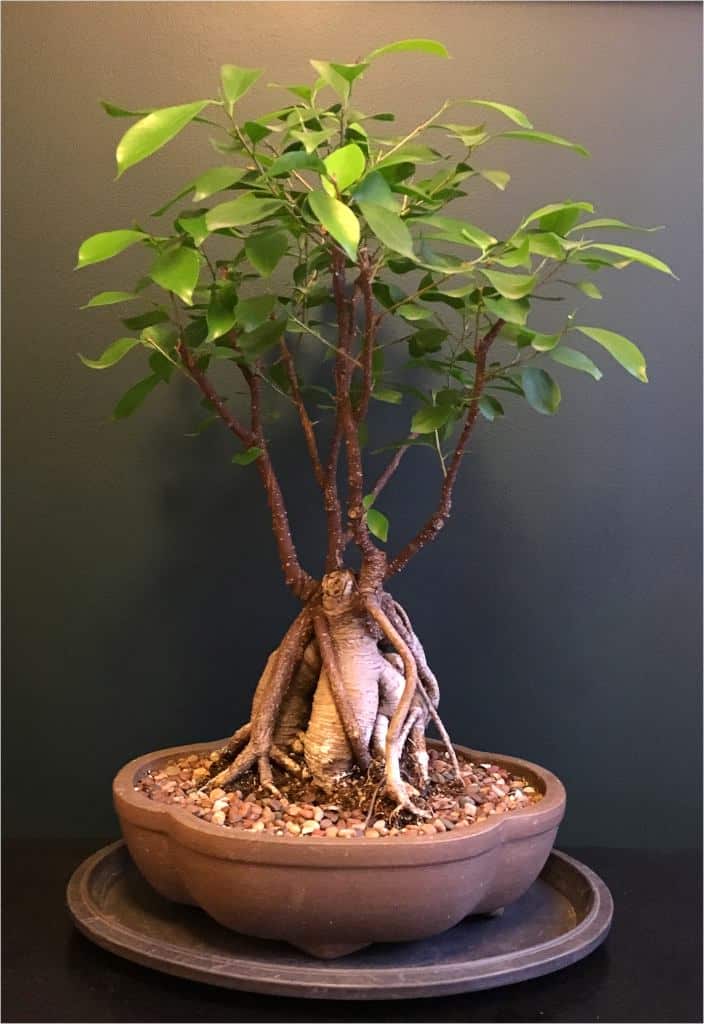
Native to Asia, Ficus ginseng is grown under our latitudes as an indoor plant. It’s one of the favorite ficus for bonsai.
Its small size and thick trunk make it a very decorative plant, ideal for modern designer homes. It also clears air pollution.
The word “ginseng” means root in Chinese, and is attributed to this plant because of the magnificent aerial root. However, its very shiny dark green leaves are equally appealing.
Since it is easy to grow and care for, it is often called the beginner’s bonsai. Its life cycle can span many years, even decades, and the key to a successful life is simply to provide appropriate watering.
Ficus ‘ginseng’ is the common name for what is usually called Ficus microcarpa in the scientific community. The name “ginseng” refers to the appearance of the root. Actually the thick, bulbous stem was an underground part of the plant, dug out and planted about 4 inches (10 cm) above ground level.
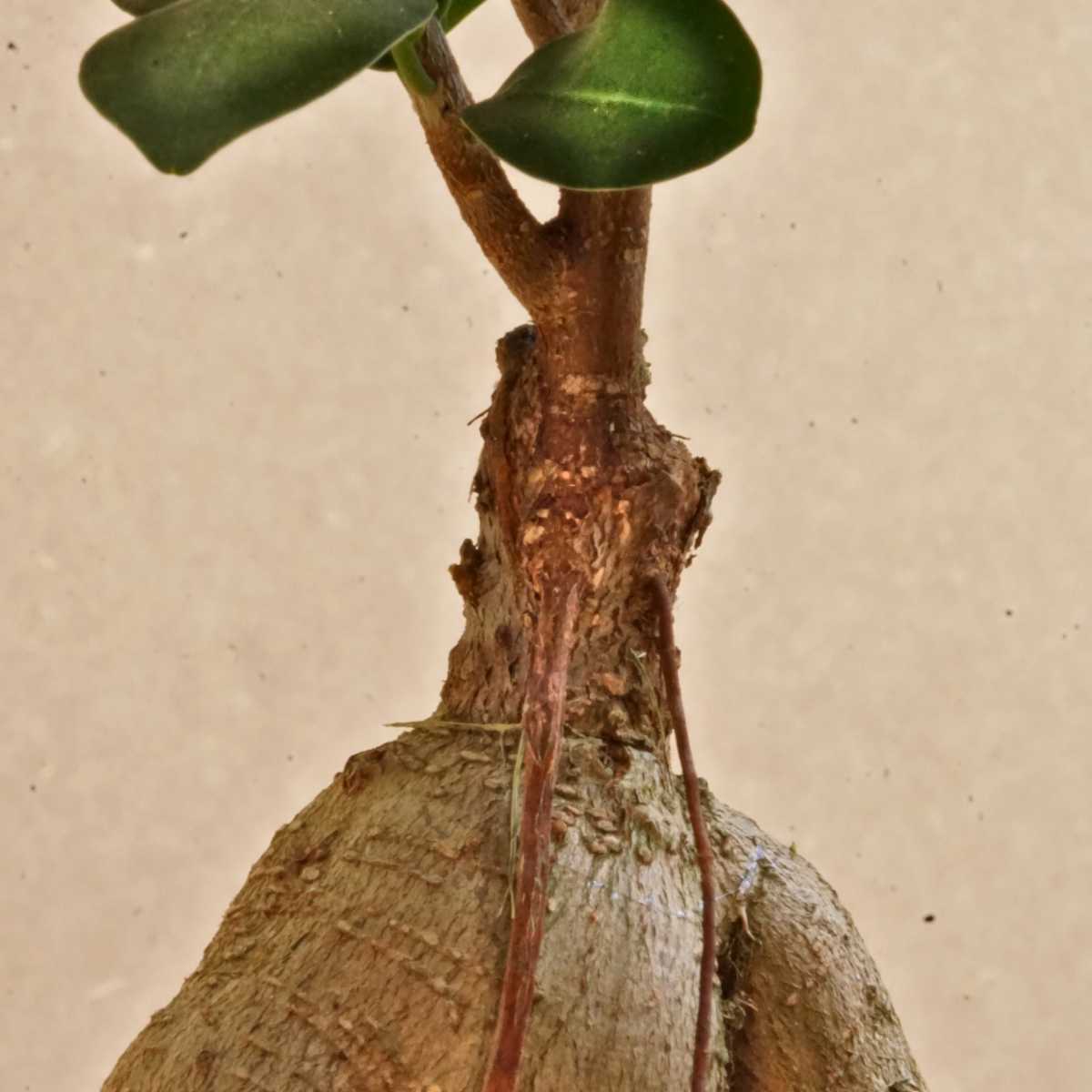
The Ficus ginseng plant is most often simply a Ficus microcarpa plant. However, due to confusion between production centers, consumer stores and the general public, it also came to be known under the name Ficus retusa.
95% of all Ficus ginseng plants sold are actually Ficus microcarpa grafted together with other varieties like Ficus benjamina, Ficus retusa, and lesser-known cultivars filling in the rest.
Other plants bear a confusing resemblance to Ficus ginseng, too!
Ficus ginseng is different from Panax ginseng, the “original” ginseng root used for its health benefits.
When only few leaves are visible, Ficus ginseng is easily confused with another thick-stemmed plant, Adenium obesum. Telling them apart is easier when Adenium blooms.
Read also:
Ficus ginseng will appreciate spending the winter in a cooler spot, ideally around 60°F (15°C).