Home » Health » Ginseng root: traditional uses, preparations and cautions
Ginseng root: traditional uses, preparations and cautions
·
0
Ginseng is the dried root of a small Asian perennial that has been used as a tonic for some four thousand years. This page sets out which part you use, how to turn it into a decoction, an infusion or a tincture, what it tastes like, when in the day to drink it, and who is better off leaving it alone.
A small perennial: the root, not the leaf, is what herbalists use
Where it comes from
Native to north-east Asia: mountain slopes of north-east China, far-eastern Russia, Korea and Hokkaido in northern Japan.
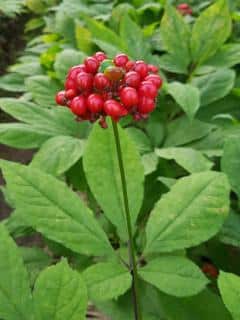
Palmate, lobed leaves, whitish flowers in umbels, then small red berries.
Now very rare in the wild; almost all ginseng on sale is cultivated, mostly in north-east China and South Korea.
Two main species are traded: Panax ginseng (Korean or Asian, “hot” ginseng in Chinese tradition) and Panax quinquefolius (American, classed as “cool” and traditionally considered less stimulating).
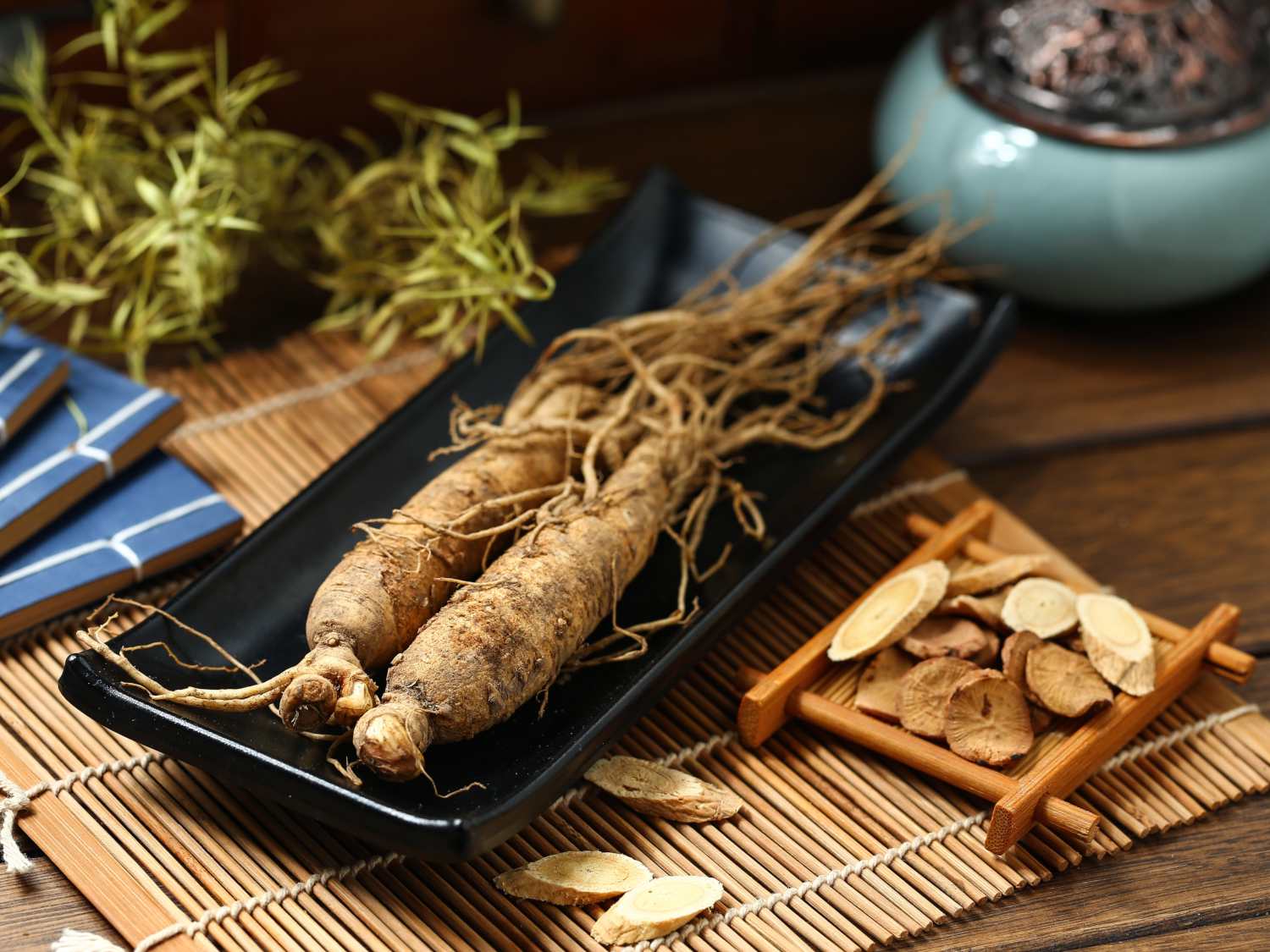
White ginseng is simply washed and dried; red ginseng is steamed before drying.
Ginseng at a glance
Item
Detail
Botanical name
Panax ginseng (also Panax quinquefolius, American ginseng)
Family
Araliaceae
Part used
The root, from plants of five years old or more
Forms of use
Decoction, infusion, tincture, powder and capsules, root slices in cooking
Harvest season
Mid-autumn to late autumn, after several growing years
Taste
Bitter and earthy up front, with a sweetish, slightly liquorice-like aftertaste
What it is credited with
In traditional Chinese and Korean medicine, ginseng root is the archetypal reinvigorating tonic, reserved for centuries for emperors and warlords.
Modern Western herbalism classes it among the adaptogens — plants credited with helping the body hold its balance under strain.
Herbalists traditionally reach for it during periods of physical exhaustion, convalescence and long stretches of emotional pressure.
It has a long reputation as a stimulant of mental alertness and concentration, and Far-Eastern tradition speaks of it as calming the “Spirit” and opening the path of “Wisdom”.
Naturopathy credits it with supporting appetite and general vitality, and with acting as a tonic across the body’s functions.
It carries an old and well-known reputation as an aphrodisiac; Westerners who discovered it in the 18th century used it as a fortifier, an aphrodisiac and a nerve stimulant.
Traditional herbal use also credits the root with supporting the body’s defences in tired people.
Early ethnographers recorded that Native American peoples used their local ginseng to support fertility in women and to strengthen the elderly; Indian writings described it as a plant of life-giving power.
Ashwagandha (Indian ginseng) and Peruvian maca are credited in their own traditions with similar anti-fatigue and stimulating roles, though they are botanically unrelated.
Dried root: the form sold for decoctions, tinctures and powders
How to use it
Decoction (the classic method)
Roots are woody, so they need simmering rather than steeping.
Put a teaspoon or two of chopped or sliced dried root in a small pan with a large cup of cold water.
Bring to a bare simmer and hold it for about a quarter of an hour, lid on.
Strain, and drink it warm. Traditionally taken in the morning or early afternoon.
The same slices can often take a second simmering; the brew will be lighter.
Cold-steeped infusion (for a day’s worth)
Add several teaspoons of dried root to a litre of just-boiled water.
Cover and leave to steep for around 45 minutes, then filter.
Let it cool, keep it in the fridge, and drink a cup at a time through the first half of the day.
Tincture, powder and capsules
Tincture of the root is taken in a little water; follow the maker’s instructions on the bottle.
Powdered root can be stirred into a warm drink, or swallowed as capsules — again, to label instructions.
Food supplements made from ginseng root are sold in health-food shops, wellness centres and many supermarkets.
In the kitchen
In Korea, whole roots are simmered with chicken, garlic, jujubes and rice — the well-known ginseng chicken soup.
A slice or two can be added to a rice porridge, a broth or a slow-cooked stew.
Some people simply chew a thin slice of dried root; expect a strong bitter-sweet, earthy taste.
Rhythm of use
Tradition treats ginseng as a course, not a daily habit for life: a few weeks on, then a clear break.
Morning and midday suit it best. Evening cups are the usual cause of a sleepless night.
It pairs awkwardly with coffee and energy drinks — the two stimulating effects stack up.
Forms of ginseng and how they are prepared
Form
Preparation
Traditionally chosen for
Decoction
Sliced dried root simmered about 15 minutes in a cupful of water
The everyday tonic cup, taken in the morning
Long infusion
Root steeped about 45 minutes in a litre of hot water, then filtered
A batch to sip through the day, hot or cold
Tincture
Alcoholic extract of the root, taken in water as the label directs
Convenience and a consistent strength
Powder or capsules
Ground dried root, stirred into a drink or swallowed
Travel and people who dislike the bitterness
Culinary root
Whole or sliced root simmered in soups, broths and porridge
The Korean way: tonic food rather than remedy
Frequently Asked Questions
The one thing to remember: simmer a teaspoon or two of sliced dried root for a quarter of an hour, drink it in the morning, and keep it to short courses rather than an endless daily habit.
Which part of ginseng do you actually use?
The root, and only the root. Its character builds with age, which is why the herbal trade works with plants of at least five years, often six or seven. Leaves, flowers and berries are not what tradition uses.
How do I make a ginseng decoction at home?
Put a teaspoon or two of sliced dried root into a small pan with a large cup of cold water. Bring it to a bare simmer, keep it there about a quarter of an hour with the lid on, then strain. Drink it warm, in the morning or early afternoon.
What does ginseng taste like?
Bitter and distinctly earthy at first, with a sweetish, faintly liquorice-like aftertaste. Simmering it with a little honey, ginger or jujube softens the edge, and in Korean cooking the root goes into chicken soup where the bitterness fades into the broth.
Can I drink ginseng every day, and in the evening?
Tradition treats it as a course: a few weeks, then a clear break. Evening cups are the usual reason people report a restless night, so stick to the first half of the day. Taken in excess the root can cause anxiety and insomnia.
Is the ginseng ficus sold as a houseplant the same thing?
No. The ginseng ficus is an ornamental ficus with a swollen root that merely resembles a ginseng root. It has nothing to do with Panax ginseng and is not for consumption.
Images: adobestock: xb100, CC BY 2.0: Doug McGrady; Pixabay: 회찬 박
This information is provided for general interest and reflects the traditional use of plants. It is not a substitute for medical advice. If you are on medication, pregnant, or in any doubt, ask a healthcare professional.
Written by Gaspard Lorthiois | Loves helping out, especially when it comes to growing things. Worked in herbal medicine, runs a farm, and dabbles in tech. Master's degree and engineer.
I am impressed to see the garden and also interested to build a garden like that. Can you please let me know if it would be possible to build a garden in Virginia, USA area? Where the winter temperature maybe sometimes drop below 10 degrees F?
Gaspard Lorthiois wrote on 1 March 2019 at 19 h 28 min
Hi Matin! Well, 10°F is a bit cold to grow ginseng commercially. It would grow faster in warmer climates.
🌿 Nature & Garden Newsletter
Gardening tips, recipes & seasonal advice, twice a week.

I am impressed to see the garden and also interested to build a garden like that. Can you please let me know if it would be possible to build a garden in Virginia, USA area? Where the winter temperature maybe sometimes drop below 10 degrees F?
Hi Matin! Well, 10°F is a bit cold to grow ginseng commercially. It would grow faster in warmer climates.