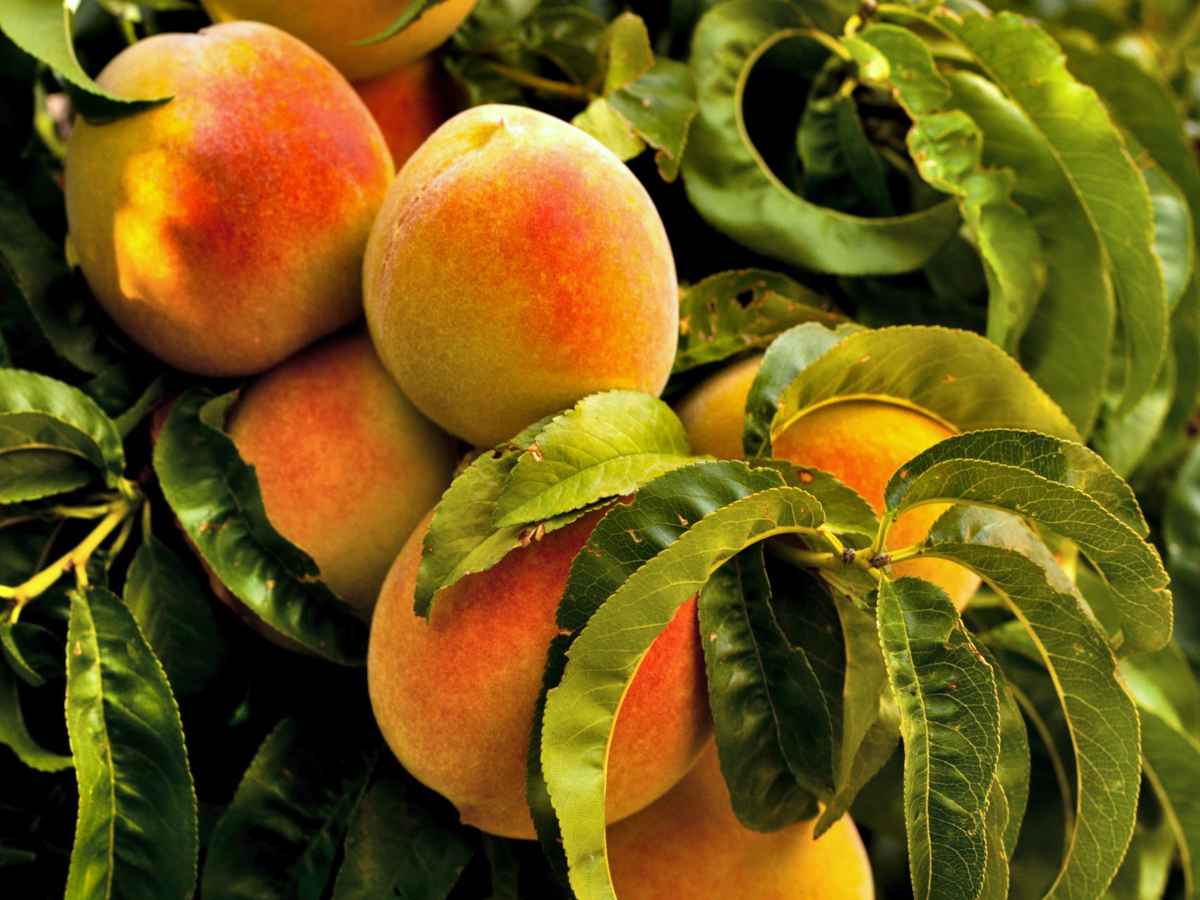
Six and a half to sixteen feet of low, open branching, blossom to watch over, then white- or yellow-fleshed fruit in summer: that is the peach tree (Prunus persica vulgaris), grown for dessert peaches and, in its smooth-skinned forms, nectarines. It is very vulnerable to peach leaf curl, so sun, balanced pruning and well-timed treatment decide the harvest.
Peach tree at a glance
Name
Prunus persica vulgaris
Family
Rosaceae
Type
fruit tree
Height
6 ½ to 16 feet (2 to 5 meters)
Climate
temperate and warm
Exposure
full sun
Soil
ordinary, well drained
Foliage
deciduous
Harvest
summer
Planting, pruning and caring for it is important to avoid diseases.
Choose a sunlit spot sheltered from dominant winds
Our recommendation is to plant your peach tree in a sunlit and wind-sheltered spot so that dominant winds don’t sweep through.
Once the spot is chosen, plant your peach tree in fall or in spring.
Prepare a blend of soil mix and garden soil, which will make the soil lighter and add nutrients that the tree needs to grow well.
If your soil is clay and loamy, add about ⅓ sand to your blend of earth and soil mix.
Spread mulch to protect it from frost spells in winter, and it also adds organic matter and avoids weed growth.
Planting, pruning, and caring for a peach tree
Peach trees tend to not have apical dominance, which means that after pruning, they will sprout new shoots from the base rather than from the top.
Copper treatment must be finished before bloom
Every year, it is important to prune your tree at the end of winter just above a well-formed wood bud. Don’t prune if there’s still a risk of freezing.
Check that the pruning is well balanced.
In most cases, there isn’t a dominant central stem, but rather a number of evenly-sized branches, jutting out from knee-height.
You’ll have to remove any shoots emerging from the trunk.
However, you can leave select shoots that come out from the scaffold branches. Eliminate any branches that crossover and that grow straight up or inwards. Only keep those climbing out to an angle.
A peach tree is very vulnerable to peach leaf curl, and, clearly, proper pruning will give your peach tree vigor and a make it more resilient.
Can I prune peach trees when fruits are already forming?
Only prune out of season for the following cases:
suckers shooting out from the base
dead wood
infection or illness of certain branches
One last possibility is to perform summer “tip pruning”. For a peach tree, this means pinching or snipping off the last 2 inches (5cm) of as many stems as you have the patience for.
This slightly increases the size of fruits on the tip-pruned branch.
The main goal is to trigger more branching out from both main scaffold and secondary branches. This makes it easier to choose which branches to leave or remove during the following end-of-winter pruning.
Which peach pruning, and when
A peach tree is cut at three very different moments, and each cut does a different job. Use this table to decide which one you are actually doing before you pick up the secateurs.
Which peach pruning, and when
Pruning
When
What you cut
What it achieves
Main annual pruning
Late winter, once frost risk has passed
Cut just above a well-formed wood bud; keep evenly sized branches jutting out from knee-height
A balanced framework and, with fruit-inducing pruning, plenty of peaches
Out-of-season pruning
Any season, only when needed
Suckers from the base, dead wood, infected or diseased branches
Keeps the tree clean and stops problems spreading
Summer tip pruning
Early to midsummer
Pinch or snip the last 2 inches (5cm) of as many stems as you have patience for
Slightly larger fruit and more branching, making the late-winter choices easier
Remember that peach trees have little apical dominance, so regrowth tends to come from low down rather than from the top.
Diseases and parasites that frequently attack peach trees
Start treating your peach tree at the end of winter or at the very beginning of spring, spraying Bordeaux mixture.
After that, spray every two weeks to keep peach leaf curl and other fungus from appearing.
Pick off and destroy every mummified peach still hanging on the branches, as these dried fruits carry brown rot spores through winter.
Do not apply copper during bloom; for peach leaf curl, complete treatment while trees are dormant, after leaf fall and before bud swell, rather than planning routine copper sprays after petal fall.
Gather the fallen curled leaves and bin or burn them instead of composting.
The best peach varieties
From the many peach tree varieties, we’ve selected the following interesting cultivars. Although taste is always subjective, there are still among the most delicious varieties to grow in our temperate climates.
Picking time depends entirely on the cultivar chosen
‘Springtime’ – harvest end of June, white, fruits require thinning, prune short.
‘Royal Gold’ – harvest from June 30th to July 15th, yellow, fruits require thinning.
‘Robin’ – harvest from July 1st to July 15th, white and soft flesh.
‘Redhaven’ – July 15th to 20th, yellow, light productivity.
‘Anita’ – July 10th to 20th, white flesh, vigorous, large fruits.
‘Dixired’ – July 20th to August 5th, yellow flesh.
‘Charles Roux’ – July 15th to August 15th, white, vigorous, very productive.
‘Redwing’ – August 1st to 15th, white, tasty, vigorous.
‘Orchard Queen’ – August 25th to September 10th, white, for colder areas.
‘Michelini’ – August 25th to September 10th, white, late blooming, prune long.
‘Sanguine’ – September 1st to 15th, regular and late production.
The best smooth peach varieties, called nectarines
‘Fantasia’ – harvest end of August, a tasty nectarine.
‘Flavor Gold’ – harvest mid-July, prime quality fruits.
‘Fuzadole’ – harvest August 15th, white nectarine, grows anywhere.
‘Large Violet’ – end of August, vigorous and its fertile stone can be sown.
‘Independance’ – harvest around August 10th, large yellow fruit.
‘Morton’ – harvest end of July, beginning of August, fertile stone, prune short.
‘Nectared 4’ – harvest August 1st to 15th, early, juicy, sweet.
‘Nectared 6’ – harvest end of August, one of the best nectarines.
‘Nectarose’ – harvest around August 20th, very sweet, resists European brown rot.
‘Olympia’ – harvest August 15th, nectarine with white flesh, very fragrant.
‘Silver Lode’ – harvest August 10th, white and very sweet nectarine.
Learn more about peach trees
Location, pruning and feeding decide this harvest
Who has never dreamed of standing up after a nice family feast to go fetch a few peaches from the tree in the garden?
This dream is within reach, if you simply care for your tree and considered location, pruning and fertilizing.
You can also treat your peach tree before the first leaves appear, with organic acaricide (mite killer) or a spray containing Bordeaux mixture.
Learn to use organic products, because nowadays they have become very effective and won’t contaminate the fruits you’re eating…
Images: Pixabay: Alicja Juskowiak, Anita Fontana, Emilian Robert Vicol, Unsplash: Kelly Neil, Ian Baldwin
Written by Gaspard Lorthiois | Loves helping out, especially when it comes to growing things. Worked in herbal medicine, runs a farm, and dabbles in tech. Master's degree and engineer.