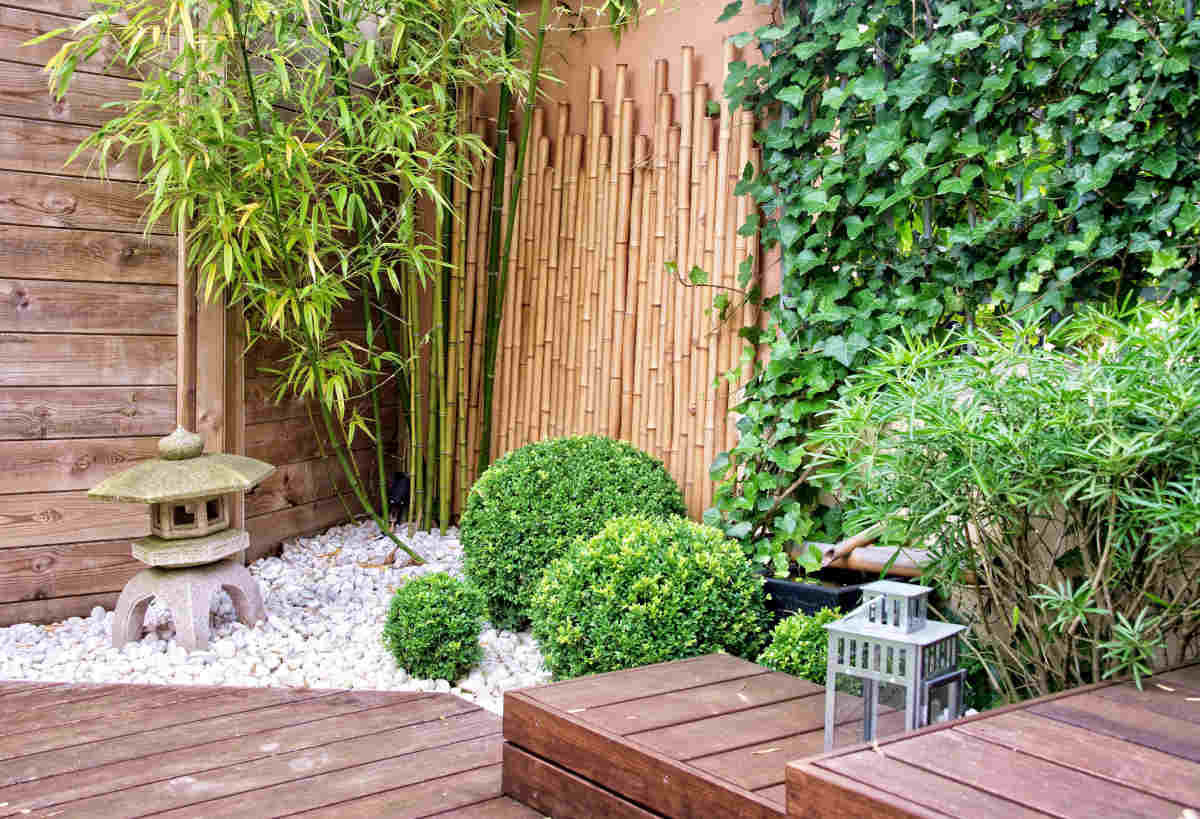
Ginkgo leaves shaped like butterflies, a Japanese maple turning furnace-red, a lantern hung on a branch above stepping stones: the Japanese garden works through precise pruning and a handful of well-chosen plants. Most of those plants want acidic soil, so on chalk grow them in pots — meet that one condition and even a small terrace becomes a place for meditation.
You can select certain plants or ornamental elements to give your garden an Asian touch.
| Ideal for | urban garden, ornamental garden, cloister garden |
|---|---|
| Compatible with | easy garden, sustainable garden, permaculture garden |
| Not suited for | shared garden, native garden, raised garden |

Trees and shrubs pruned with precision are very important in Japanese gardens: they offer structure and play around with perspective. If you also want to jab the hand pruner around to produce a shrub with a perfect silhouette, best go for small conifers like the dwarf fir tree and false cypress which are great for bonsai and cloud pruning.
Bamboo will contribute to bringing over a bit of Asia to your garden. They are quite convenient to set up a hedge. Select them to be clumping (non-running) to avoid them invading your garden. If your garden is small, select a dwarf variety that you can also grow in pots. With bamboo-like leaves but entirely non-spreading, the Mahonia ‘Soft Caress’ will also gift you with wonderful yellow flowers in fall!
Among other species that are distinctly associated to the country of the rising sun are ginkgo biloba, with its surprising butterfly-shaped leaves. Together with taller Japanese cherry tree, maules’s quince have an extraordinary blooming in spring. Of course, impossible to forget Japanese maple (Acer palmatum and japonicum), that takes on furnace-like colors in fall. Set yours up in part sun with acidic soil (pH 5 to 6), cool and well drained.
You can enhance the stage with shrubs like camellia, azalea, hydrangea and rhododendron. Note that all these plants require acidic soil which is very common in Japan! If your soil is very chalky, try growing these in pots to create a mini-Japanese garden on your terrace for instance.
To cover the ground itself, bring in greenery like ferns and hostas, and plant iris which is a flower that inspired a great many Japanese artists. The symmetrical bearing of Cycas makes that Japanese native plant an interesting feature at mid-height.
The plants that carry a Japanese garden each play a different part: some give the pruned structure, others the seasonal event. This table gathers the ones named above so you can see what each contributes before you buy.
| Plant | Role in the garden | Season of interest | Soil and siting |
|---|---|---|---|
| Dwarf fir, false cypress | Pruned structure, bonsai and cloud pruning | All year (evergreen) | Kept small by regular pruning |
| Bamboo (clumping, or dwarf in pots) | Hedge and screening, a touch of Asia | All year | Choose clumping types; dwarf kinds for pots |
| Mahonia ‘Soft Caress’ | Bamboo-like leaves without any spread | Flowers mid-autumn to late autumn | Entirely non-spreading |
| Japanese cherry, Maule’s quince | Flowering trees and shrubs | Blooming in spring | Cherry is the taller of the two |
| Japanese maple (Acer palmatum, A. japonicum) | Autumn colour, the signature tree | Fiery leaf colour in autumn | Part sun, acidic soil pH 5 to 6, cool and well drained |
| Ginkgo biloba | Distinctive foliage feature | Leaves through the growing season | Associated with the country of the rising sun |
| Camellia, azalea, hydrangea, rhododendron | Shrub layer that sets the stage | Flowering shrub interest | All need acidic soil; use pots on chalky ground |
| Ferns, hostas, iris | Ground cover and greenery | Leafy through the growing season | Iris inspired many Japanese artists |
| Cycas | Mid-height feature with symmetrical bearing | All year | A Japanese native plant |
With the planting settled, the ornaments can be added to finish the scene.

Various ornamental objects will bring the final touch to your Japanese garden. Create a winding path along the lawn with Japanese stepping stones, attach a lantern or wind chimes to the branch of a tree, plant bamboo torches along a garden trail…
Each special touch will help induce meditation in the garden…
Stone lanterns are almost a must-have, but you might also prefer a little fountain. In the shape of a Buddha or simply square, there are sun-powered models that are activated by the sun’s rays.
Laure Hamann
minor edits by Gaspard Lorthiois
©Delphotostock/AdobeStock