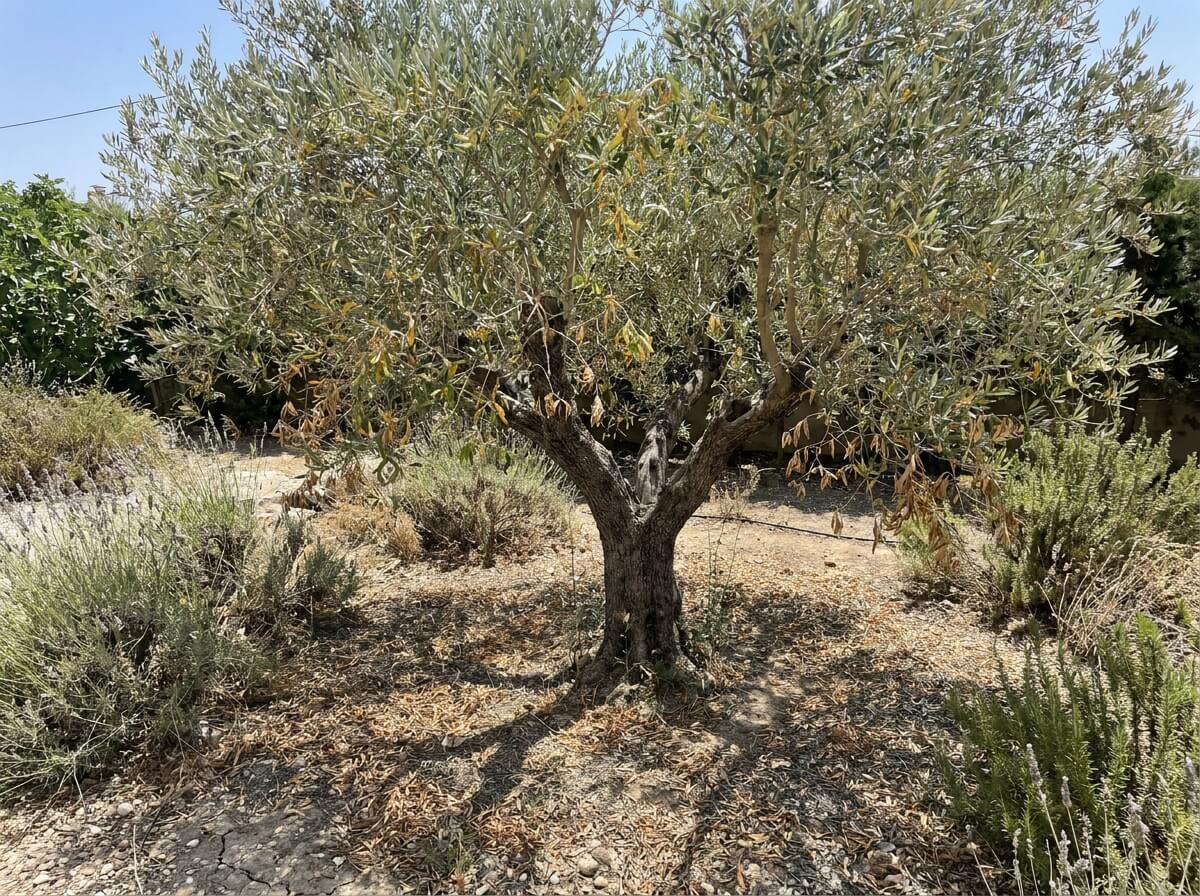
Olive trees have a reputation for indestructibility, and mostly they deserve it. But peak summer — sustained heat above 35°C (95°F), dry air, baked soil — puts the tree in a physiological state that catches most gardeners by surprise.
The watering schedule that worked in spring stops working. Leaves turn a dull grey-silver rather than a bright one.
Tiny fruitlets drop. The instinct to water more is wrong, and acting on it can cause genuine harm.
Understanding the olive’s survival mechanism changes everything about how you care for it in summer. When temperatures stay consistently above 35°C, the tree enters a state of reduced metabolic activity — not quite dormancy, but close. Stomata (the leaf pores) close during the hottest part of the day to limit water loss. Photosynthesis essentially pauses between noon and 4pm.
It’s normal. It’s not a sign of deficiency or disease.
The tree is doing exactly what 10,000 years of evolution has optimised it to do in a Mediterranean summer.
What disrupts this survival mode is inconsistency — frequent shallow watering that wets the top 10cm of soil, then lets it dry, then wets it again. The roots never push deep.
The soil surface heats and cools in violent cycles. And the crown stays damp, which is where root rot begins.
The single most damaging thing you can do to an olive tree in peak summer is water it daily. Or every two days.
It feels attentive. But it’s quietly destructive.
Olive roots are extraordinary. On a mature tree planted in open ground, lateral roots can extend 3–5 metres from the trunk and reach 60–90cm depth.
Surface watering — a hosepipe run for five minutes at the base — doesn’t reach them. The water evaporates before it penetrates.
The shallow soil layer stays cool and moist while the functional root zone stays bone dry.
The proper summer rhythm for a mature in-ground olive tree is a deep watering once every 10–14 days. Each session should deliver water slowly over 30–40 minutes at the base — a soaker hose left running, or two or three full watering cans applied over 20 minutes with pauses to let water soak rather than run off.
Then nothing. Let the soil dry completely before you water again.
For a potted olive, the interval shortens to every 5–7 days in peak heat, but the same principle applies: water until it drains freely from the bottom of the pot, then stop. Never leave a pot sitting in a saucer of water in summer.
Stop all nitrogen feeding by late spring — no later than the end of May in the Northern Hemisphere. Full stop.
A nitrogen application in peak summer triggers a flush of soft, pale new growth at precisely the moment when that growth has no chance of hardening off before the worst heat arrives. The new shoots scorch within days.
They look like heat damage, which they partly are, but the fertiliser created the vulnerability.
If your tree genuinely needs a nutrient boost — yellowing older leaves, dodgy growth over the whole season — use a slow-release granular feed formulated for Mediterranean or fruit trees, applied once in early spring. The RHS olive growing guide recommends a balanced fertiliser in March or April, with nothing after flowering begins. That advice holds.
Potassium is the exception. A potassium-rich feed (a tomato feed works fine, despite the branding) applied once in early summer supports fruit development without pushing vulnerable leafy growth.
Use it once, at half the recommended dose.
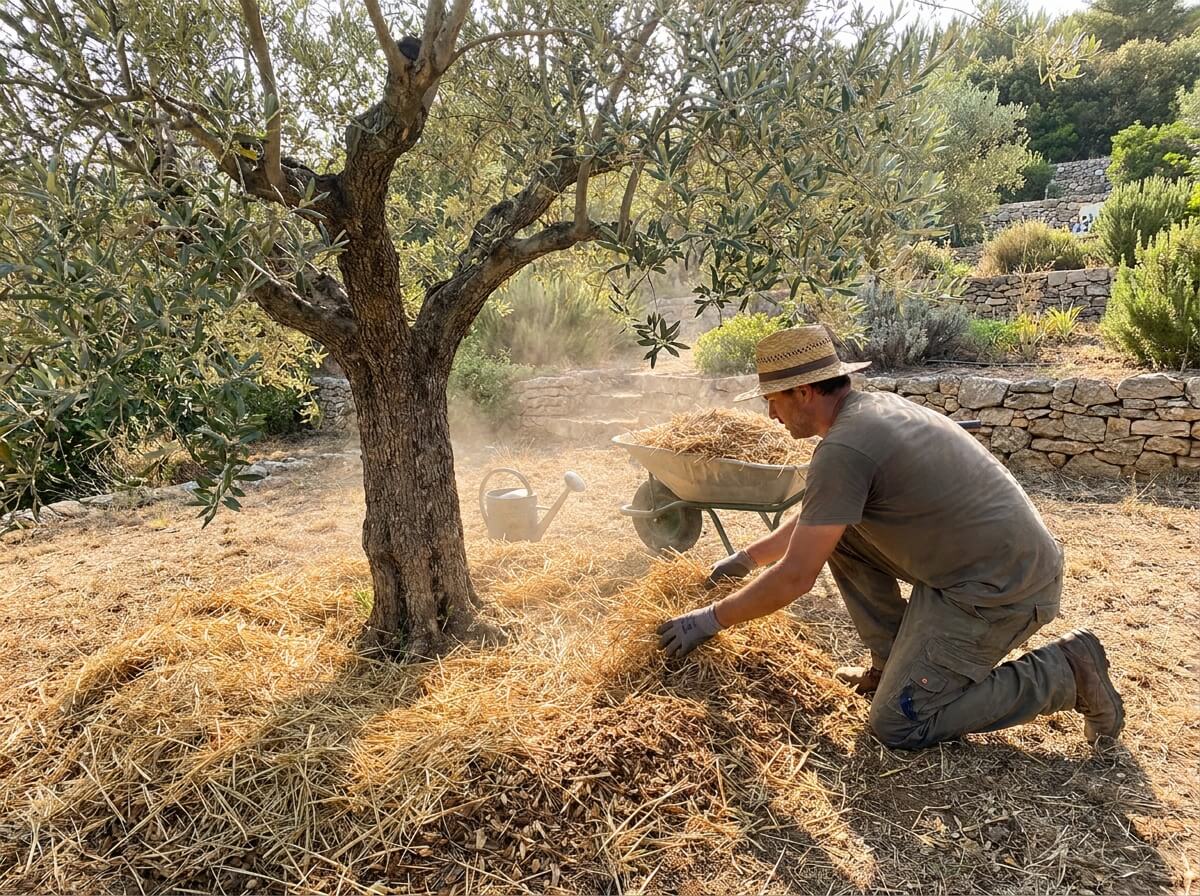
A 7–10cm layer of mulch around the base of the tree — stopping 15cm short of the trunk itself — does wonders for a stressed olive in summer than any watering adjustment. It insulates the root zone, slowing the rate at which soil heats and dries.
It reduces surface evaporation by up to 70%.
Gravel mulch works well for olives and suits the Mediterranean aesthetic. Bark chips work too.
What doesn’t work is piling mulch against the trunk — that traps moisture at the crown and creates the conditions for collar rot, which will kill a mature tree from the base up.
Yes, it’s a ten-minute job. Worth it. The difference in how quickly the soil dries out between waterings is night and day.
If you grow other Mediterranean plants alongside your olive, the same mulching logic applies. Watering Mediterranean plants correctly in summer covers the shared principles that apply across the whole dry-garden palette.
Olive trees shed leaves in summer. This alarms gardeners who don’t expect it.
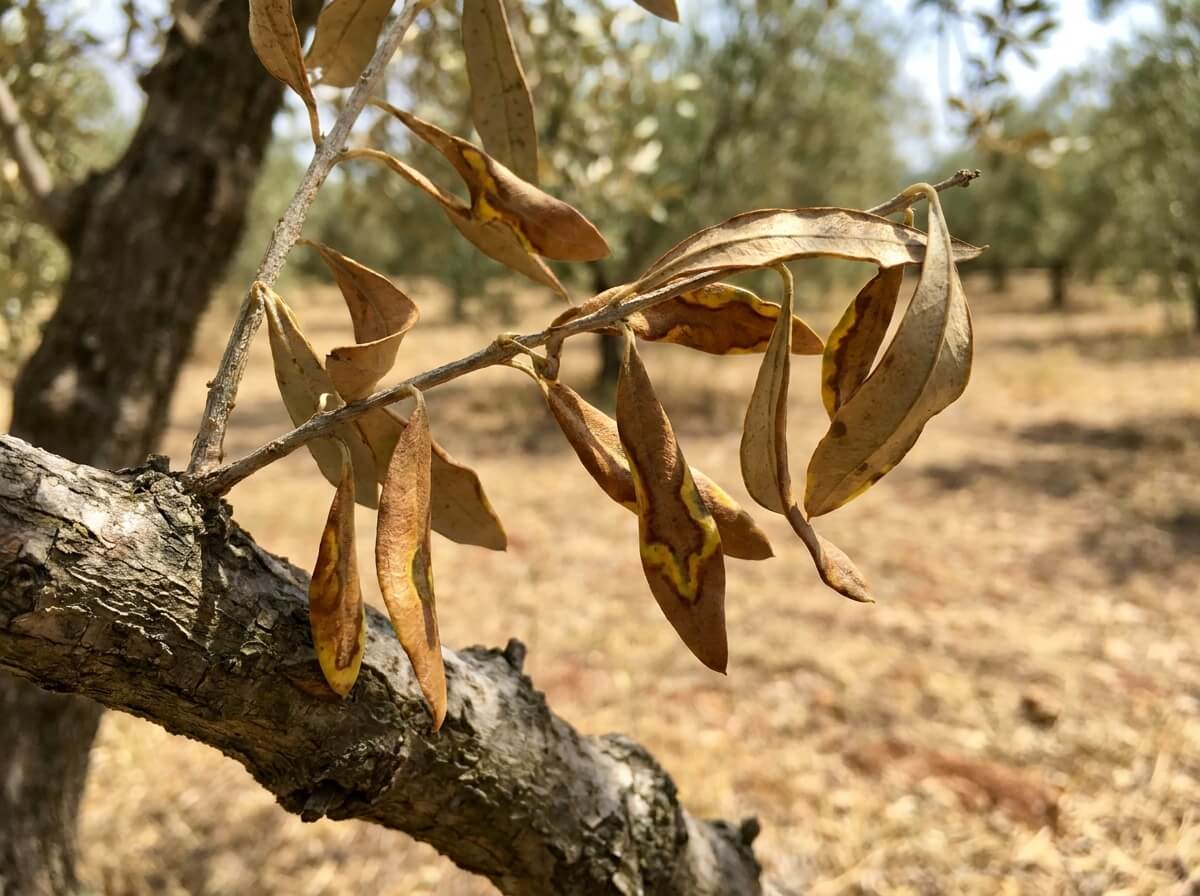
But a light, ongoing leaf drop from the interior of the canopy is normal — the tree is shedding older leaves to reduce its water demand. Yellowed leaves falling from inside the canopy in small numbers through summer don’t require action.
What does require attention:
The first three are usually correctable water management issues. The fourth suggests fungal disease — Colletotrichum or Verticillium — and needs a systemic fungicide.
The fifth, a sudden green leaf drop, is often a signal of root distress caused by waterlogging, especially in heavy clay soils after a thunderstorm following a dry spell.
There’s also a more serious threat worth knowing: Xylella fastidiosa, a bacterial pathogen spreading through parts of southern Europe, causes a rapid, irreversible decline in olives that can look like extreme summer stress. If your tree is declining fast and nothing corrects it, report it to your local plant health authority rather than continuing to treat it as a watering issue.
Container olives sit at the intersection of two opposite dangers in summer: the pot heats up fast, accelerating soil dry-out, but poor drainage means the roots can still sit in water if you’re not paying attention.
Move a potted olive away from south- or west-facing brick walls in peak summer. The radiant heat from masonry can push the soil temperature at the container wall above 50°C, cooking roots on that side.
A metre of distance from the wall, or a light-coloured pot sleeve, makes a measurable difference.
Check soil moisture at 5cm depth before every watering. If the soil is still cool and faintly damp, wait.
The visual signal — foliage looking slightly soft and less rigid in the afternoon heat — is a much better watering trigger than a fixed schedule. That slight afternoon droop, the leaves losing their characteristic stiff, upright angle, is the tree telling you it’s time.
But if the droop is still there at 8am the next morning, water immediately and water deeply.
The University of Wisconsin Extension notes that olive trees in containers need repotting every three to four years — a root-bound olive in peak summer has almost no buffer against heat stress because there’s effectively no soil reservoir to hold moisture between waterings.
Peak summer is not the time for any significant pruning. The tree is under metabolic stress, and large pruning cuts made in 35°C heat won’t callus quickly.
They stay open.
What you can do in summer — and should do — is pull off any dead or crossing branches under 2cm diameter. Thin cuts.
Clean tools dipped in a dilute bleach solution between cuts. And nothing more until autumn.
If your tree suffered frost damage the previous winter and you’ve been waiting for the right moment to cut it back, early autumn — mid-September in the UK, October in northern US states — is the right window. Not now.
Smart tip: Water deeply and infrequently — once every 10–14 days for in-ground olives in summer, letting soil dry completely between sessions.
This is almost always normal. The trichomes (tiny hairs) on olive leaves reflect intense light as a heat defence, and the effect intensifies in peak summer.
If the leaves are also curling or dropping en masse, then suspect water stress.
Skip nitrogen entirely after late spring. A single half-strength application of a high-potassium feed (tomato fertiliser works) in early summer supports fruit development without triggering the soft leafy growth that scorches in heat.
Some fruit drop in early to midsummer is normal self-thinning. Excessive drop after midsummer, or drop combined with leaf yellowing, usually points to irregular watering — either too frequent and shallow, or a period of drought followed by sudden heavy watering.
No. Repotting in peak heat puts severe stress on a tree already managing its water budget carefully.
Wait until September or early October — cool roots, reduce watering for two weeks before repotting, and the tree’ll establish in its new container before winter.