Hydrangeas are in full bloom right now — and right behind those flowers, your shrub is quietly building next year’s display. Deadheading spent blooms in summer maintains the plant’s pristine appearance and redirects energy vigorously. But cutting in the wrong place, or on the wrong variety, can rob you of an entire season of flowers.
Here is the complete guide to nailing it, type by type.
Everything hinges upon this. Cut the wrong hydrangea in the wrong place and you will not see flowers again until the season after next. That is a full 12 months of waiting for one mistaken snip. A proper wait.
The thing is, the non-negotiable distinction is whether your hydrangea flowers on old wood (growth produced last year) or new wood (growth produced this season). These two groups demand completely different approaches in summer.
If you are at a loss for which type you have, look at when it began to unfurl its flowers. Mopheads open in early to midsummer on stiff upright stems from last year. Sorted.
Panicle types begin slightly later, on arching new shoots that burst forth just this spring.
These are the classic, ubiquitous hydrangeas — the big blue or pink domes you see in almost every garden from Cornwall to Vancouver Island. And they are the ones deadheaded improperly.
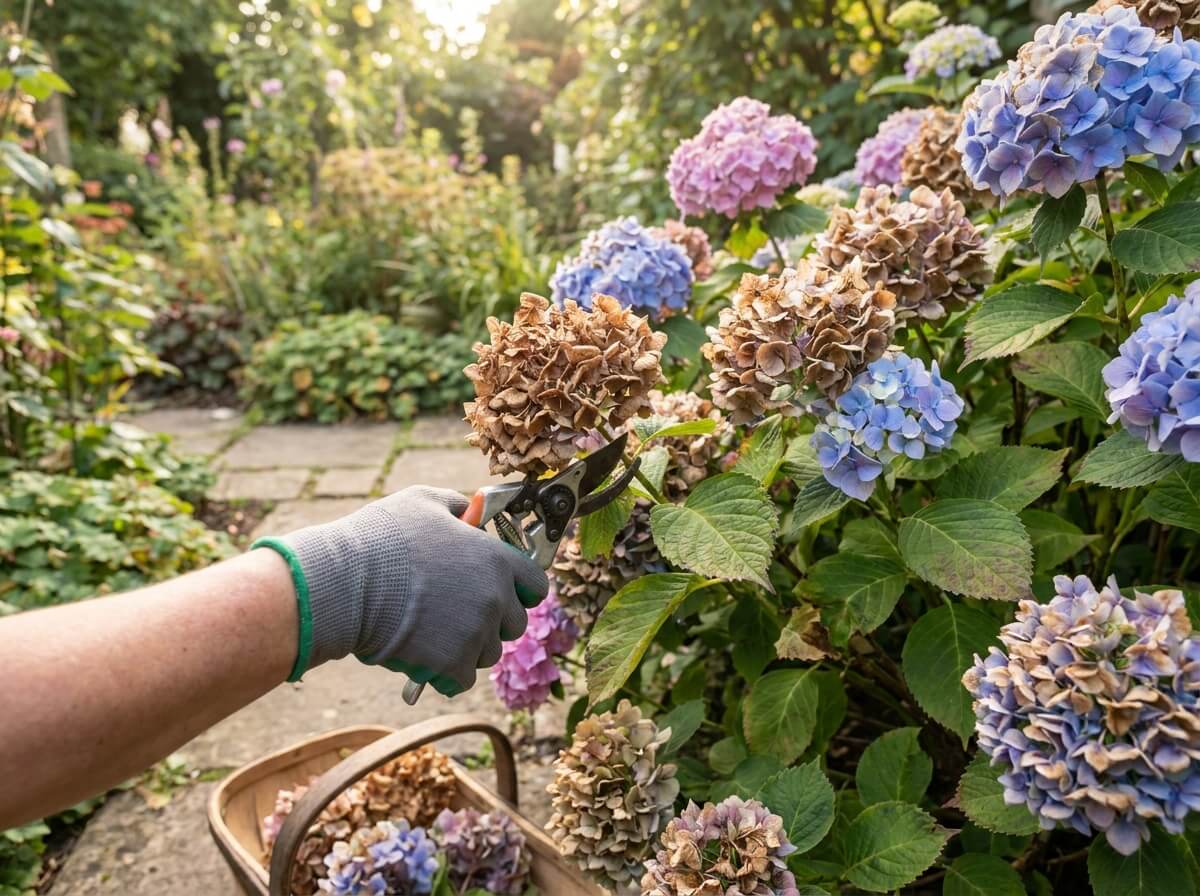
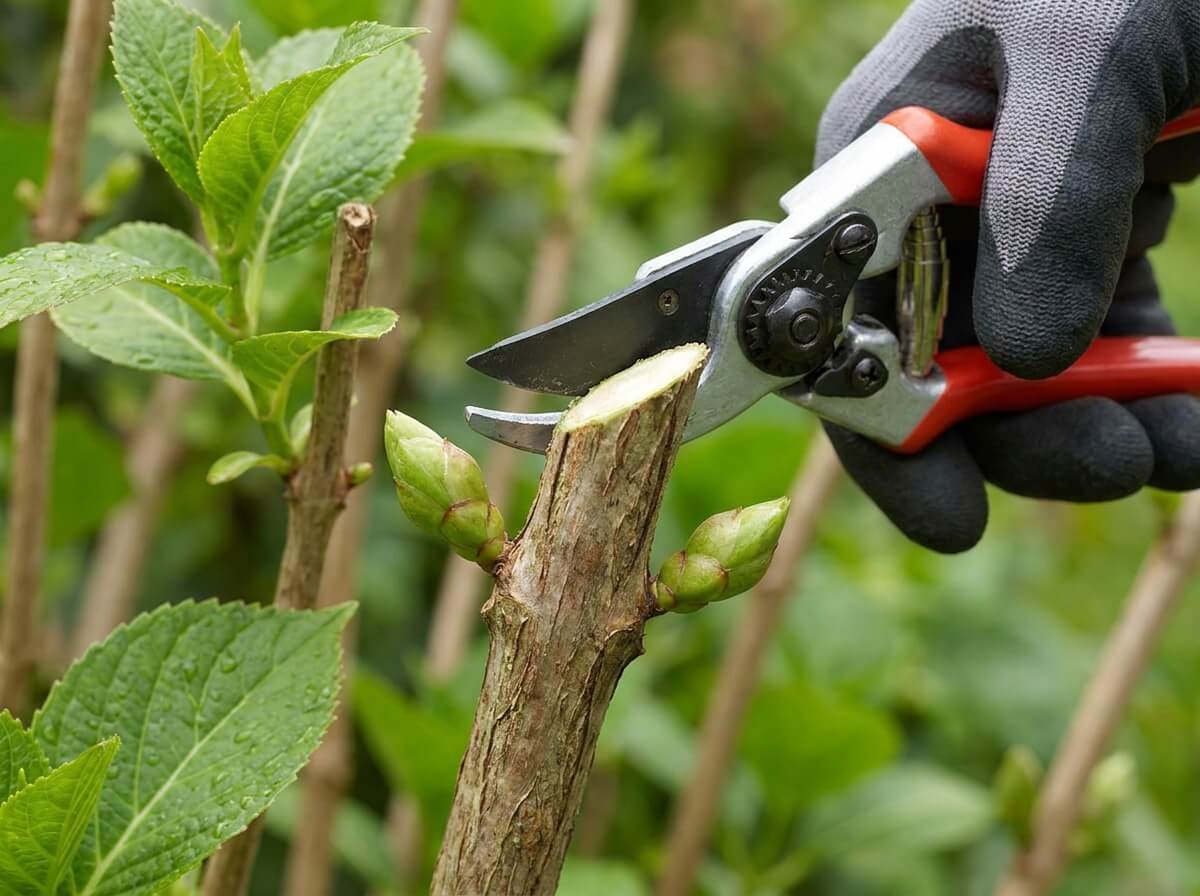
The rule is non-negotiable. So, find the spent flower head. Follow the stem down to the first pair of leaves beneath it, and look carefully — you should see two small, fat, slightly pointed buds nestled in the leaf axils. Snip neatly just 5mm above those buds. That is your cut point. No lower.
Those buds are next year’s flowers. They formed over the past few weeks while this summer’s blooms were open, and they are already there, poised.
Cutting below them obliterates the entire floral potential for next season on that stem.
Use sharp, clean secateurs — a blunt blade crushes the stem tissue and beckons disease into the wound. Wipe the blades with a cloth soaked in diluted household disinfectant between plants if you are working across several shrubs. This is proper essential.
Do not attempt to reshape or reduce the overall height of mopheads and lacecaps in summer. That restructuring work, if needed at all, belongs to early spring — bang on when the buds begin to swell and you can discern acutely what has survived winter. For general pruning shrubs technique and timing, the principles of reading bud activity apply across most flowering shrubs.
Panicle hydrangeas — ‘Limelight’, ‘Vanilla Fraise’, ‘Grandiflora’, ‘Quick Fire’ — are considerably more amiable. Because they bloom on new wood produced this spring, pulling off spent flowers does not imperil next year’s spectacle in the same way.
You can trim away the faded flower heads back to the nearest robust pair of leaves or a visible side shoot. Some gardeners trim away by around 30cm on mature, well-established plants and get a second flush of smaller but still charming blooms before autumn.
Yes, it takes nerve the first time. Worth it. The difference in plant vigour is real.
Hydrangea arborescens ‘Annabelle’, revered for its enormous white globes that can reach 30cm across, behaves the same way. Deadhead as the flowers turn a papery beige, cutting back to a robust pair of buds. This is bang on.
The stems on ‘Annabelle’ can be fragile under heavy flower heads. If you observe yours collapsing noticeably, a light trim now actually does wonders for stiffening the remaining stems by reducing the weight load.
Not every spent bloom demands removal.
The papery, dried flower heads of mopheads and panicle hydrangeas are truly enchanting through autumn and winter — they turn a warm buff, bronze or silver-cream, hold raindrops like tiny beads on a cold morning, and lend a delicate skeletal architecture in the border when everything else has died back. The RHS actively recommends leaving a proportion of spent mophead blooms in place through winter. Because the dried flower clusters also offer some frost protection for the susceptible buds immediately below them.
On panicle types like ‘Limelight’, the aged flower heads turn a rich antique pink before becoming parchment-coloured by December — proper worth keeping for that alone.
The practical approach: pull off the blooms that have turned brown and look conspicuously weary or diseased. Leave the ones that still hold their shape and colour.
Deadheading is not shaping. Shaping means pulling off structural stems, redefining the silhouette, reducing bulk.
And in summer, this should be negligible for most hydrangeas.
For mopheads and lacecaps, summer shaping is essentially forbidden. Pulling off any woody stem now imperils dormant buds for next year.
The only permissible structural cuts are to pull off stems that are:
For panicle hydrangeas, a modest tidy — pulling off one or two wayward stems that have shot up rambunctiously out of the natural line of the shrub — is entirely permissible. The thing is, cut just above a leaf node or side shoot junction, not to bare wood.
Oakleaf hydrangeas (H. quercifolia) warrant attention here. They are old-wood bloomers like mopheads, but they also have spectacular autumn foliage and exfoliating bark that makes them architectural garden plants all year.
Handle them minimally in summer. Pull off the spent flower spikes if you want a pristine aesthetic, but leave the structure completely alone until you can read the buds in early spring.
Early morning is the optimal time to deadhead — the stems are hydrated, the secateurs slice crisply, and you can see the bud positions with perfect clarity in good light before the afternoon heat sets in. This is a proper time for the task.
The tools you need are uncomplicated:
After deadheading, a light feed with a balanced, slow-release fertiliser applied around the root zone — not touching the stems — nurtures bud development for next season. Eschew high-nitrogen feeds now. They encourage lush leafy growth at the expense of flower bud formation.
A fertiliser with a roughly equal NPK ratio, or one slightly higher in potassium, is the ideal selection from midsummer onward.
Water diligently if conditions are dry — deeply twice a week rather than a light daily sprinkle, aiming for at least 20 minutes at the base. Hydrangeas under water stress abort their buds. This is a real issue for next season’s blooms.
Southern Hemisphere gardeners: these techniques apply to your late winter and early spring, as your hydrangeas come out of dormancy and commence to display new bud activity — typically August to September in Australia and New Zealand.
For more on timing pruning cuts across a range of flowering shrubs this season, the guidance on pruning shrubs at the right moment to protect next season’s flowers elucidates the broader principles with perfect clarity. And if you cultivate other summer-flowering shrubs like Buddleja alongside your hydrangeas, the approach to spent flower management adheres to comparable logic — though Buddleja is far less sensitive to the exact cut position.
The RHS hydrangea growing guide and the University of Maryland Extension hydrangea resource both provide trustworthy cultivar-specific insights if you are at a loss about your specific cultivar.
Smart tip: Always identify your hydrangea type before cutting — old wood or new wood dictates everything.
No — not for mopheads or lacecaps. Hard cutting in summer obliterates the buds already formed for next year.
But reduce size only in early spring, just as buds swell, and only by one-third at most.
Pull off the ones that look diseased or completely collapsed. Leave the ones that still hold their structure; they protect the buds below them through winter and remain aesthetically pleasing until early spring.
Scratch the bark lightly with a fingernail — live stems show green tissue underneath. Dry, pale-tan tissue with a hollow centre means the stem is dead and can be pulled off cleanly at the base.
For panicle and ‘Annabelle’ types, yes — a modest second flush is possible on properly fed, properly watered plants. For mopheads and lacecaps, deadheading enhances the plant’s condition and next year’s flowering, but does not typically generate fresh blooms in the same season.