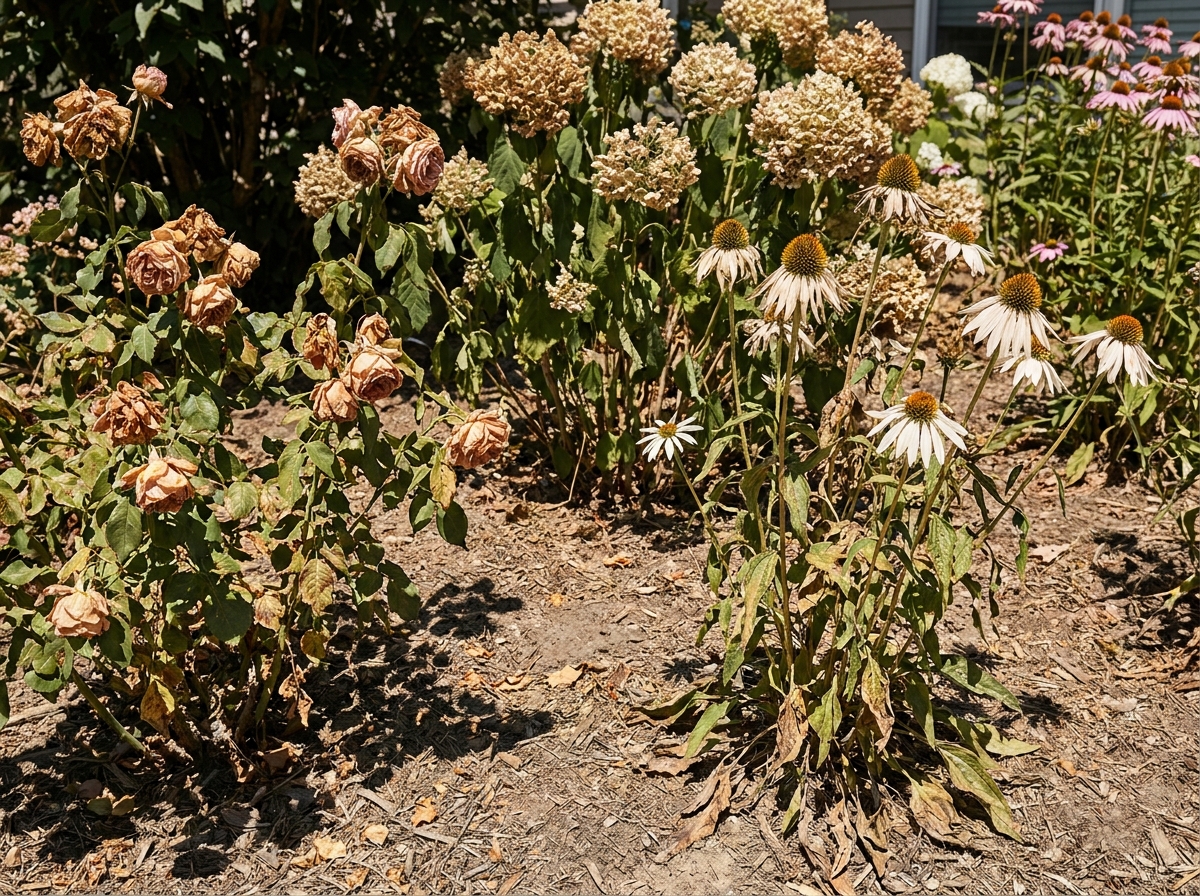
Your borders were glorious ten days ago. Now the colour’s washed out, the petals look papery, and the whole thing has gone somehow knackered-looking — even though you’ve been watering. June heat doesn’t kill flowers slowly; it bleaches them fast, and most gardeners misread what’s happening and respond with exactly the wrong fix. What’s actually going on, then, and what you can do before you lose the rest of the season?
The short answer nobody tells you: flowers are not built for prolonged heat. They’re built for transition.
A rose or a petunia or a cosmos in full bloom is essentially a temporary structure — soft tissue, thin cell walls, high water demand. And when air temperature sits above 28°C (82°F) for more than 3 or 4 consecutive days, the plant starts abandoning blooms to protect everything else. It just gives up, you see.
What you’re seeing isn’t drought damage. Not exactly.
It’s the plant making a rational decision. Don’t overthink this. Blooms are expensive — they cost water, sugar, energy — and a stressed plant just cuts its losses. Seriously, it’s that simple.
The petals go translucent, then papery. And the colour fades, because the pigment molecules themselves degrade under UV at high temperatures. It’s chemical warfare on your borders.
My grandmother back in the Vendée used to say the garden “gets a sunburn from the inside.” She wasn’t wrong, you know. Not in the least.
The specific culprit this June is night temperature. That’s it. When nights stay above 15°C (59°F), the plant never cools down enough, does it? It can’t rebuild its sugars.
It’s running a deficit every single day. And after about 9 or 11 days of that? The blooms just — give up. You’ll notice this worst on plants with delicate petals, mind you:
Depends. If you do nothing, you’ll find the plant moves straight into seed production.
That’s not a disaster. But it means flowering stops, doesn’t it? The plant has completed its reproductive task, as far as it’s concerned. And it won’t restart the bloom cycle without intervention. Trust me on this one.
You can lose 6 to 8 weeks of summer colour that way. And I’ve done it myself, mind. Proper gone pear-shaped. Second week of July, standing in front of a border that looked utterly finished, feeling like a complete idiot. What a sight that was.
The hidden danger is what happens underneath, of course. Heat stress, you see, weakens the plant’s immune response. That’s the real issue.
Spider mites and aphids, which thrive in hot dry conditions, they’ll move in within about 4 days of a stress event. So a fading display can quickly become a fading-and-infested display, a right proper mess.
I’ve watched a pot of calibrachoa go from slightly tired to completely mummified in under two weeks in the corner of my walled garden. That’s where the stone holds heat like an oven until past 10pm, mind you — you can actually smell it. That hot-stone smell, it mixes with something almost sweet and slightly wrong, you know? That’s the beginning of the mite damage.
First thing, and this is non-negotiable: deadhead aggressively. Not tidily, you understand? Aggressively. Pull off everything that’s fully open, everything that’s past its best, everything that looks like it’s about to fade. My grandfather in Provence always said you have to be ‘sans pitié’ (without pity) when deadheading. He was bang on. Cut back to the next leaf node. Do it before 9am or after 6pm — never in the midday heat, because fresh cuts in full sun desiccate before they can heal.
Then do this:
Also see: Do This to Your Summer Flowers in June or Regret It All Year.
Petals crisping at the edges but not dropping? That’s sun scorch, my friend, not disease. No spray needed. Seriously.
Just shade and water.
Buds that form but never open — called “bud blast”. This happens when the temperature swings too hard between day and night, you see. Dahlias are particularly prone to it. But the RHS has decent guidance on bud drop causes.
Stems going soft and floppy even though the soil is moist? Right, that’s heat wilt, not drought, full stop. Watering more? It’ll rot the roots, guaranteed. This is the one properly massive mistake I see constantly. And it drives me mad.
If the soil is already damp and the plant is wilting, put it in shade first. Then assess.
Don’t water again. Not until the top 2cm of compost is bone dry. Please.
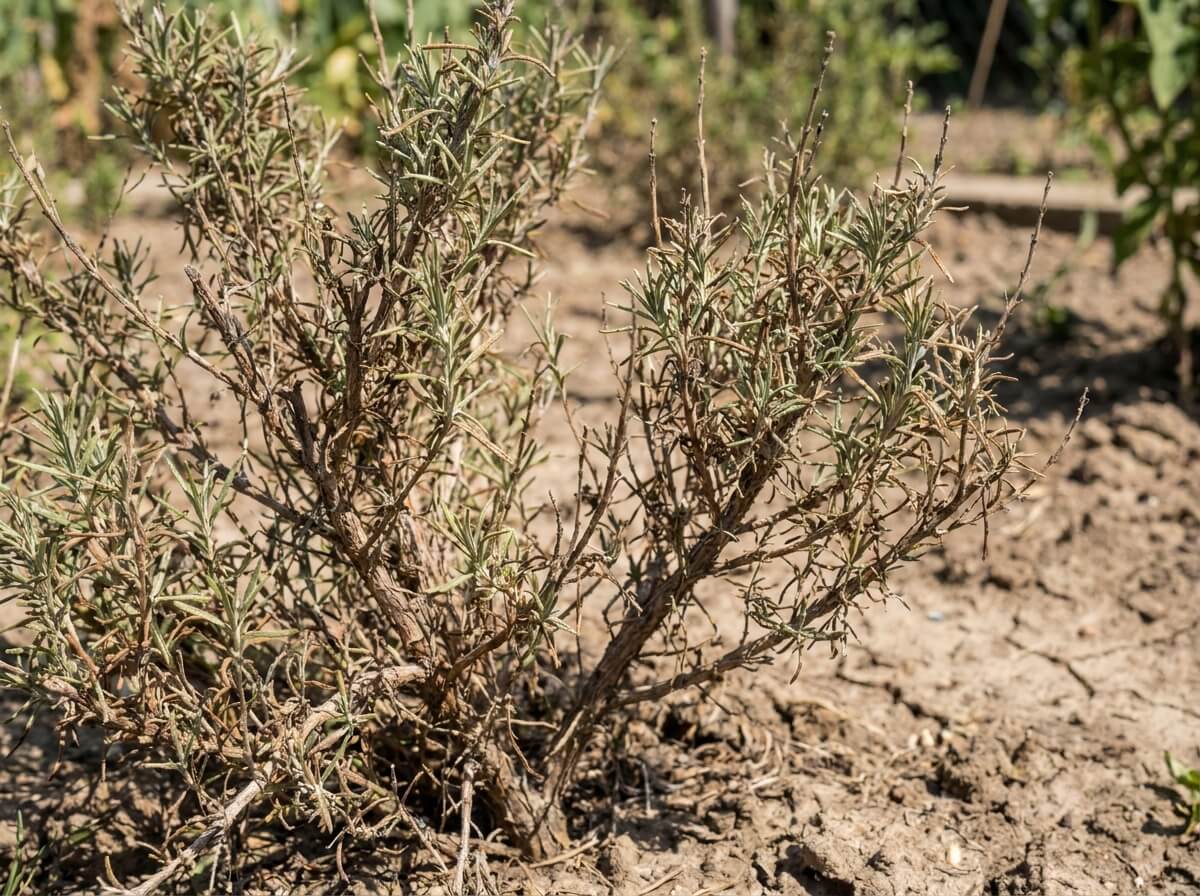
Yellow leaves appearing low down at the same time as bloom fading? Right, that’s heat-induced root stress screaming at you. And you’ve got to act on it within 48 hours, or you’ll lose the whole plant entirely, not just the flowers. That is non-negotiable. I wrote more about this properly nasty problem — with lavender specifically, actually — over at Your Olive or Lavender Is Dying From the Inside.
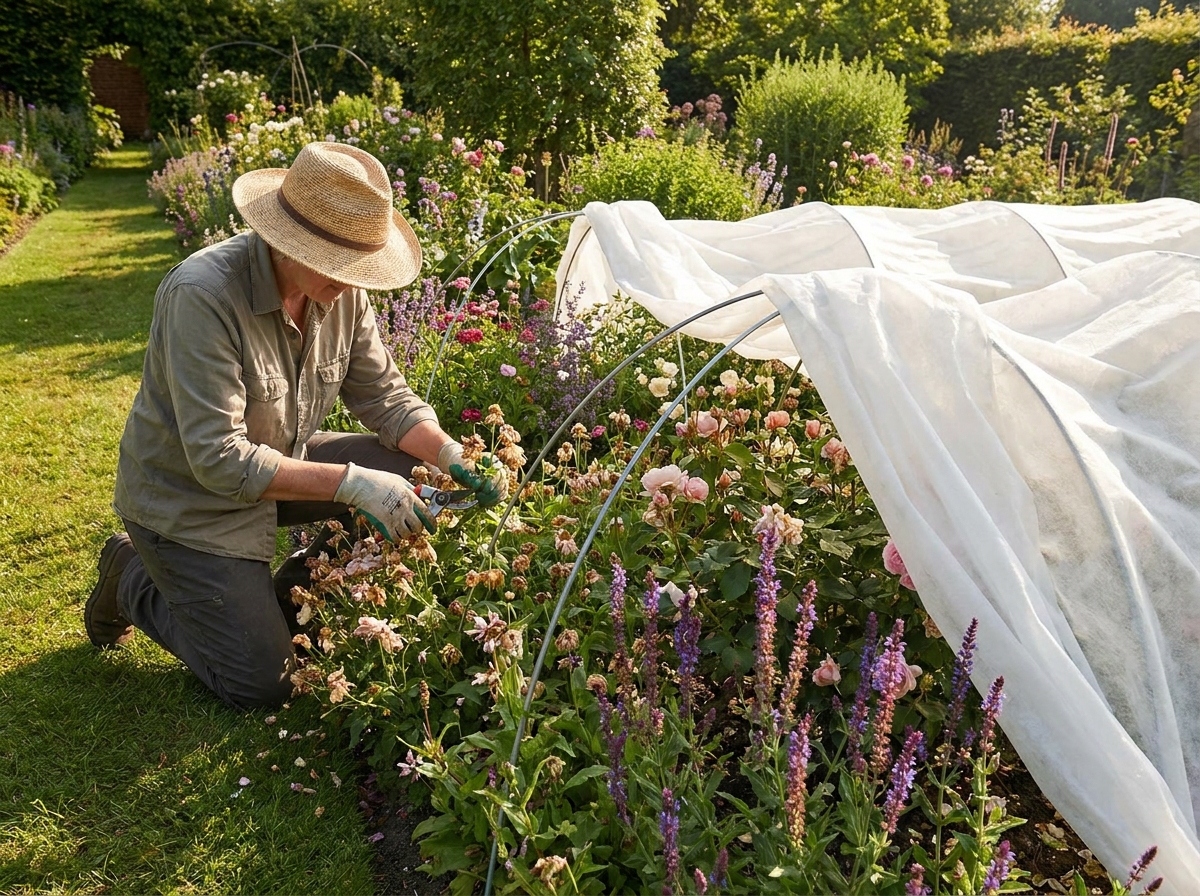
Smart tip: Deadhead before 9am and you’ll see new buds forming within 6 to 8 days, even in a proper heatwave. Trust me, it’s worth it.
UV radiation at high temperatures breaks down anthocyanins — the pigments that give flowers their colour, you see. Shade cloth or afternoon cover does wonders for slowing this down, I’ve found. Does absolute wonders.
Only if the soil is dry, understand? If it’s already moist and plants are wilting? You’ve likely got heat wilt. And extra water? It’ll just make things properly worse by reducing oxygen at the roots, creating more of a faff for you. It truly will.
The damaged blooms won’t recover, you know. Pull them off, all of them. But the plant absolutely can rebloom within 7 to 14 days. If you deadhead, that is, and reduce the heat stress. And give it a proper potassium-rich feed, of course.
Right, Zinnias, portulaca, lantana, and marigolds? They hold colour well above 30°C. Petunias, sweet peas, and cosmos though — they’re the most vulnerable, by far. And they need the most intervention in June heatwaves. They truly do.