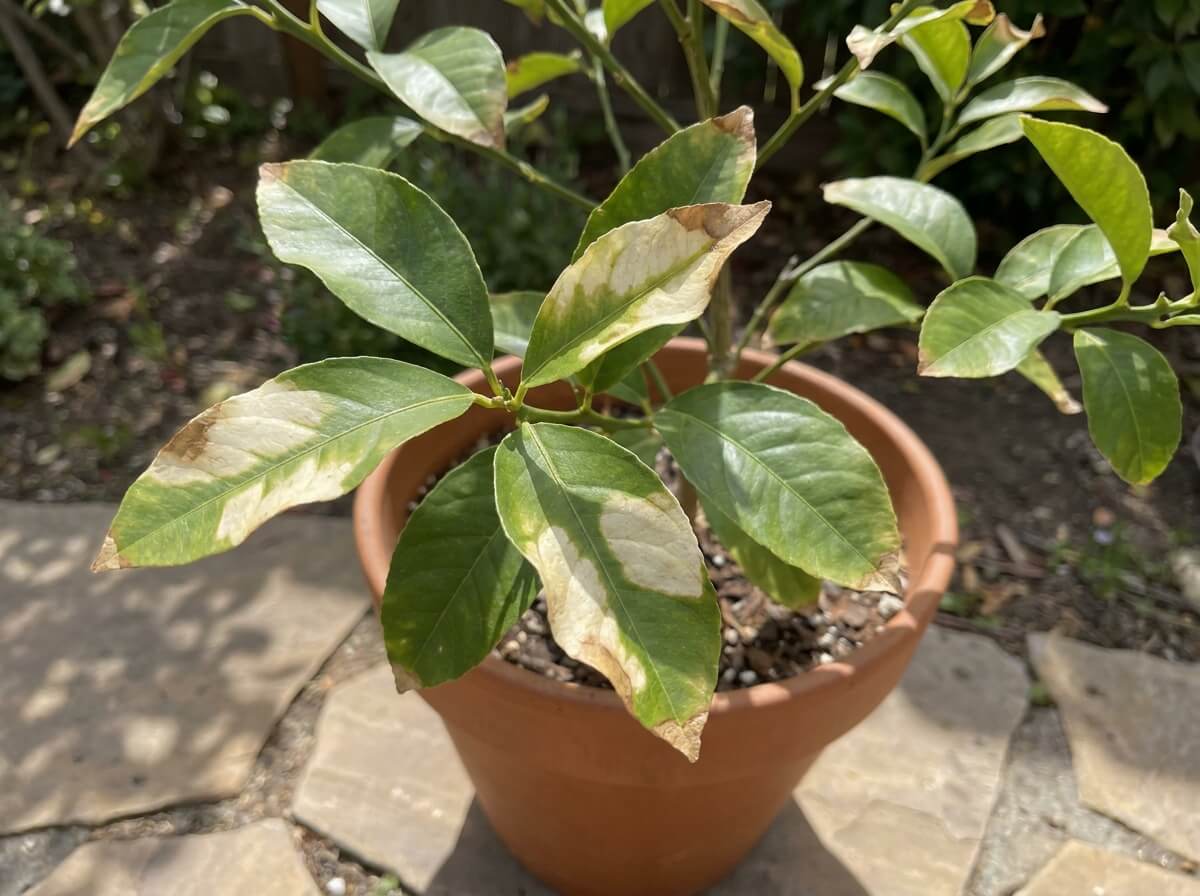
Those pale, bleached patches spreading across your lemon tree’s leaves are not a disease. They are sunburn. And during peak summer heat, a potted lemon can go from healthy to visibly scorched in under 48 hours. The good news: a few simple changes today stop the damage cold. But burned leaves do not recover. You are racing the next sunny afternoon.
A lemon tree planted in the ground has some protection — its roots reach cool, moist soil deep below the surface, and the thermal mass of surrounding earth buffers temperature swings. A pot has none of that. On a hot terrace, a dark-coloured container absorbs heat like a radiator, and soil temperatures inside the pot can climb to 45–50°C — enough to kill the fine feeder roots that keep the whole tree alive.
The foliage bears the brunt of two directions at once: direct solar radiation from above, and reflected heat bouncing up from paving, pale walls, or glass surfaces. A tree sitting against a south-facing white wall in full afternoon sun is not getting normal sunlight.
It is not merely sunlight; it is a proper reflected furnace blast.
There is also the hardening-off issue. A lemon tree wintered indoors or in a sheltered greenhouse and moved outside in early summer has not adjusted to high UV levels yet.
Push it straight into a blazing July afternoon and the leaf tissue simply can not cope — the chlorophyll breaks down faster than it can regenerate, leaving those characteristic papery, washed-out patches.
Cosmetic sunburn on a few leaves will not kill a mature tree. But ignore it, and the cascade rapidly escalates.
A young tree in its first or second season in a pot is the most vulnerable. One serious heatwave can set it back by a full growing season; that is a bit much.
Start with the pot itself. Wrap dark-coloured containers in hessian sacking, bubble wrap, or a purpose-made pot insulator to reflect heat away from the roots — this alone can drop internal soil temperature by 5–8°C. If you can, switch to a light-coloured or glazed pot at repotting time.
Move the tree. Not into deep shade — lemon trees need good light — but 60–90cm back from reflective walls or paving breaks the worst of the reflected heat.
The thing is, a position with full morning sun and dappled or indirect light from roughly 1pm onwards is close to ideal during a heatwave.
Yes, moving a large pot is awkward. Do it anyway — the difference between a shaded spot and a reflective terrace corner on a 35°C afternoon is measurable in plant survival, not just comfort. For more on growing lemon trees in containers, the full guide covers pot sizing and soil choices that also reduce heat stress.
Sunburn is visible on the leaves, but root heat damage manifests differently — and later. Watch for these warning signals over the next 7–14 days:
Also check the undersides of leaves during hot spells. Spider mites run rampant in hot, dry conditions — you will see fine webbing and tiny bronze speckling.
And catch them early with a forceful spray of water to the undersides, twice a week for 10 days.
The RHS guidance on growing citrus and University of Wisconsin Extension’s citrus growing notes both identify container heat stress as a non-negotiable factor for sudden summer decline in potted trees — and both recommend shade cloth as a first response during heatwaves. Simple kit. Significant results.
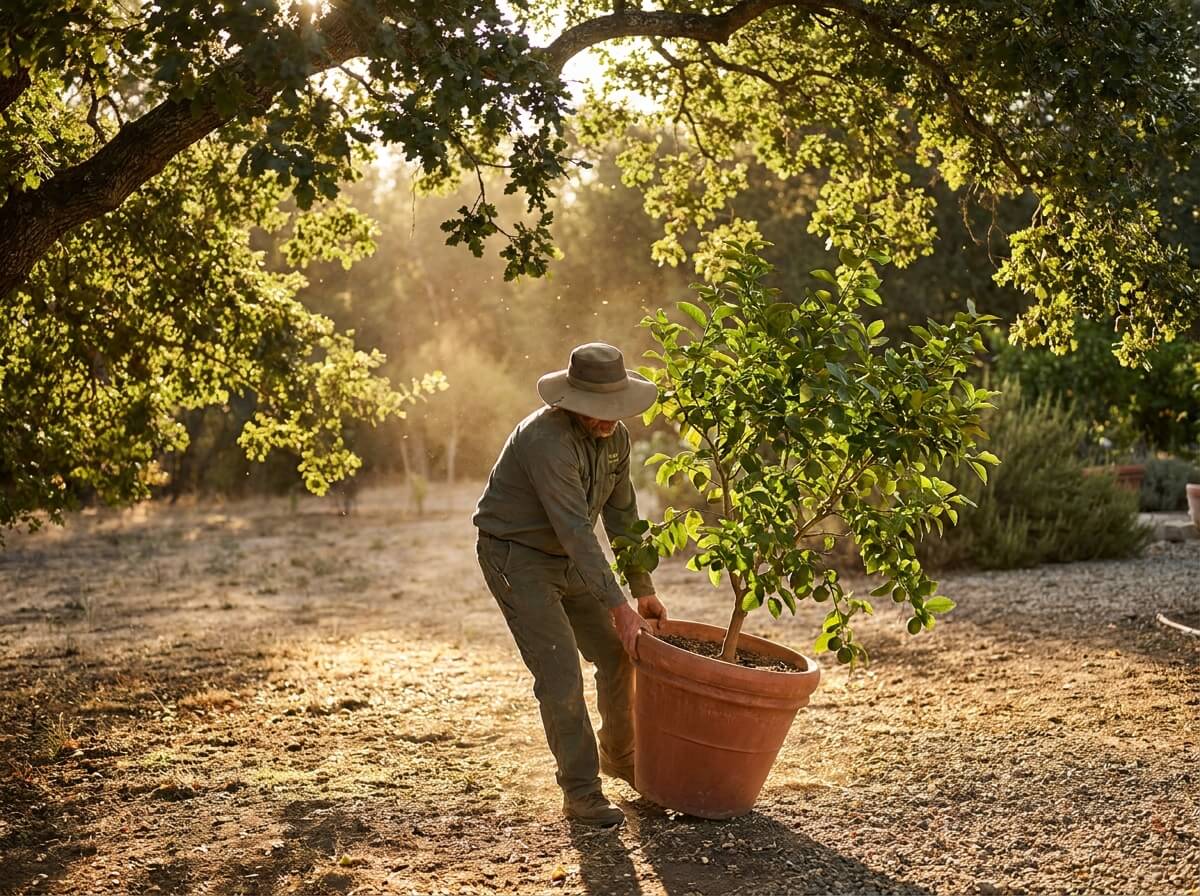
Smart tip: Move your pot before the heatwave peaks — reactive shade after burning can not undo already-damaged leaves.
No. Bleached, papery patches are permanent — those cells are dead.
Protect the rest of the canopy now and let new growth replace the burned leaves naturally over 6–8 weeks.
Briefly, yes — 2 to 3 days of reduced light will not harm a healthy tree. But prolonged deep shade stops fruit development and weakens the canopy, so aim for filtered light rather than total shade.
The telltale sign is wilting that does not recover after evening watering, paired with yellowing new growth appearing 10–14 days after the heatwave. Damaged feeder roots can not absorb water even when it is available.
Kaolin clay — sold as Surround WP in the US — creates a reflective film on leaves that measurably reduces leaf surface temperature and is approved for organic use. It is more effective than repositioning alone on trees too large or heavy to move easily.