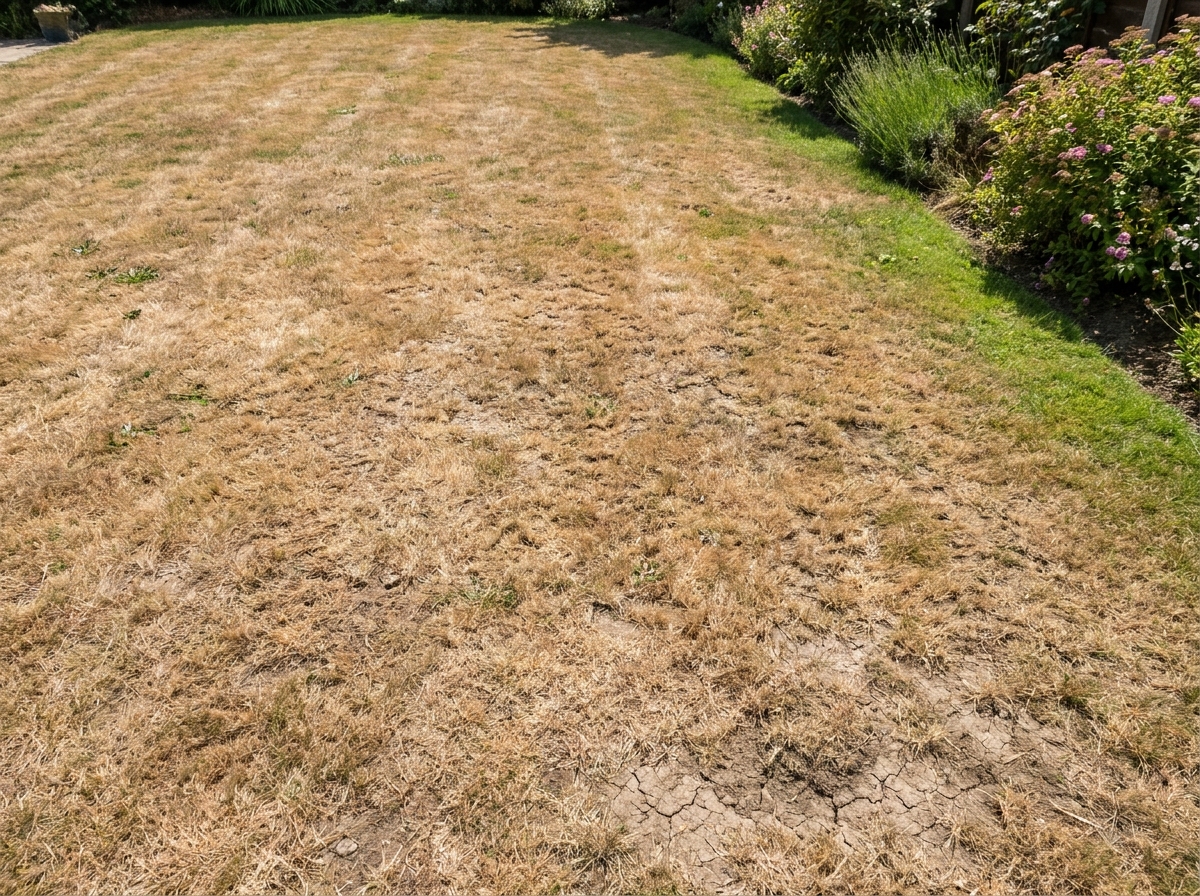
Your lawn is brown. Crispy. The colour of an old paper bag. And you’re standing there in June wondering if you’ve killed it or if it’s just sulking. Here’s the answer: most brown summer lawns are dormant, not dead — and the two things require completely opposite responses. Get this wrong and you’ll either waste thousands of litres of water or panic-water a lawn that needed to rest.
Grass is smarter than it looks. When temperatures spike and rainfall dries up — which is exactly what’s happening across large parts of the US, UK, and Australia right now — cool-season grasses like fescue, bluegrass, and ryegrass deliberately shut down.
They pull all their energy into the roots and let the blades die back. It’s not failure.
It’s strategy.
Warm-season grasses like Bermuda and zoysia (common in southern US states, South Africa, and much of Australia) do this too, but in a slightly different way — they brown when temperatures get too extreme even for them, usually above 38°C (100°F).
Dormancy can kick in after as few as 11–14 consecutive dry days. That’s not long.
One dry fortnight in June and your entire lawn can go straw-coloured practically overnight.
Yes. Sometimes.
But it’s rarer than you think, and there’s a simple test.
Pull a small section of brown grass firmly — roots and all. If it comes up easily with almost no resistance, like pulling dry tissue paper off a table, and the crown (that white junction between blade and root) is completely dry and brittle: that section’s dead.
If there’s resistance, if the crown still has a faint greenish or white tinge and feels slightly spongy at 6am when the air is cool and damp — it’s dormant. Alive.
Waiting.
Dead patches also tend to be irregular and often have a different cause underneath: fungal disease, grubs eating the roots, or summer watering mistakes that quietly kill plants from below. Dormant lawns go brown more uniformly.
The RHS confirms that most UK lawns recover fully from summer dormancy once rain returns — and University of Minnesota Extension says cool-season grasses can stay dormant for 4–6 weeks without dying, provided the roots stay intact.
If it’s dormant, you have two options — and you need to commit to one. Fully.
The mistake — the one everyone makes — is flip-flopping between the two. Three days of drought, then panic-watering, then stopping again.
That cycle will kill grass. Full stop. Pick a lane.
Look, I know this sounds fussy — wait, that’s not quite right — it’s not fussy, it’s essential. Just do it: if you choose to water, use a long screwdriver pushed into the soil. It should penetrate to 15cm (6 inches) without force after watering.
If it hits resistance at 5cm, you haven’t watered deeply enough.
Don’t mow below 7–8cm right now. Taller grass blades shade the soil, reduce evaporation, and protect the crown.
And hold off on any nitrogen-heavy fertiliser until temperatures drop — feeding stressed grass in peak summer heat is like force-feeding someone running a fever.
Brown is one thing. But some symptoms alongside brown grass signal something worse is happening.
That last one I noticed on my own lawn last August around 7 in the morning, when the light was low and the pinkish tinge caught the sun at just the right angle. I’d have missed it entirely in full midday light.
Worth getting down low and looking.
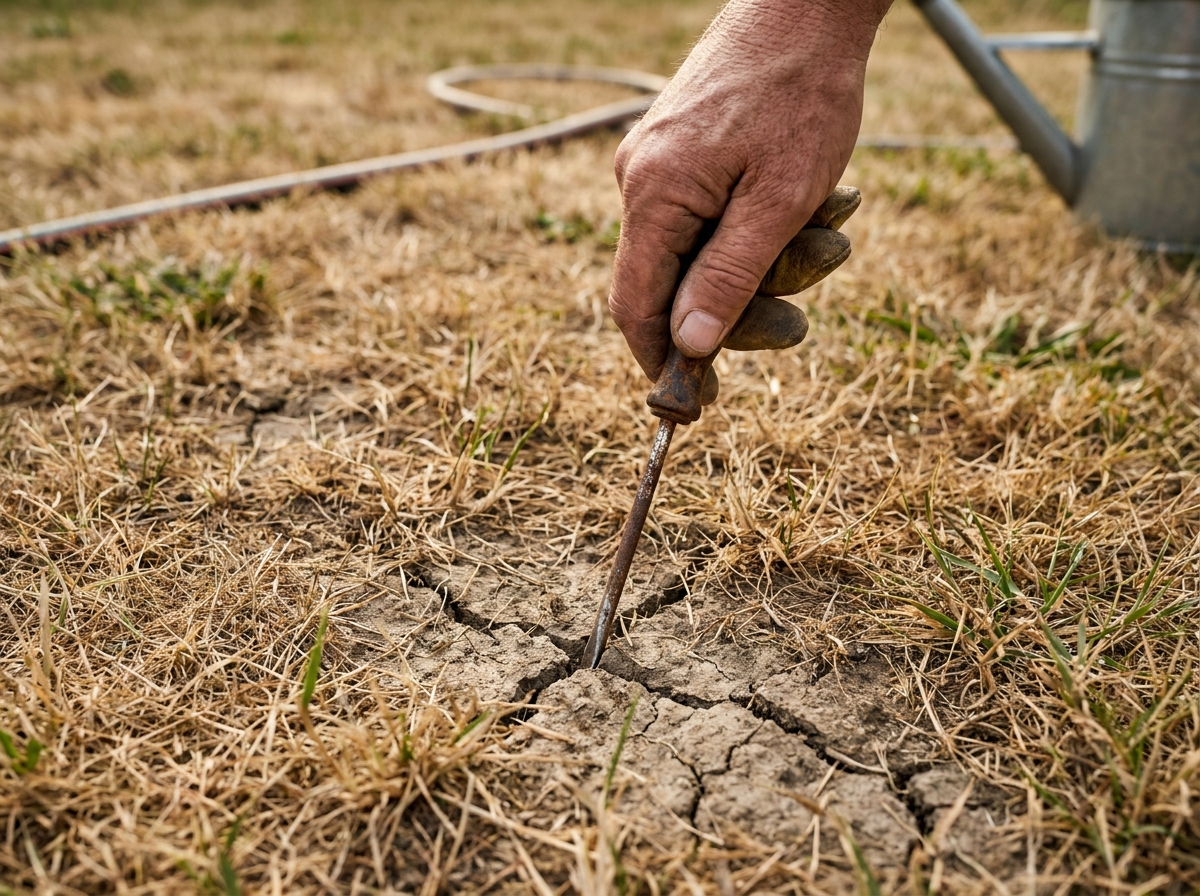
Smart tip: Push a screwdriver 15cm into the soil — if it slides in after watering, your depth is right.
Cool-season grasses can survive 4–6 weeks of dormancy without permanent damage, as long as temperatures don’t remain extreme for the entire period and the roots aren’t disturbed.
No — daily shallow watering is one of the worst things you can do. Water deeply once a week, applying 2.5cm of water each time, or let the lawn go fully dormant and stop watering entirely.
Almost certainly, if it’s dormant. Most lawns green up within 2–3 weeks of consistent rainfall returning, without any intervention needed.
If you’re in Australia, New Zealand, or South Africa, this applies to your December and January. In June you’ll probably be dealing with winter lawn thinning, which is a whole different faff.