When summer heat builds and the garden overwhelms you with produce, the answer is not always a recipe requiring an oven. Sometimes it is a tall jug of something ice-cold and botanically brilliant.
Borage blossoms and cucumber make two of the most underused summer drinks available to any gardener — distinct enough to be interesting, simple enough to make on a Tuesday afternoon. Here is how to do both properly.
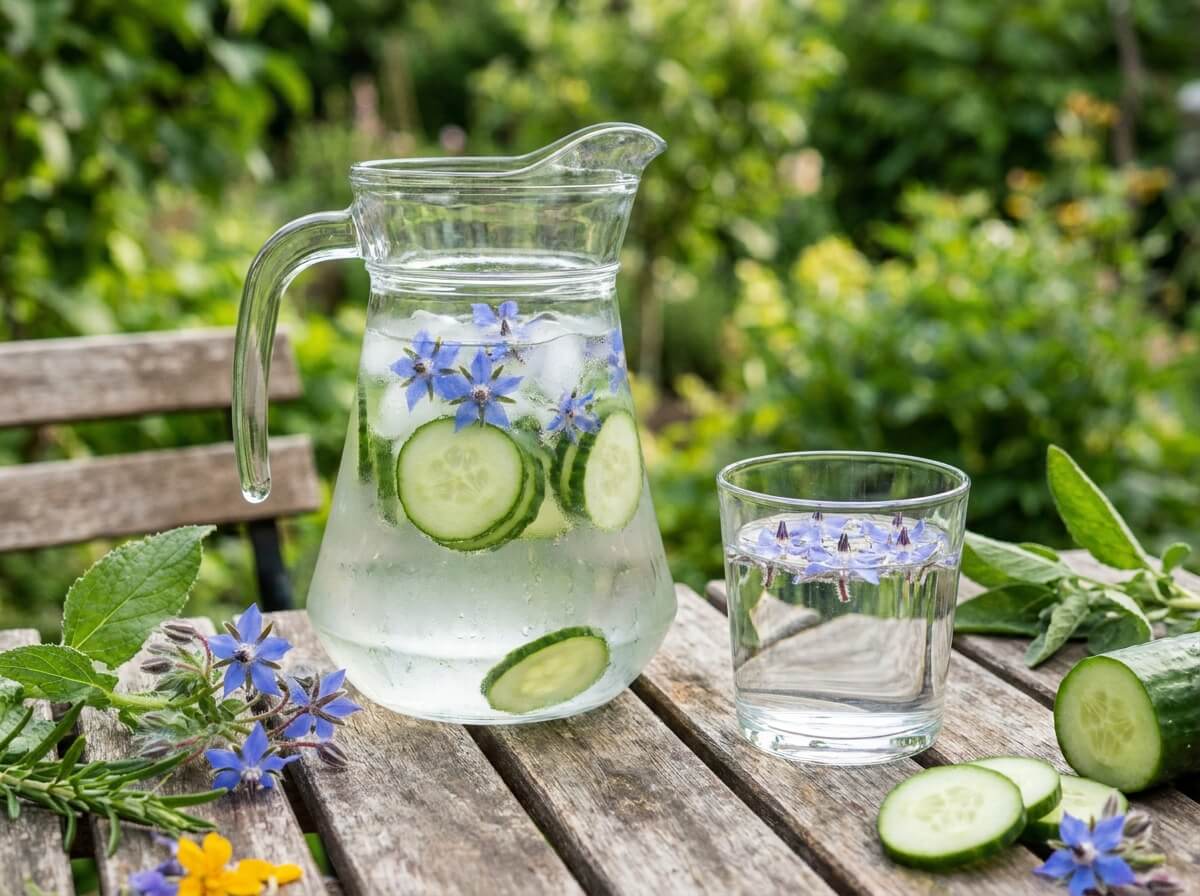
Borage (Borago officinalis) is one of those plants that earns its space three times over. Bees adore it. It self-seeds freely without becoming a nuisance. And those vivid star-shaped flowers — the most saturated blue in any kitchen garden — taste, without exaggeration, exactly like cucumber. Cool, faintly mineral, slightly sweet.
The flowers are at their best harvested in the morning, before 9am, when the essential oils are concentrated and before the heat of the day begins to dull them. Pinch the entire floret cleanly at its base. Avoid any that are browning at the edges — those have passed their peak. A single established plant produces dozens of flowers daily through the whole summer season.
The leaves are also edible — young ones especially — but for drinks, focus on the flowers. Their texture is delicate, their flavour is precise, and they look extraordinary floating in a glass.
If you shoot up borage primarily for pollinator support, rest assured that taking a daily handful of blossoms only encourages the plant to produce more. You are actually doing the bees a proper favour.
For those who have not shot up borage yet: it is an annual, sown directly in the ground, happy in poor soil, and entirely unfussy. The RHS rates it as one of the unfailingly simple annual herbs to establish from direct sowing. Start seeds now and you will have flowers within 5 to 6 weeks. It is bang on.
This is the simplest version, and it is the one to master before experimenting. The proportions matter more than you would think.
Place the borage blossoms in a glass jug. Add the mint. Pour over the cold water — never hot, never warm. Heat turns borage flowers from blue to grey and destroys their delicate flavour entirely. Do not ignore this. Add ice and refrigerate for a minimum of 45 minutes before serving.
Now, the lemon. Add a squeeze of lemon juice and watch something extraordinary happen: the blue petals shift to a vivid purple-pink.
The anthocyanin pigments in borage are pH-sensitive, and the acid in the lemon triggers a visible colour change. It is not a trick — it is basic chemistry, and it makes the drink look spectacular.
Serve straight from the jug, blossoms floating, over more ice. Drink within 4 hours of making — the flowers begin to soften beyond that and the visual effect fades.
Cucumber water is often made badly. That method does not work. Skip it.
The flavour compounds in cucumber — primarily the aldehydes responsible for that clean, green scent — need time to migrate into the water.
Two hours minimum at room temperature, or overnight in the refrigerator. That is the non-negotiable rule. The difference between a 15-minute steep and a 2-hour one is not subtle — it is the difference between flavoured water and something that genuinely tastes of cucumber.
The base recipe:
Combine everything in a jug, cover with a plate or clingfilm, and refrigerate for 2 hours. Strain before serving, or leave the cucumber and herbs in for a more rustic presentation.
The skin of the cucumber adds bitterness — pull it off if you prefer something cleaner and softer.
Garden cucumber harvested at 18 to 22cm produces the best flavour. Older, larger cucumbers have begun converting their sugars and the taste turns hollow.
Pick young, pick often.
This is the version worth making for guests, for a garden party, for a hot afternoon when you want something that looks as good as it tastes.
Steep the cucumber and mint in the water for 2 hours in the refrigerator. Strain into a serving jug. Add lime juice, stir, then float the borage blossoms on top immediately before serving. The blossoms go in last, never during steeping — they will lose their colour and turn limp. This is not quite right for guests.
The result: a pale green, faintly floral drink with blue-purple blossoms on the surface and a flavour that tastes precisely like a midsummer garden smells. If you want a touch of sweetness, that elderflower cordial drops in perfectly — a teaspoon per glass, not more.
Yes, it is fiddly. But do it anyway — the difference is night and day. Worth it.
Pick blossoms early morning. Place one flower face-down into each compartment of an ice cube tray.
Fill slowly with water and freeze for at least 4 hours. When you drop one of these into a glass, the flower is suspended inside the ice, perfectly preserved, visible from all sides.
It melts slowly, releasing the blossom into the drink as the ice diminishes.
These flower ice cubes work in still water, sparkling water, gin, lemonade, or any pale-coloured drink. They take about 8 minutes to prepare.
The visual impact is completely disproportionate to the effort. Make a full tray and store them in a zip-lock bag in the freezer — they keep well for up to 3 weeks.
The same technique works with other edible flowers from your garden — violas, nasturtiums, and calendula petals all freeze beautifully and add colour variation to a summer drinks spread.
Once you have these two base drinks, the variations are straightforward. None require special equipment or unusual ingredients — only what is already shooting up.
For anyone dealing with a cucumber glut at the same time as these drinks — and it is a real possibility in summer — there are similar ideas for courgette and summer vegetable abundance worth exploring alongside these recipes.
Southern Hemisphere gardeners: borage and cucumber are warm-season plants — these recipes apply to your December and January, when both will be in full production.
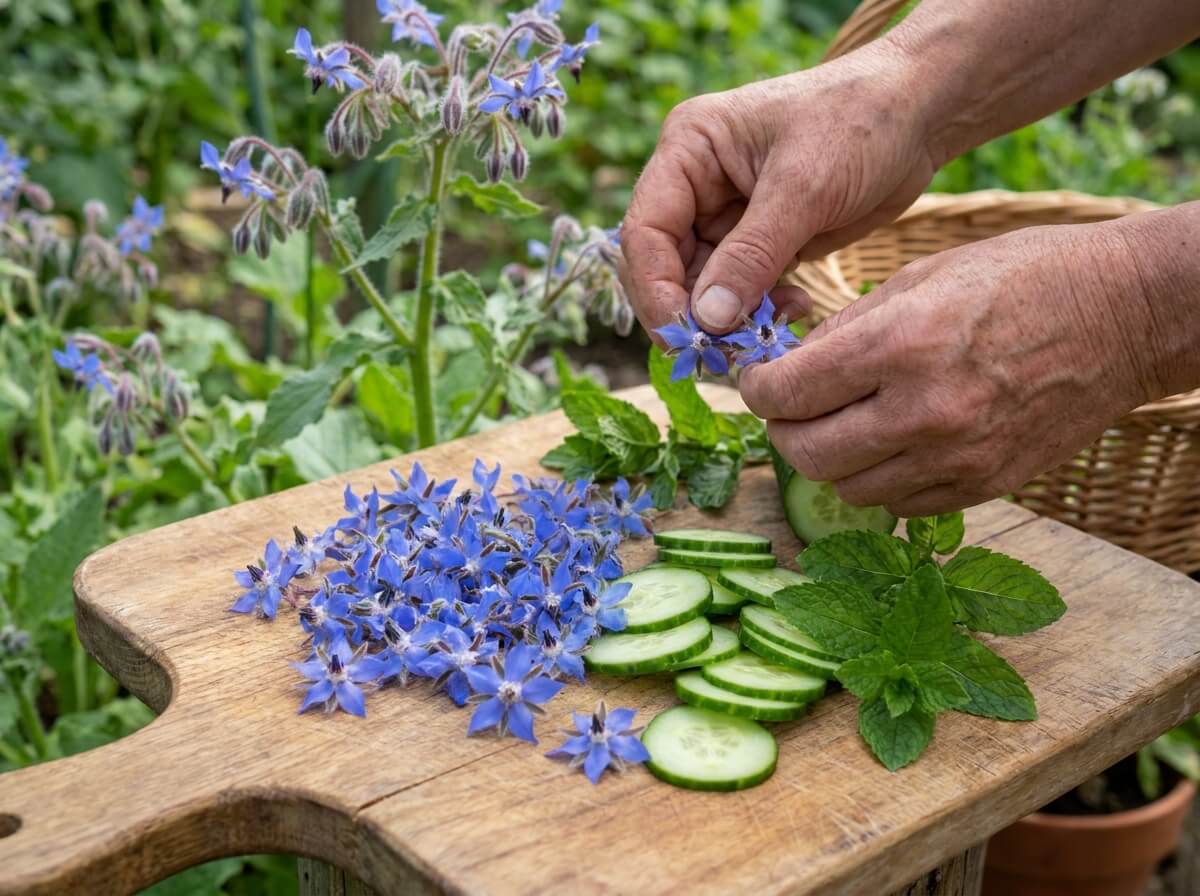
Smart tip: Always add borage blossoms after steeping, never during — heat and time both destroy their colour and flavour.
Yes, borage flowers are widely consumed and considered safe for healthy adults. Plants for a Future lists borage as fully edible. Avoid consuming the leaves in properly large quantities due to trace pyrrolizidine alkaloids, but the flowers present no such concern in normal culinary use.
Refrigerated and strained, cucumber water keeps for up to 24 hours. Beyond that, the cucumber begins to ferment slightly and the flavour turns sour and hollow — discard it and make a fresh batch.
No. Dried or browning borage flowers have lost their flavour compounds entirely and will add nothing to a drink — and may add bitterness.
Only use freshly picked, fully open flowers at their most vivid blue.
English (long) cucumbers and Armenian cucumbers both produce excellent results due to their thin skin and high water content. Short pickling varieties work too but have a slightly more bitter finish — peel them first.
Steep the cucumber water overnight in the refrigerator and strain in the morning — that actually produces the best result. Prepare frozen borage ice cubes 4 hours ahead.
Add fresh blossoms only at serving time, never the night before.