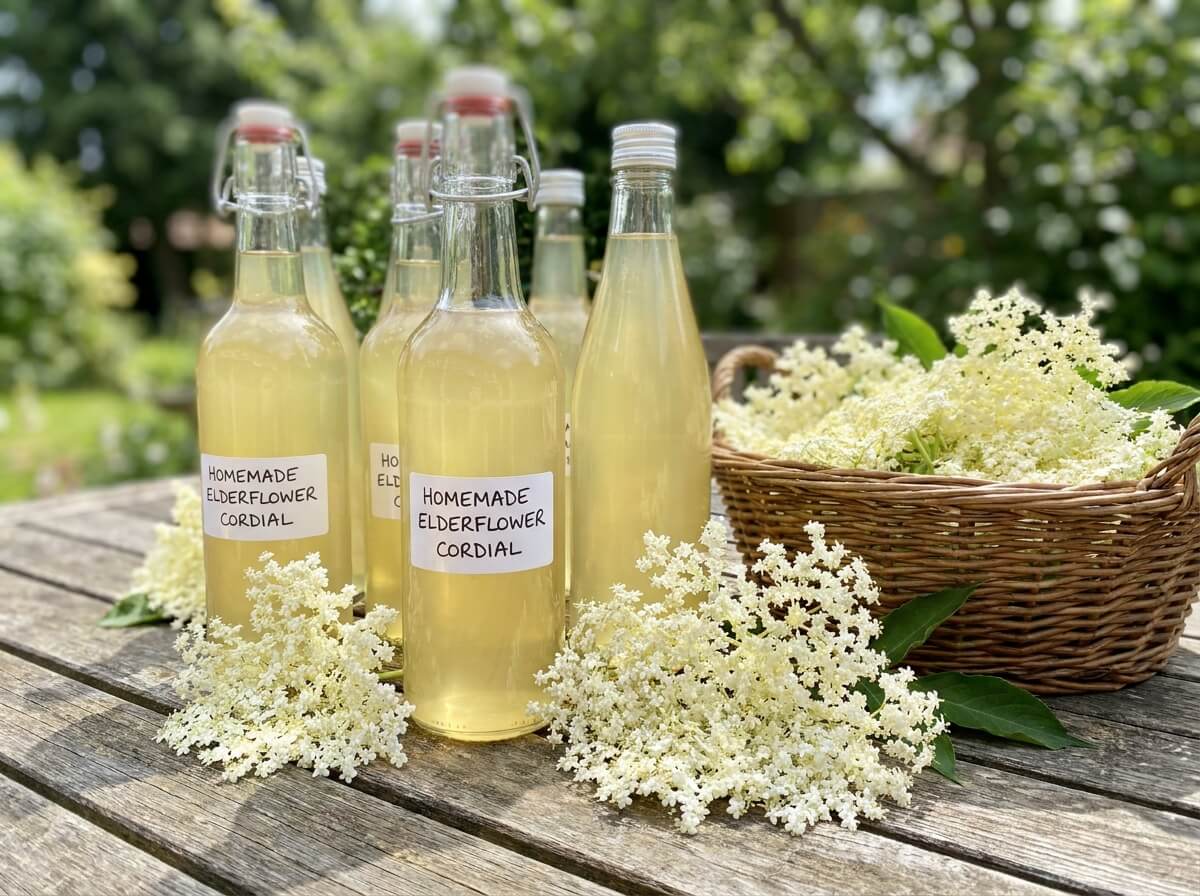
Elderflower cordial has been made in British and European kitchens for centuries. Yet the window to make it’s brutally short — roughly three weeks in early summer when the creamy flower heads hang heavy and fragrant, their scent beckoning you to capture summer’s ephemeral essence. Pick too early? The flavour isn’t there.
Miss the peak and you’re waiting another year. But this complete recipe gives you the method, the ratios, and the variations — including a sparkling elderflower cordial — so you can bottle something genuinely extraordinary from flowers that cost nothing at all.
The common elder, Sambucus nigra, is the only species to use. Its flowers shoot up in large, flat-topped clusters called corymbs — dozens of tiny creamy-white blooms grouped together, each cluster roughly 15–20cm across. And the scent’s unmistakable: sweet, slightly musky, with a faint powdery quality that’s somewhere between honeysuckle and lychee. A proper smell, really.
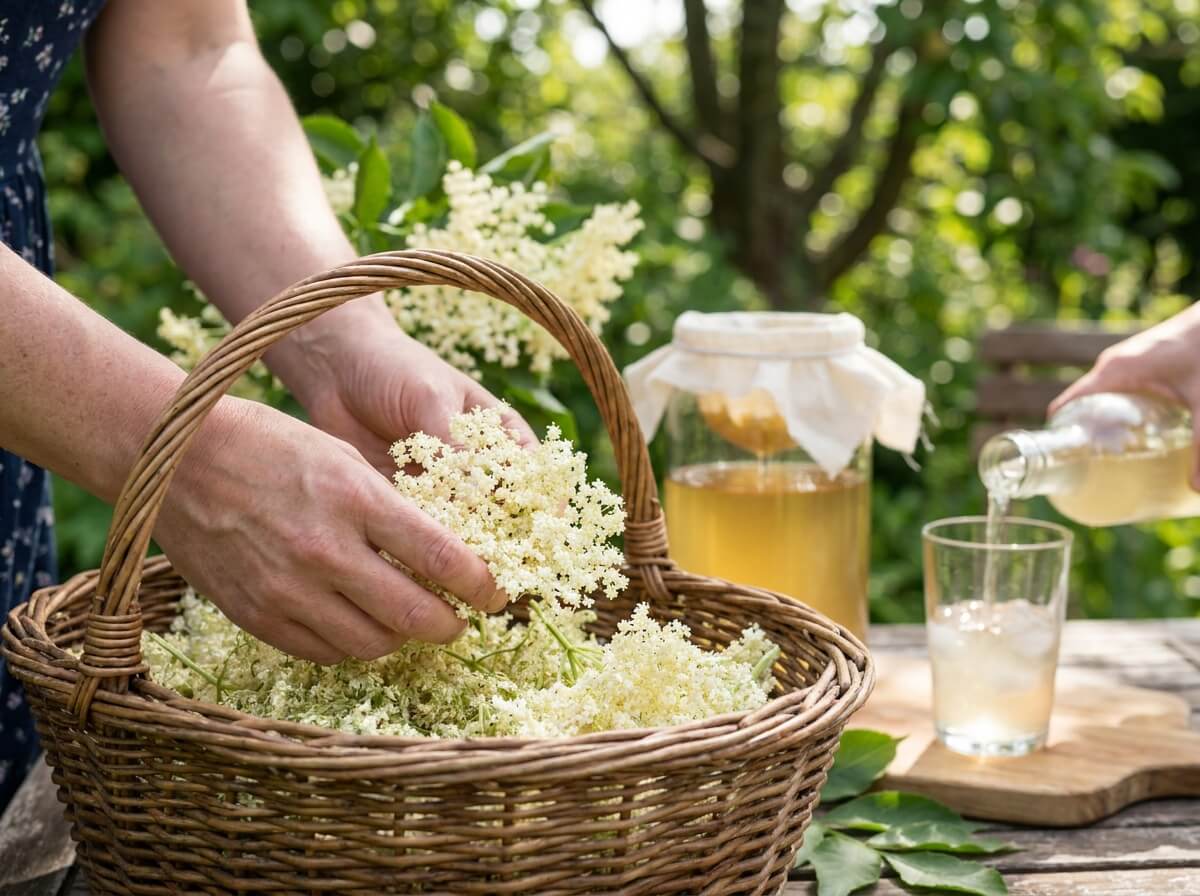
Harvest in the morning, before the sun burns off the volatile compounds that carry all the flavour. Choose heads that are fully open but not yet browning at the edges — brown flowers taste stale and slightly bitter. Don’t miss this.
You need 20–25 large heads for a standard batch yielding about 1.5 litres of cordial.
Don’t wash the heads under running water. A gentle shake to dislodge any insects is enough. The pollen on the surface contributes to flavour; you don’t want to rinse it away. For more on harvesting edible flowers from the garden, see Edible Flowers Are in Your Garden Right Now — Are You Using Them?
These quantities produce approximately 1.5 litres of finished cordial, enough to fill two standard 750ml bottles.
Ingredients:
Citric acid’s the non-negotiable ingredient here. It acts as a preservative, brightens the flavour considerably, and prevents the fermentation that would otherwise turn your cordial alcoholic within days. It’s bang on.
Find it in pharmacies, health food shops, or online — a small bag costs almost nothing and lasts for years.
Dissolve the sugar in the boiling water, stirring until completely clear. Pull off from heat and allow to cool for 10 minutes. You want it hot, not boiling, when it hits the flowers, or you’ll cook the delicate volatiles away.
The colour after straining? It’s a pale, luminous gold — not bright yellow, not colourless. That gentle amber’s what you’re aiming for. If it looks murky, strain a second time. A cloudy cordial isn’t dangerous, but it turns darker faster and has a shorter shelf life.
Sterilisation takes five minutes. It determines whether your cordial lasts two weeks or two months. Wash bottles thoroughly, then place them in an oven at 140°C (275°F / Gas Mark 1) for 15 minutes.
Pour the cordial in while both the bottles and the liquid are still warm. Cold liquid into a hot bottle cracks glass, guaranteed.
Stored in a cool, dark cupboard, sealed cordial keeps for up to 6 weeks. So, in the fridge it keeps for 8–10 weeks once opened.
For longer storage, freeze it in 250ml portions — it defrosts overnight in the fridge and tastes just as good in winter, when the memory of standing under a laden elder tree feels distinctly remote. It’s sorted.
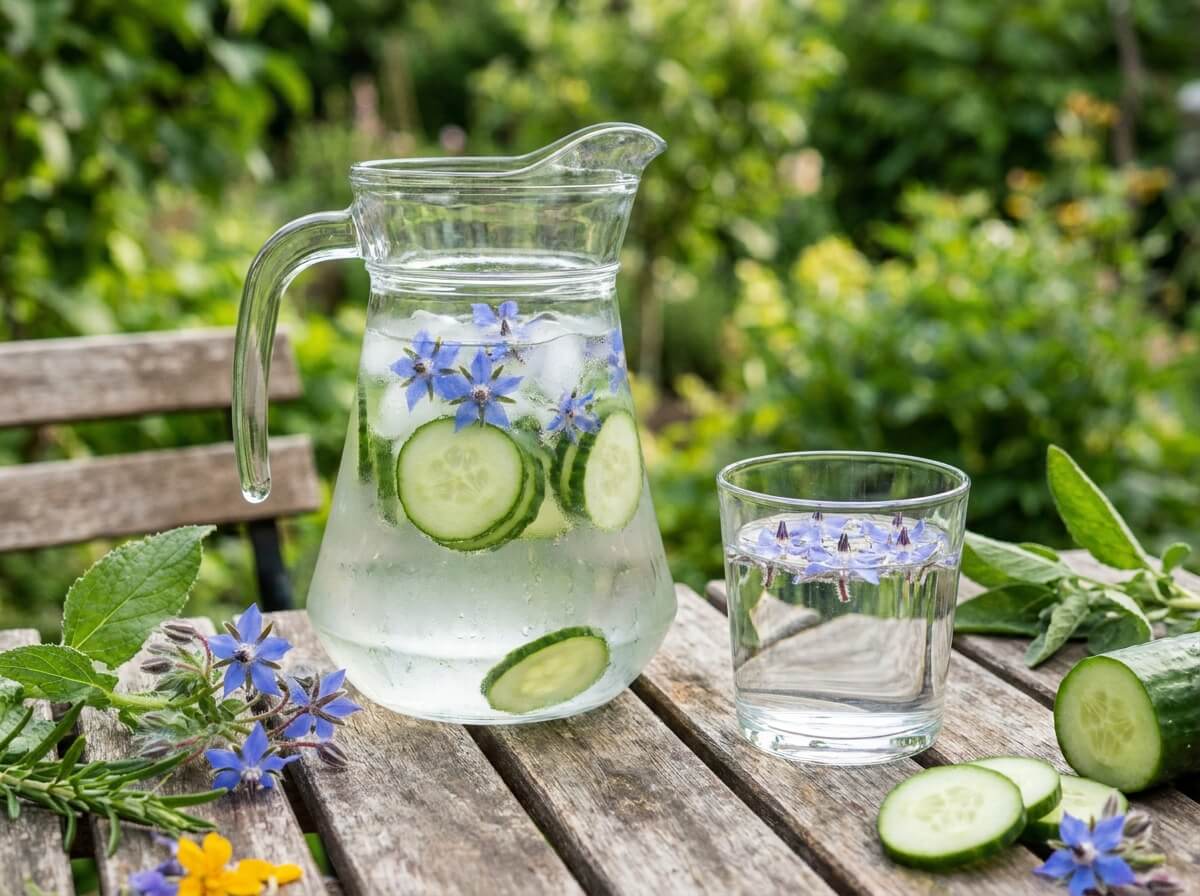
The standard dilution’s 1 part cordial to 8–10 parts still or sparkling water. But tasting as you go matters more than following a ratio precisely. Elderflower cordial over ice with sparkling water and a slice of cucumber? It’s one of summer’s genuinely underrated drinks. Properly refreshing.
Beyond drinks, cordial’s a versatile kitchen ingredient.
This version makes a lightly carbonated, mildly alcoholic drink — elderflower “champagne” — using only the wild yeasts already living on the flower heads. No added yeast. No equipment beyond a bucket and bottles with flip-top caps.
Use the same basic recipe but replace the citric acid with 2 tablespoons of white wine vinegar, and use only 700g of sugar per 4.5 litres of water. Leave the mix to steep uncovered for 48 hours rather than 24; the wild yeasts need air to activate.
Strain, bottle in strong flip-top bottles (never thin glass). Leave at room temperature for 2 days. Then open carefully over a sink.
This is a living product. It continues to ferment slowly in the bottle. Refrigerate after 2 days and consume within 2 weeks. The Royal Horticultural Society notes that elderflower fermentation can vary significantly depending on ambient temperature and the natural yeast load on the flowers — in a warm summer, fermentation moves faster than expected, and you don’t want explosive bottles.
Cordial too sweet? The sugar ratio’s fixed for preservation reasons. But you can adjust the dilution ratio when serving rather than reducing sugar in the recipe itself. That’s the way it’s sorted.
Going below 900g sugar per litre of water risks fermentation in the bottle.
If you enjoy using herbs and botanicals from the garden to make your own infusions and flavourings, the method for herb-infused vinegar follows a similar steeping logic and is worth reading alongside this.
Smart tip: Citric acid isn’t optional — it’s what separates a two-week cordial from a two-month one.
You can use extra lemon juice instead (juice of 4 lemons per 1.5 litres), but the shelf life drops to around 2 weeks even refrigerated, and the flavour is slightly less bright.
Only Sambucus nigra — the common black elder — should be used for cordial. Its flat-top.ped white flower clusters and opposite, pinnate leaves are distinctive; if in doubt, cross-reference with a reliable field guide before harvesting.
Yes. Freeze heads in a single layer on a tray, then transfer to bags — use within 3 months.
The texture suffers but the flavour compounds are preserved, and the resulting cordial is perfectly good.
The terms are used interchangeably in home cooking. Commercially, “syrup” sometimes refers to a thicker, more concentrated product, but the recipe and ingredients are identical.
Elder trees bloom in your spring — September to October in Australia, New Zealand, and South Africa. Bookmark this recipe now and return to it then; the method is identical regardless of hemisphere.