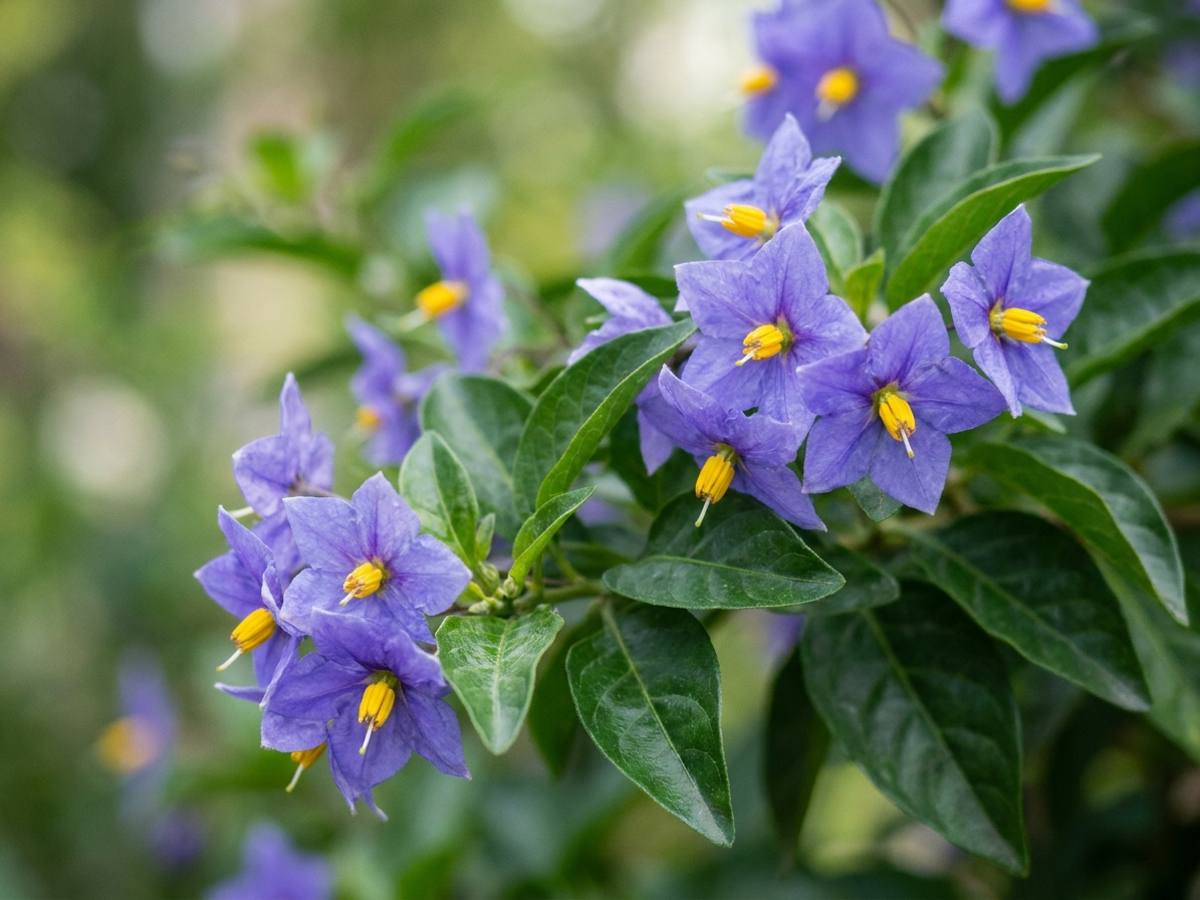
Solanum crispum is a fast, scrambling wall shrub from Chile and Peru, smothered from early summer to autumn in loose clusters of star-shaped violet-blue flowers with bright golden anthers. It is one of the quickest ways to clothe a sunny wall, fence or pergola, flowering for four months or more in a good season. Unlike a true climber it has no tendrils or twining stems, so it leans and sprawls and must be tied in to its support.
Growing conditions
Give Solanum crispum the sunniest position you can find, ideally against a south- or west-facing wall. Full sun produces far more flowers and ripens the wood, which in turn improves winter survival. It will grow in light shade but becomes leggy and shy to bloom.
Almost any reasonably fertile soil suits it, provided drainage is good. It is notably tolerant of alkaline conditions and thrives on chalk, as well as on neutral to slightly acidic loam. Heavy, wet clay is the main enemy — cold, waterlogged roots in winter kill more plants than frost does.
Shelter from cold, drying easterly winds matters as much as raw temperature. In mild coastal and southern gardens it stays largely evergreen; in colder inland areas expect it to shed leaves and behave more like a herbaceous wall shrub, regrowing from the base in spring.
Choosing the right spot: what makes or breaks it
Site decides how freely this wall shrub flowers and whether it comes through winter at all. The table sums up the four things worth checking before you dig the hole.
Choosing the right spot: what makes or breaks it
Site factor
Best conditions
Avoid
If you get it wrong
Light
The sunniest position you can find, against a south- or west-facing wall
Deep or heavy shade
Leggy growth, few flowers, softer wood and poorer winter survival
Soil
Reasonably fertile and well drained; chalk, or neutral to slightly acidic loam
Heavy, wet clay
Cold, waterlogged roots in winter, which kill more plants than frost does
Shelter
Protection from cold, drying easterly winds
Open, exposed positions
Wind damage as well as cold injury; fleece needed in severe spells
Local climate
Mild coastal and southern gardens, where it stays largely evergreen
Cold inland gardens if you want evergreen cover
Leaf drop and behaviour more like a herbaceous wall shrub, regrowing from the base
Get sun, drainage and shelter right and the plant will do the rest, at up to 1.5 m of growth a season.
How to plant Solanum
Plant in mid to late spring, once the soil has warmed and frosts are past, so the plant has a full season to establish before its first winter. Autumn planting is possible only in the mildest districts.
Spacing: allow 2–3 m between plants, or a single specimen per 3 m stretch of wall — it grows up to 1.5 m in a season and quickly fills the space.
Depth: set the rootball at the same level it sat in the pot, with the base of the stems just at soil level; do not bury the crown.
Soil preparation: dig a hole twice the width of the rootball and fork in garden compost plus grit if drainage is doubtful; keep the planting hole 30–45 cm out from the wall to escape the dry rain shadow.
Watering in: soak thoroughly after planting, then water weekly for the first summer, and mulch with 5 cm of bark or compost keeping it clear of the stems.
Propagation: take semi-ripe cuttings 10 cm long in July or August, root them in gritty compost in a cold frame, and overwinter under cover; layering low stems in autumn also works well.
Solanum crispum growing in a naturalistic garden border
Care through the seasons
Spring: Prune in April once the risk of hard frost has passed, cutting out dead, damaged and congested growth and shortening side shoots to two or three buds from the main framework. Tie in new stems to wires or trellis as they extend, spreading them fanwise. Apply a balanced general fertiliser and a fresh mulch to fuel the surge of growth.
Summer: Water deeply during prolonged dry spells, especially for wall-trained plants in a rain shadow — a bucketful twice weekly is better than daily sprinkling. Keep tying in the whippy new growth before wind snaps it, and shorten wayward shoots to keep the plant flat against its support. Deadheading is not essential but removing spent trusses can encourage another flush.
Autumn: Stop feeding by late August so growth hardens before the cold arrives. Tidy rather than prune hard, as the top growth gives some frost protection to the crown. Mulch the base with 10 cm of leaf mould, bark or straw in late autumn, particularly on younger plants.
Winter: Expect partial or total leaf drop in cold gardens, and dieback of the youngest shoots after sharp frost. In exposed areas, wrap the main framework in horticultural fleece during severe spells and leave all pruning until spring.
Best varieties to grow
There are few true cultivars, but the selections below — plus its close cousin Solanum laxum — cover most garden situations.
Solanum crispum ‘Glasnevin’ — the outstanding form, holding an RHS Award of Garden Merit, with rich purple-blue flowers over an exceptionally long season and better hardiness than the species.
Solanum crispum ‘Autumnale’ — a name often applied to the same clone as ‘Glasnevin’, valued for flowering reliably late into October.
Solanum laxum ‘Album’ — the white potato vine, a twining relative with fragrant milk-white stars, ideal for a warm sheltered wall or a conservatory.
Solanum laxum ‘Aureovariegatum’ — grown for gold-splashed foliage as much as its pale flowers, best in a very sheltered, frost-free spot.
Pests, diseases and common problems
Aphids: dense colonies on soft new shoot tips cause distorted growth and sticky honeydew; dislodge with a jet of water, encourage ladybirds and lacewings, or use an organic soft-soap spray.
Verticillium wilt: whole stems suddenly wilt and die back with brown staining inside the wood; there is no cure, so cut out affected branches promptly, disinfect tools and avoid replanting another Solanaceae in the same soil.
Winter dieback and root rot: blackened shoots after frost, or a plant that fails to shoot at all in spring, usually signal cold combined with wet feet; improve drainage with grit, mulch the crown and be patient, as growth can appear as late as June.
🌿 Nature & Garden Newsletter
Gardening tips, recipes & seasonal advice, twice a week.