Your zinnias are already covered in colour — but if those stems are shooting straight up with just one flower each, you are leaving most of the plant’s potential on the table. A single pinch at exactly the right moment redirects all that upward energy into a sprawling network of branches.
More branches mean more flowers, a longer season, and the kind of dense, chaotic display that makes people stop at your garden gate.
Zinnias are annuals with one biological priority: reproduce before the season ends. Left alone, a zinnia funnels its energy straight up the main stem, blooms once at the top, sets seed, and begins to wind down.
That is not failure — that is the plant doing exactly what it evolved to do.
The architecture matters here. A zinnia has a single apical growing tip that produces a hormone called auxin, which actively suppresses the side buds lower on the stem.
Pull off that tip and the auxin signal disappears almost overnight. The side buds, suddenly uninhibited, break dormancy and push outward.
One stem becomes four or six. The plant does not weaken — it multiplies.
Pinching is non-negotiable if you want a genuinely full plant. It is the mechanical override of a built-in survival strategy.
Nothing catastrophic. Your zinnias will still bloom.
But they will bloom thinly — tall, slightly awkward stems with a single flower nodding at the top of each one, and bare lower stems that show gap after gap in the border. In a heatwave summer, those tall unpinched stems also become vulnerable: they snap in wind, flop after heavy watering, and the root system struggles to support a plant that is all height and no structure.
Unpinched zinnias also fade faster. One flower per stem means the plant reaches its reproductive goal quickly and redirects energy toward seed production. Pinched plants, with their multiple stems still in bud, keep that goal perpetually just out of reach, extending the season by 6 to 8 more weeks of continuous flowering. So if you are growing zinnias to cut, you want stems. Lots of them. Pinching yields a proper cutting garden. Forget a few sad stalks. You want an abundance. See how stopping deadheading on certain summer flowers can have a similarly unexpected effect on your seasonal display.
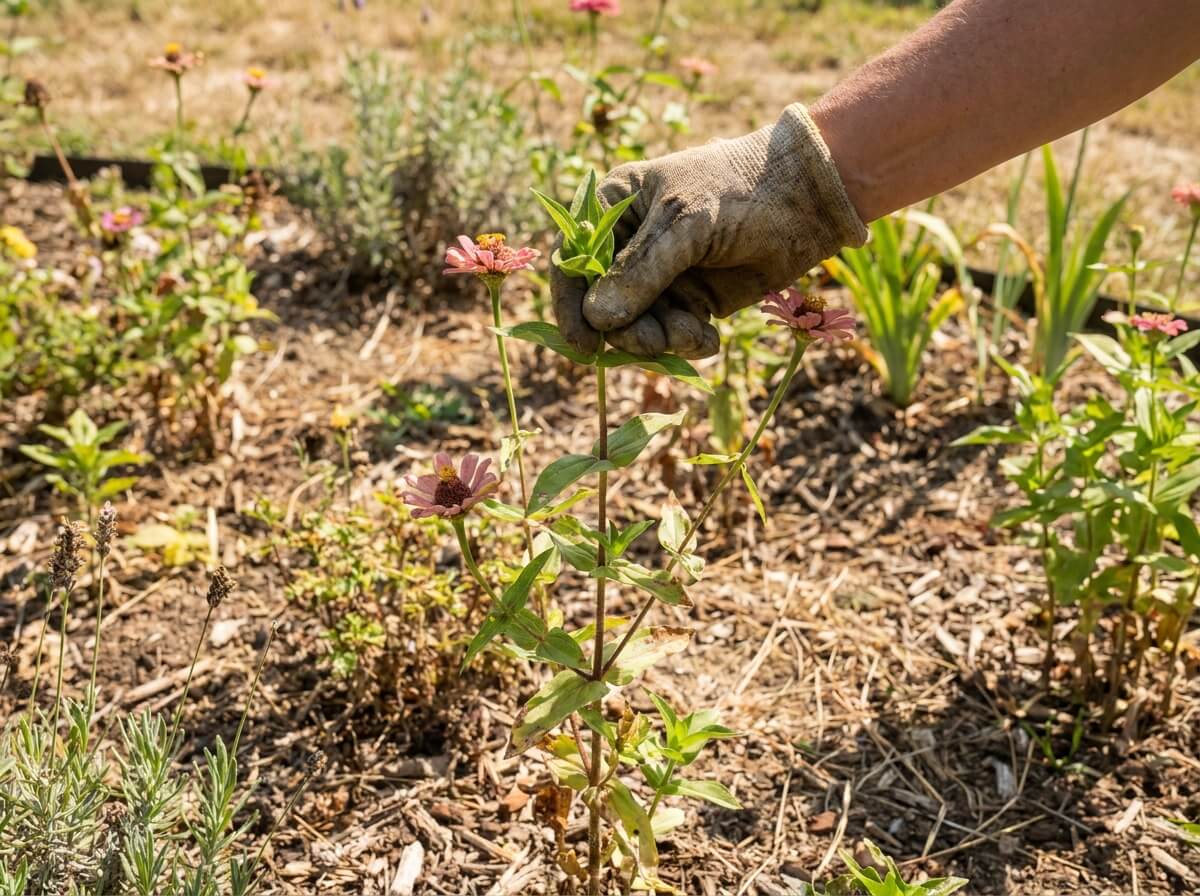
Timing is everything. Pinch too early — below 10cm — and the plant has not built enough root mass to support the branching response.
Pinch too late, once the first bud is already showing colour, and you will delay your display by 3 weeks for little gain.
The thing is, the sweet spot is when the plant reaches 15 to 20cm tall with at least 3 pairs of leaves. That usually happens 3 to 4 weeks after transplanting, or about 5 weeks after direct sowing.
Within 10 to 14 days, two to four side shoots will push out below the cut. Yes, it is fiddly. Worth it. For more on getting the most out of your summer annuals right now, the guide on what to do with your annuals before you will lose colour all summer covers the full picture.
Some growers pinch a second time when those side shoots reach 15cm themselves, creating an even bushier plant with 8 to 12 potential flowering stems. But that second pinch delays blooms by another 7 to 10 days, yet the eventual display is extraordinary. The University of Maryland Extension and the RHS both recommend this double-pinch method for exhibition-quality zinnia beds.
The first sign of success is subtle: within 3 to 5 days of pinching, you will notice the leaf nodes just below the cut beginning to swell slightly. A pale, almost translucent nub pushes out from each node — those are your future flowering stems.
Watch for these signals as the season progresses:
Southern Hemisphere gardeners: this technique applies to your December and January growing season, when zinnias are at the same stage Northern Hemisphere gardens reach in late June.
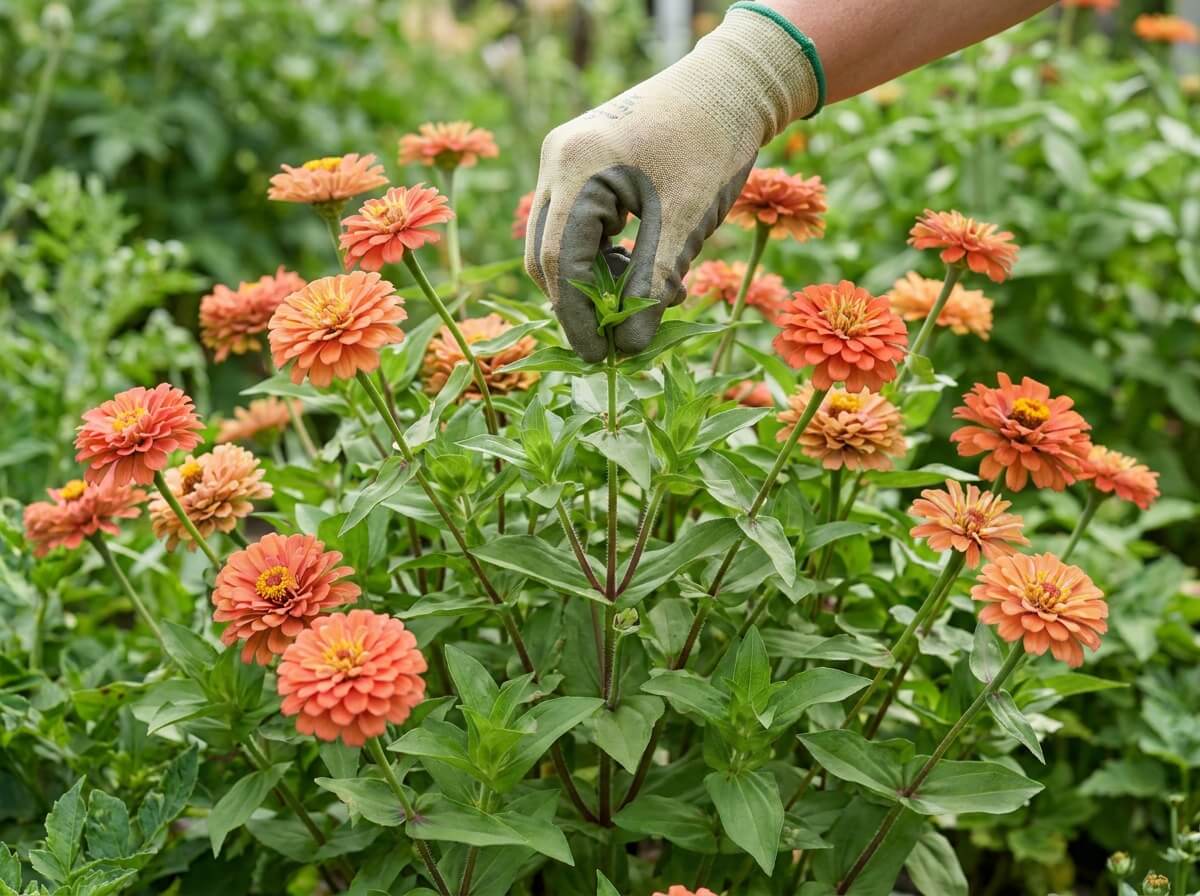
The thing is, always pinch above a leaf node — a cut mid-stem leaves a dead stub that rots and invites disease.
Pinching an already-flowering zinnia delays new blooms by 2 to 3 weeks and the branching response is weaker. Do it only if the plant is properly leggy and you are happy to sacrifice the current flowers for a better long-term display.
Tall varieties like ‘Benary’s Giant’ respond most dramatically, producing thick, cut-flower-quality stems. Dwarf varieties like ‘Thumbelina’ are already compact and benefit less — pinch them once, lightly, or skip it entirely.
Wait 7 days before feeding. The pinch creates mild stress and the plant needs to redirect energy first — hitting it with fertiliser immediately pushes leafy growth instead of the branching response you want.
Two pinches is the practical maximum. A third pinch pushes the first flowers so late in the season that you lose weeks of display time, and the return diminishes sharply after the second cut.