Your pot plant looks healthy on Monday. By Friday, it topples over and the roots vanish. Vine weevil grubs are ruthless summer pests in containers. They operate entirely underground. By the time you notice, it is too late. The adult beetle is active now, leaving clues on leaves that almost nobody recognises in time. Here is what to look for, and what to do immediately.
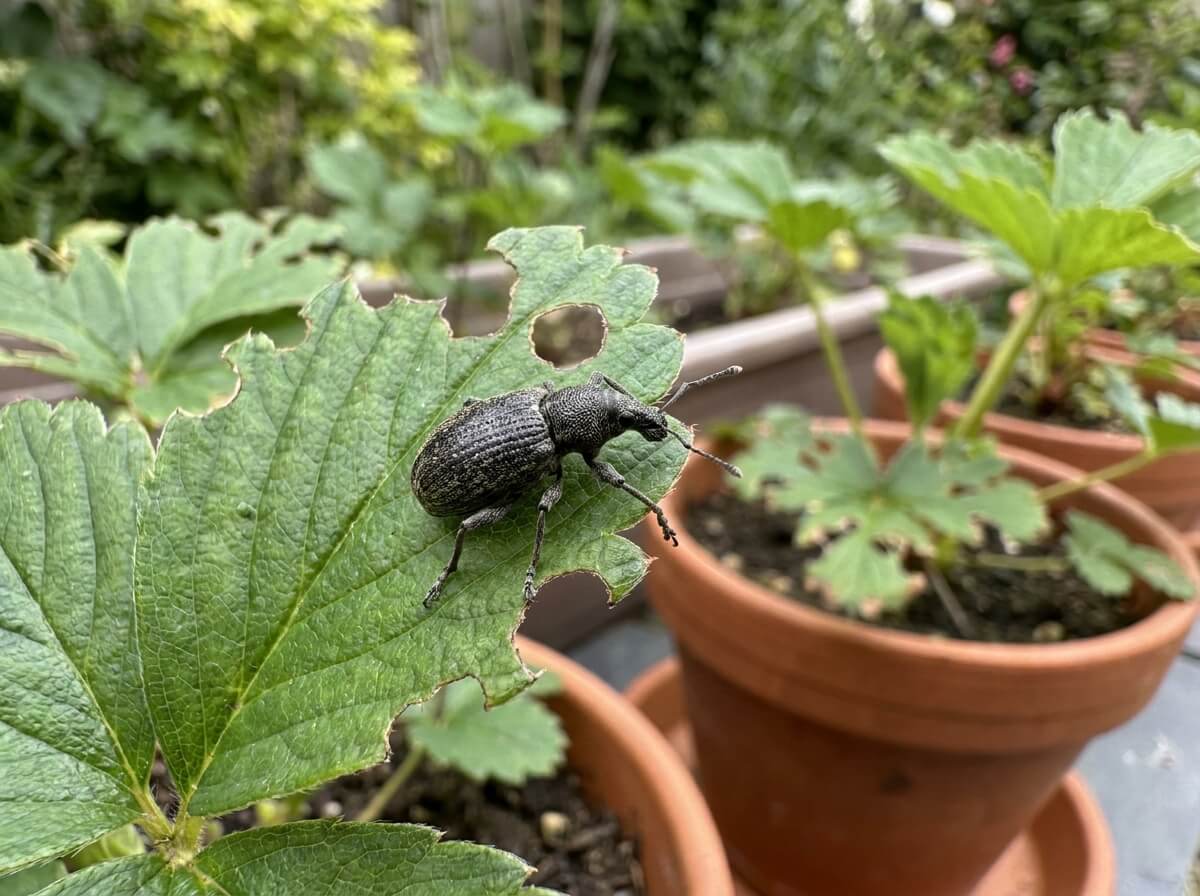
The semi-circular notches chewed from the edges of leaves — clean, smooth bites, like someone took a tiny hole-punch to the margins — are the adult vine weevil’s signature. Otiorhynchus sulcatus is a dark, slow-moving beetle, roughly 9mm long. It feeds nocturnally on a bewildering range of plants: heuchera, hosta, rhododendron, strawberry, cyclamen, fuchsia, primrose, sedum.
But the leaf damage itself is rarely fatal. It signals something urgent: wherever adult weevils are feeding above ground, eggs are being laid in your compost below.
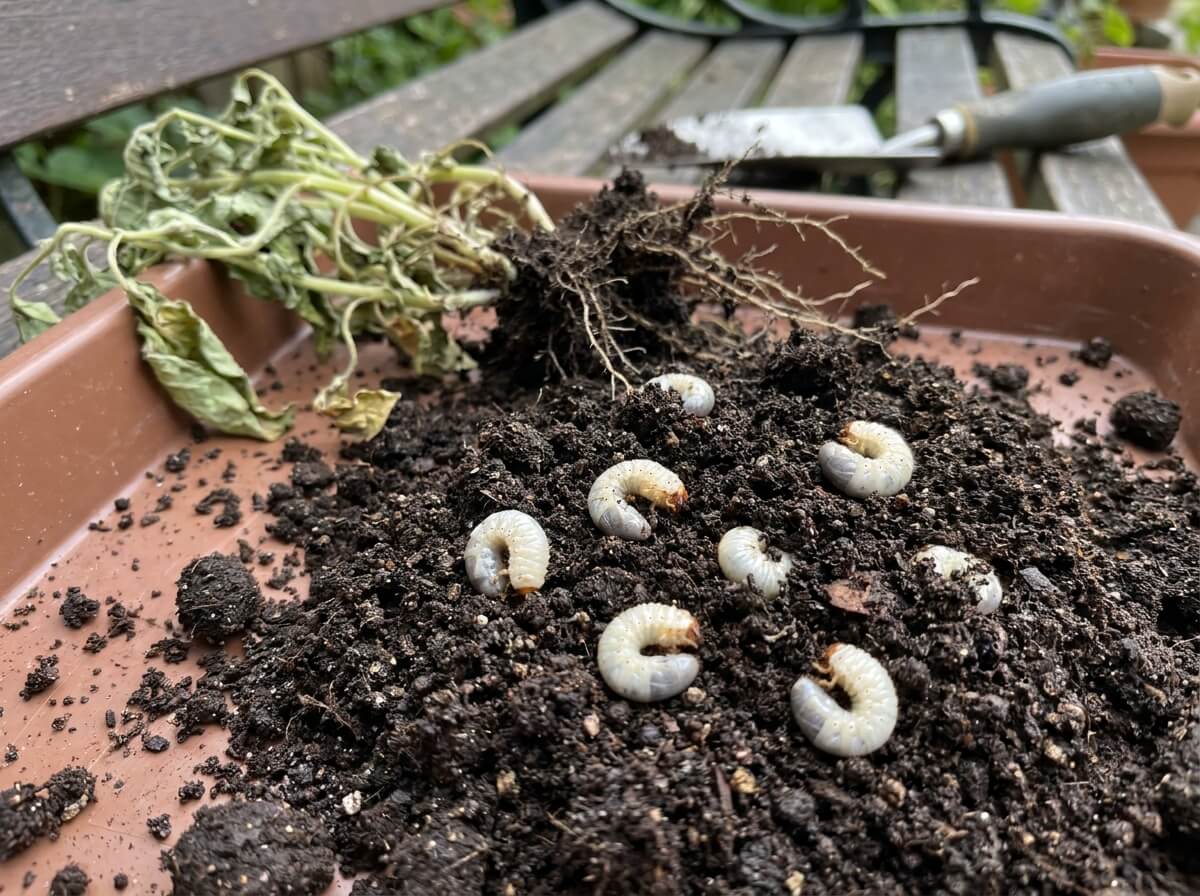
One female can deposit up to 1,500 eggs across a season. No male is required. Those eggs hatch into creamy-white, C-shaped grubs that spend the rest of summer and autumn chewing methodically through root systems.
Pot plants are hit hardest. The grubs are confined in a limited volume of compost, with no escape route for the roots. This makes things a bit much. A dodgy situation for any container.
So, the grubs shoot up steadily through late summer. By early autumn — roughly 8 to 10 weeks after hatching — they are large enough to sever the entire root ball of a medium-sized container plant. This is the non-negotiable danger point.
You will see wilting that does not respond to watering. Then the plant simply falls over when you touch it. Stem detached from rootless compost.
At that point, the plant is dead. Not salvageable. Bang on.
Not “just stressed.”
Heucheras and hostas are particularly vulnerable. Both are RHS Award of Garden Merit plants that gardeners invest in year after year, only to lose them silently to grubs. Strawberry plants in containers are almost guaranteed to be targeted if adults are present. The RHS confirms vine weevil is now one of the most frequently reported garden pests in the UK. Damage reports are rocketing every summer.
Start tonight. Take a torch out after dark and inspect the leaves of any pot plants showing notched margins. This is non-negotiable.
Adult vine weevils freeze when light hits them. They will be on or near the leaves. You can drop them into a bucket of soapy water. Ugly work.
Effective work.
Then move to biological control. It is genuinely the most reliable long-term fix:
For pots you have not checked yet, tip them out and inspect the compost. Grubs are unmistakable: white, legless, with a brown head, curled into a tight C.
Pull off any you find immediately. Birds will not always find them for you. They are a proper issue.
But do not wait for wilting. By then you have already lost the plant. It is sorted.
Watch for these earlier signals:
And if you are also dealing with other summer pests at the same time — red spider mites are exploding in summer heat. They often appear on the same stressed container plants. Stressed roots from vine weevil grubs make plants significantly more susceptible to everything else attacking the leaves. The RHS nematode guide covers application timing in detail if you want to coordinate treatments. That is a dodgy bit of business.
Smart tip: Apply nematodes when soil is warm. Summer is your best treatment window, not autumn when most gardeners finally notice the damage. This does wonders for effectiveness.
Both are at risk. But container plants are far more vulnerable. The grubs are confined, with limited roots to consume. In open ground, plants often partially recover. In pots, death is rapid. Non-negotiable.
Purely cosmetic. The leaf damage will not kill your plant. But it is a direct signal that eggs are being laid in your compost right now. That is the real threat. Make no mistake.
Less effectively than in compost. Clay restricts nematode movement. Focus nematode treatments on pots and raised beds with loose, well-draining compost. This provides the properly good results. Not quite right for clay.
Neem oil has some deterrent effect on adult beetles but does not reliably kill grubs in the soil. Nematodes remain the only organic treatment with proven effectiveness against the larval stage.