Ipheion uniflorum: your complete spring bulb guide
0
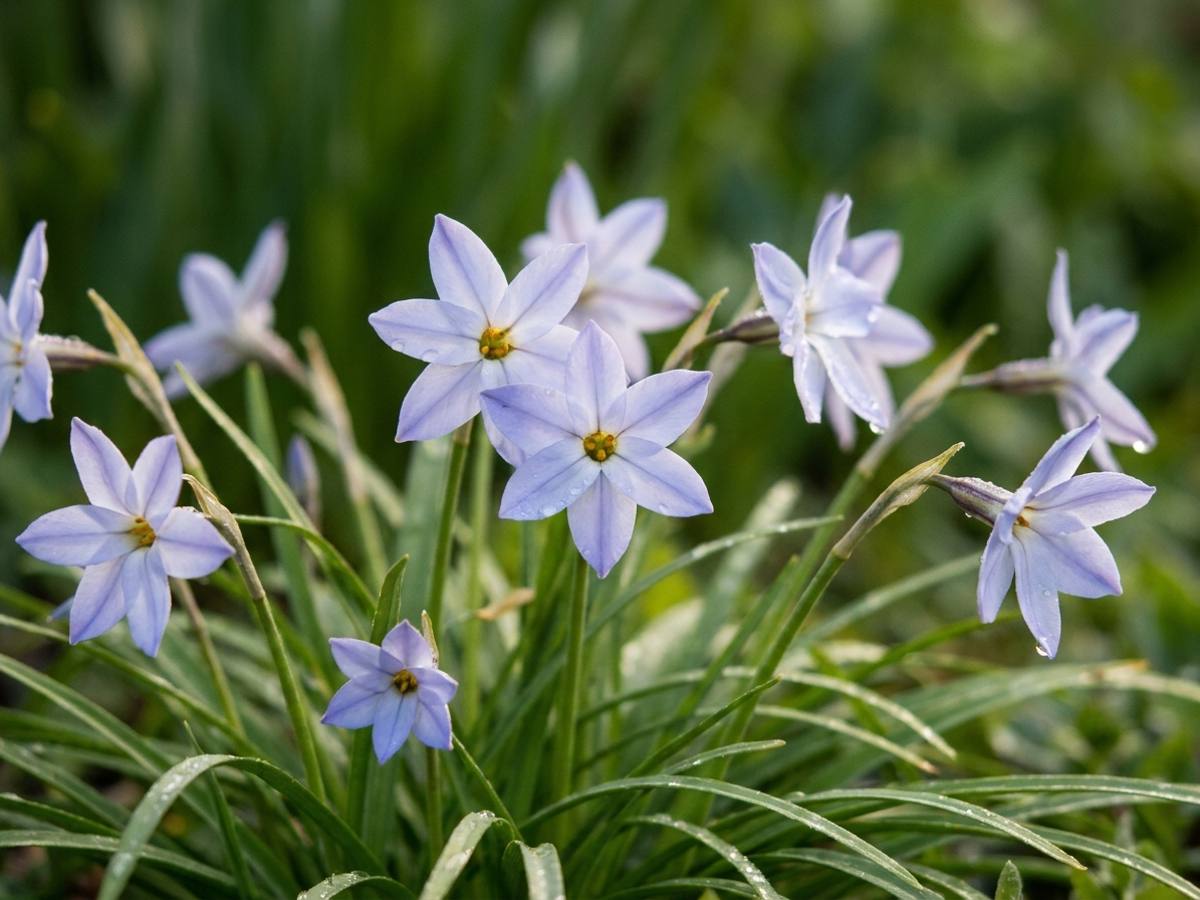
Spring starflower is one of those quietly generous little bulbs that asks almost nothing and gives a great deal. From late winter into spring it throws up sheaves of narrow, grassy leaves followed by six-petalled, honey-scented stars in shades of milky blue, violet and white, held just a few centimetres above the ground. Crush a leaf and you will notice its most distinctive trait — a distinctly oniony scent that betrays its kinship with garlic and alliums.
Growing conditions
Spring starflower flowers most freely in full sun, where the bulbs receive a good summer baking after the foliage dies down. It will cope with light dappled shade beneath deciduous shrubs and trees, since it does most of its growing before the canopy closes. In deep, permanent shade the flowers become sparse and the leaves flop.
Drainage matters far more than fertility. A light, gritty loam or sandy soil is ideal, and the plant is perfectly content on chalk or in the thin soil at the base of a warm wall. Aim for a neutral to slightly alkaline pH, around 6.5–7.5, and avoid heavy, waterlogged clay where the bulbs rot in winter.
Native to Argentina and Uruguay, it has naturalised widely across mild temperate gardens and is reliably hardy through most of Britain, Ireland and northern Europe. In colder inland gardens or exposed sites, plant a little deeper and add a gravel mulch to protect the bulbs from repeated freeze–thaw cycles.
How to plant Ipheion
Plant dry bulbs in early to mid autumn, from September to October, so they can root before winter and flower in their first spring. Pot-grown clumps bought in leaf can go in during spring, immediately after flowering.
Spacing: Set bulbs 5–8 cm apart in generous groups of at least twenty — single bulbs look lost, and the effect relies on drifts.
Depth: Cover with 5–8 cm of soil, roughly three times the height of the bulb, with the pointed nose facing upwards.
Soil preparation: Fork in a spadeful of horticultural grit per square metre on heavier ground, plus a little leaf mould for moisture retention.
Watering in: Water once after planting to settle the soil, then leave alone — autumn and winter rainfall is usually ample.
Propagation: Lift and split congested colonies every three to four years in early summer as the leaves yellow, replanting the offsets straight away at the same depth.
Ipheion uniflorum growing in a naturalistic garden border
Care through the seasons
Spring: Growth is already well advanced by the time flowering begins, so simply clear away fallen leaves and debris that might smother the low foliage. A light dressing of general fertiliser or bone meal as the buds appear supports next year’s flowers. Deadheading is unnecessary, though snipping off spent stems keeps small plantings tidy.
Summer: The leaves yellow and vanish by early summer — resist the urge to cut them off while they are still green, as they are feeding the bulb. Once dormant, the bulbs prefer to stay dry and warm, so avoid siting them where irrigation soaks the ground all summer. No watering is needed in open ground; container-grown bulbs can be tipped on their side under a wall.
Autumn: This is the season for planting new bulbs and for topping up a gravel or grit mulch, which keeps the emerging flowers clean of soil splash. Colonies that flowered poorly last spring are usually overcrowded, so lift, divide and replant them now if you missed the early-summer window. A thin mulch of leaf mould around, not over, the noses is beneficial on poor soil.
Winter: Fresh leaves often push through from December onwards and are entirely frost-proof, shrugging off snow and hard frost. No protection is needed except in very cold gardens, where a 5 cm gravel or bracken mulch is sensible insurance.
Best varieties to grow
Several excellent named forms extend the colour range from near-white to deep violet.
‘Wisley Blue’ — the classic, with soft lilac-blue stars over a white throat; holds an RHS Award of Garden Merit and multiplies freely.
‘Alberto Castillo’ — the finest white, with unusually large, rounded flowers and broader, more substantial leaves.
‘Charlotte Bishop’ — a pretty rose-pink selection with a deeper central stripe, lovely threaded through pale gravel.
‘Froyle Mill’ — the darkest form, in rich violet-purple, though slightly slower to increase than the blues.
‘Rolf Fiedler’ — compact and neat with vivid gentian-blue, wide-petalled flowers; needs a warmer, sharply drained spot.
Pests, diseases and common problems
Bulb rot in wet soils: Bulbs turn soft and brown and fail to emerge, usually after a wet winter on clay. Improve drainage with grit, plant on a slight ridge or grow in raised beds and troughs instead.
Slugs and snails: They graze ragged notches from petals and leaf tips in damp spring weather. Use wildlife-safe ferric phosphate pellets sparingly, or go out at dusk with a torch and collect them by hand.
Shy flowering: Plenty of leaf but few blooms points to overcrowding, too much shade or a soil that stays damp in summer. Divide congested clumps in early summer and move them to a sunnier, drier position.
🌿 Nature & Garden Newsletter
Gardening tips, recipes & seasonal advice, twice a week.