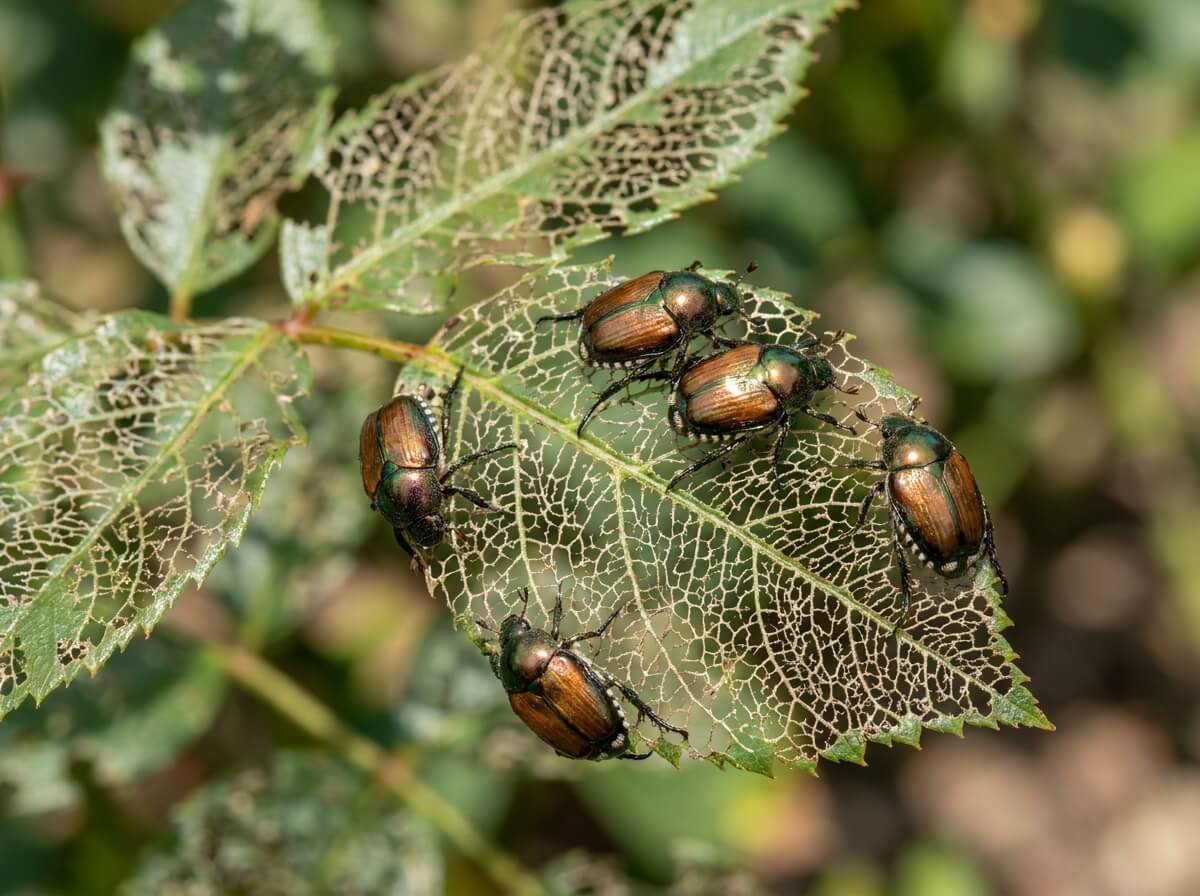
You walk out on a warm morning and your rose bush — lush just two days ago — looks like someone held a blowtorch to every leaf. Only the veins remain. Japanese beetles (Popillia japonica) are the culprit. And summer is their peak season. Good news: natural methods genuinely work. Bad news: the most popular one — those yellow pheromone bag traps — makes your issue properly worse.
Japanese beetles emerge from the soil as adults when soil temperatures consistently reach around 18°C (65°F). This lines up almost perfectly with early summer across most of the US, Canada, and parts of the UK where they have now been spotted. They live for only 4–6 weeks as adults. So, they feed with frantic intensity.
Roses, grapevines, hibiscus, linden trees, basil, and raspberries are top targets, but the beetle has a recorded host list of over 300 plant species.
The aggregation effect is what makes them devastating. When one beetle feeds, it releases pheromones that recruit more beetles to the same spot. Ignore them for 48 hours and a leaf skimming issue becomes full defoliation. If you are dealing with other summer pests alongside them, check whether thrips are also afflicting your garden. The two often overlap on the same stressed plants.
Defoliation. Repeated, severe defoliation weakens a plant’s ability to photosynthesise, drains its energy reserves, and makes it dramatically more vulnerable to fungal disease — especially in summer heat.
A rose bush hit hard in early summer may fail to set buds at all for the rest of the season.
Underground, the grubs are doing their own damage. The larvae spend roughly 10 months in the soil eating grass and plant roots. So, a heavy adult population this summer means a heavy grub population destroying your lawn through autumn. The two issues are connected. Beneficial nematodes applied to lawn areas in late summer target grubs directly. Many gardeners skip this step entirely. That is a mistake.
Skip the bag traps. Research from the Penn State Extension consistently shows that pheromone traps attract far more beetles than they catch. They draw insects from up to 150 metres away directly toward your garden. The thing is, if your neighbour has one, that is actually bad news for your plants. This method does not work. Skip it.
What actually works:
The RHS notes that in the UK, Japanese beetle remains a quarantine pest — any confirmed sighting should be reported immediately to the Animal and Plant Health Agency (APHA). For gardeners in the US and Canada, USDA zones 3–9 are all at risk during summer adult emergence.
Skeletonised leaves are the obvious tell. But catch it earlier. Look for small, irregular feeding patches on leaf edges before whole leaves are stripped. That is your 24-hour window to act before the pheromone signal pulls in a crowd.
Watch the lawn too. Spongy patches of turf that lift away from the soil like loose carpet in late summer indicate grub damage below.
Starlings pecking aggressively at one area of lawn is another reliable signal. They are finding something.
If you are growing roses and see simultaneous leaf damage and spotting, check whether rose black spot is also present. Summer stress from beetles can accelerate fungal spread. And the two issues compound each other fast.
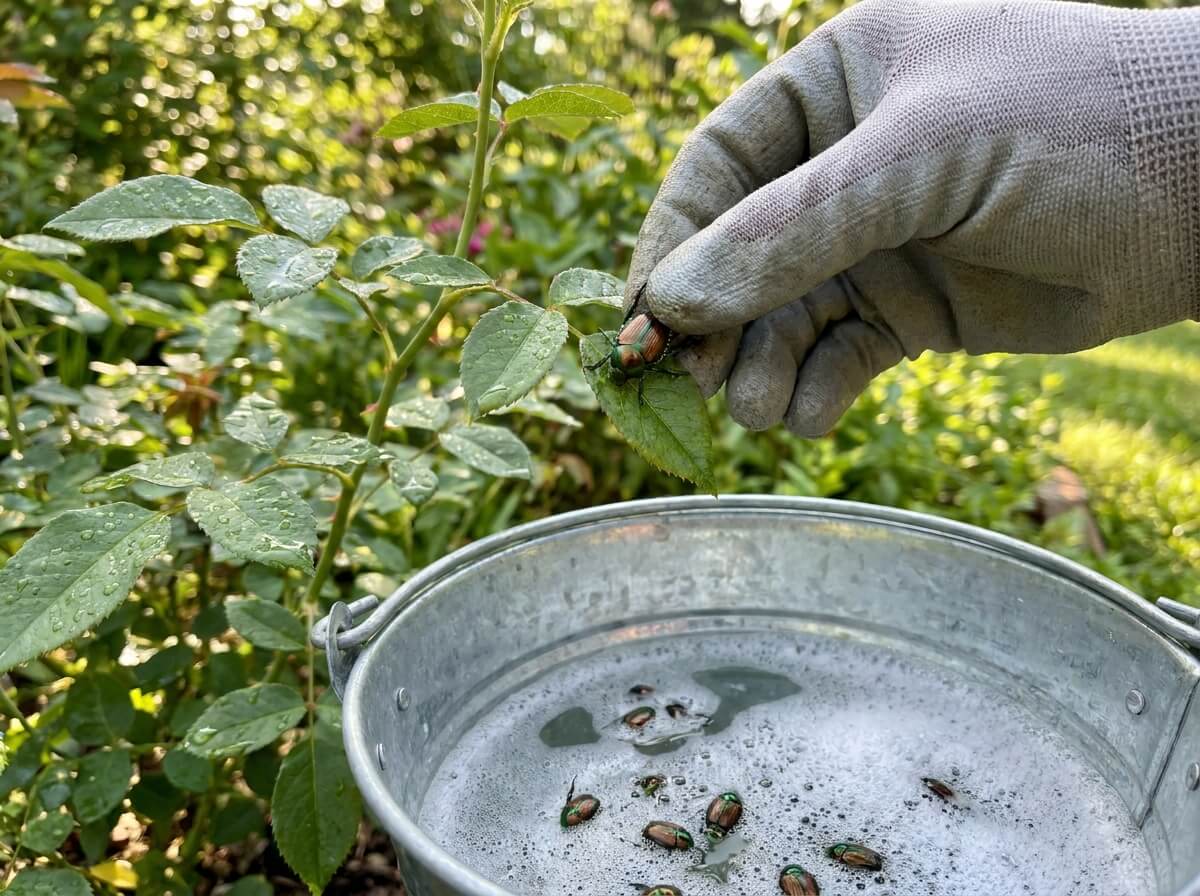
Smart tip: Hand-pick at dawn every morning for a fortnight — consistency breaks the aggregation cycle.
They catch beetles. But they attract far more than they capture. Place them at least 30 metres away from any plants you want to protect — or do not use them at all. They are not quite right for garden defence.
Applied in early morning before bees are active and allowed to dry fully, neem oil poses minimal risk to pollinators. Never spray open flowers directly.
Adult beetles are active for 4–6 weeks, typically peaking in the hottest part of summer. Damage is concentrated in that window — sustained daily action during this period makes a significant difference.
In the UK, Japanese beetle is a regulated quarantine pest. It is not yet established, but interceptions have been recorded. Australia and New Zealand remain free of it. Any suspected sighting should be reported to biosecurity authorities immediately.