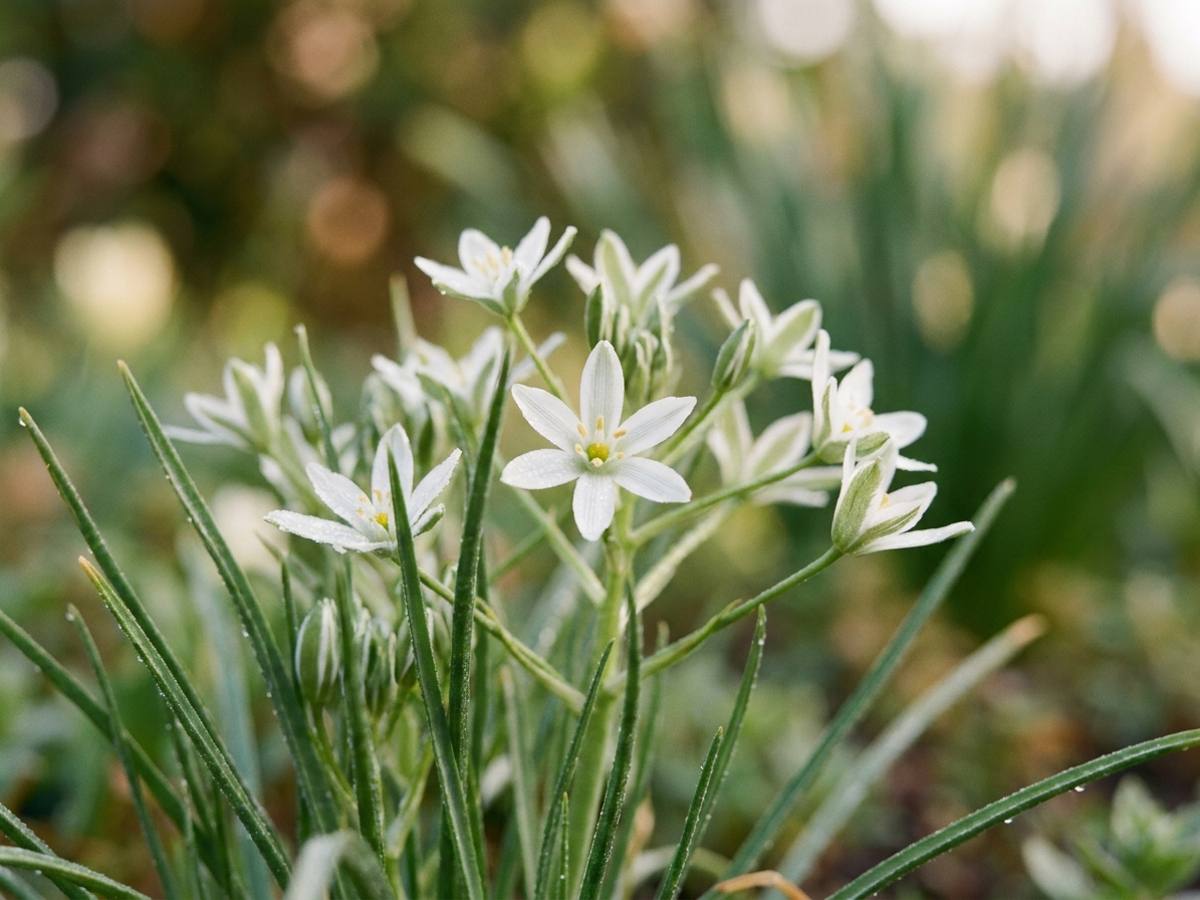
Ornithogalum umbellatum, commonly known as Star of Bethlehem, is a charming spring-flowering bulb prized for its delicate white star-shaped flowers with green-striped petals. It brings a fresh, cottage-garden appeal to borders, rockeries and naturalised settings, thriving with minimal fuss once established. This vigorous perennial is particularly valued for its ability to naturalise in lawns and multiply reliably year after year.
Growing conditions
Ornithogalum umbellatum thrives in full sun or light dappled shade, where flowering is most prolific and the characteristic star-shaped blooms open reliably in daylight hours. It tolerates partial shade but may flower less abundantly in deep shade, making a sunny border or meadow setting ideal for best displays.
This bulb prefers well-drained, moderately fertile soil and dislikes waterlogged conditions, particularly during dormancy. It is tolerant of chalky, sandy and loamy soils and will perform adequately even in poor ground, though flowering improves with balanced soil nutrition and reasonable drainage.
Star of Bethlehem is fully hardy across the British Isles and northern Europe, surviving winter temperatures well below −10 °C without protection. In warmer regions it may be treated as a cool-season perennial and lifted after flowering in long, hot summers to prevent bulb rot.
How to plant Ornithogalum
Plant bulbs in autumn (September to November) to allow roots to establish before winter dormancy and ensure vigorous spring growth. Early planting gives the strongest displays.
Space bulbs 10–15 cm apart to allow room for offsets and future clumps without overcrowding
Plant at a depth of 5–8 cm, measured from the base of the bulb to soil surface
Incorporate grit or coarse sand into heavy clay soils to improve drainage and prevent rotting
Water in gently after planting to settle soil and eliminate air pockets around bulbs
Divide established clumps in summer after foliage dies down to rejuvenate congested drifts
Green-striped white stars that close by afternoon
Star of Bethlehem season by season
Star of Bethlehem asks for very little, but the small jobs it does need are tied to a clear cycle of growth and dormancy. This table sets out what to do, and when, at a glance.
Star of Bethlehem season by season
Season
Main task
Watering and feeding
Early to mid-spring
Shoots emerge; deadhead spent flowers unless naturalisation is wanted
Apply a balanced granular fertiliser as growth begins
Early to midsummer
Flowering ends and bulbs enter dormancy; lift and divide congested clumps
Reduce watering; in dry spells give occasional deep soakings
Late summer to early autumn
Clear dried foliage and divide large clumps, replanting younger outer bulbs
Mulch with 2–3 cm of well-rotted compost or leaf mould
Mid-autumn
Plant new bulbs 5–8 cm deep and 10–15 cm apart; early planting gives the strongest displays
Water in gently after planting to settle the soil
Winter
Bulbs are dormant and need no attention or protection
Nothing required; guard against excessive winter wet
Excellent drainage matters more than shelter: winter wet is a greater risk to the bulbs than cold.
Care through the seasons
Spring: Emerging shoots appear in late March or early April. Apply a balanced granular fertiliser as growth begins, then deadhead spent flower heads promptly to prevent self-seeding (unless naturalisation is desired). Allow foliage to fade naturally; resist the urge to tidy too early, as leaves feed the bulb for next season’s flowering.
Summer: Once flowering ends in June, reduce watering as the bulbs enter dormancy. In very dry spells, give occasional deep soakings rather than frequent light watering. If Star of Bethlehem is spreading too vigorously in borders, lift and divide congested clumps to keep growth in bounds.
Autumn: Clear away completely dried foliage in August or September to tidy the planting and reduce pest harbouring. Divide large clumps at this time if needed, replanting younger outer bulbs immediately. Mulch around plantings with 2–3 cm of well-rotted compost or leaf mould to improve soil structure and retain moisture through winter.
Winter: Bulbs remain dormant and require no care. They are fully hardy and do not need protection; excessive winter wet is a greater risk than cold, so ensure planting sites have excellent drainage during heavy rainfall.
Best varieties to grow
The species itself is the most commonly grown form, but several cultivars and closely related selections offer subtle variations.
Ornithogalum umbellatum — The reliable species type, bearing pure white flowers with distinct green-striped outer petals and neat umbels that close in afternoon and dull weather
Ornithogalum umbellatum ‘Alba’ — A pure white double-flowered form with fuller, more decorative blooms for those seeking extra garden impact
Ornithogalum nutans — A related species with nodding, silvery-white flowers streaked green, taller and more elegant for semi-wild settings
Ornithogalum arabicum — A tender Mediterranean species with bold black ovaries and larger, later-flowering heads; best in a cool conservatory in Britain
Pests, diseases and common problems
Bulb rot: Soft, smelly bulbs in waterlogged soil indicate fungal rot, usually caused by poor drainage. Improve drainage immediately, lift affected bulbs, discard diseased ones and replant healthy stock in gritty, well-drained soil.
Narcissus flies: Larvae may tunnel into bulbs, causing hollow centres and weak growth. Dust surrounding soil with diatomaceous earth in spring and remove any mushy bulbs promptly; mulching helps prevent egg-laying.
Slugs and snails: These pests graze emerging shoots and flower buds, particularly in wet seasons. Encourage ground beetles and toads by leaving log piles nearby, or lay copper tape and organic pellets around vulnerable plantings.
Excessive spreading: Star of Bethlehem reproduces prolifically via small bulbils and self-seeding in ideal conditions. Deadhead regularly if containment is desired, and divide clumps every 3–4 years to prevent smothering nearby plants.