Growing Bear’s Breeches: care, uses and garden design
0
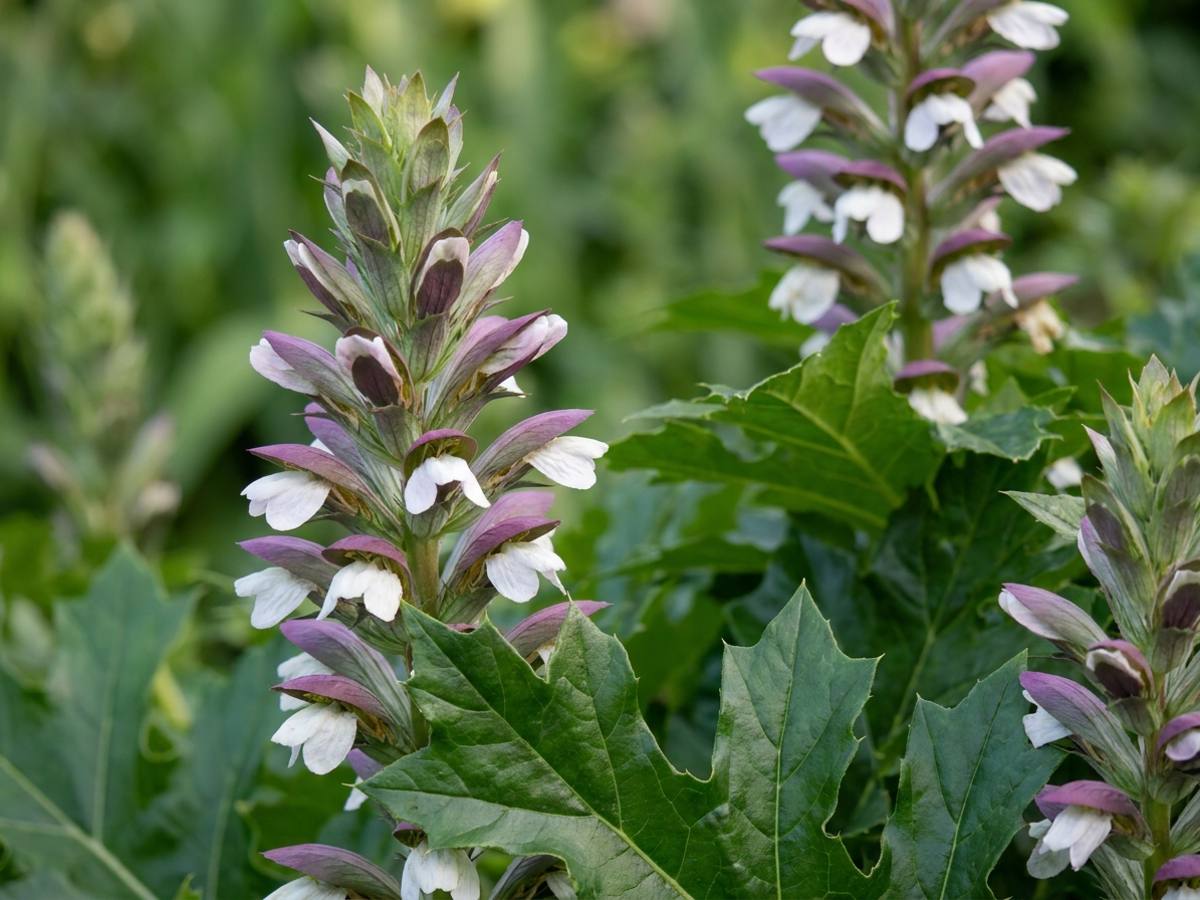
Bear’s breeches is a statuesque architectural perennial grown as much for its glossy, deeply lobed foliage as for its towering spires of hooded white and dusky-purple flowers. It brings a Mediterranean grandeur to borders, courtyards and shady corners where few other bold plants thrive. Its leaves are famously the inspiration for the carved capitals of Corinthian columns — a piece of classical history growing in your garden.
Growing conditions
Acanthus is remarkably adaptable on light. It flowers most freely in full sun, but produces its largest, glossiest leaves in dappled or partial shade. In hot, dry regions, afternoon shade prevents the foliage scorching and collapsing by midsummer.
Give it a deep, fertile soil that drains freely — the fleshy roots resent sitting in cold winter wet. It copes admirably with heavy clay once established, and is untroubled by chalk or a mildly alkaline pH. A neutral to slightly alkaline soil, around pH 6.5–7.5, suits it best.
Established plants are notably drought-tolerant thanks to their thick, questing taproots. In colder gardens the crown may be cut down by hard frost, but it reliably resprouts; in mild coastal or Mediterranean climates the foliage stays green all winter.
Sun, shade or dry shade: choosing a position
Acanthus will grow in almost any light, but the position you pick decides whether you get flower spikes or leaves. Use this table to settle where the clump should go before you dig the hole.
Sun, shade or dry shade: choosing a position
Position
Flowering
Foliage
What to do
Full sun
Freest flowering
Can scorch and collapse in hot, dry regions
Give afternoon shade where summers are hot
Dappled or partial shade
Flowers less freely than in full sun
Largest, glossiest leaves
Best for a bold foliage effect in shady corners
Deep or heavy shade
Few spikes
Magnificent leaves
Move to a spot with at least four hours of direct sun
Dry shade under trees
Sparse where shade is deep
Holds up where hostas fail
Soak and mulch with compost for its first two summers
The real choice is not survival but whether you want spires of flower or the biggest possible leaves.
How to plant Acanthus
Plant in autumn or early spring, when the soil is warm and moisture reliable. Autumn planting gives the roots a long settling-in period before their first summer.
Space plants 90 cm to 1 m apart — they build into broad clumps and crowded specimens flower poorly and mildew more readily.
Set the crown level with the surrounding soil, never buried, to avoid rot at the base.
Dig the planting hole twice the width of the rootball and fork in garden compost or well-rotted manure, plus grit on heavy clay.
Water in generously and keep moist for the first season; after that, watering is rarely needed.
Propagate by root cuttings in winter, or by dividing established clumps in autumn — every scrap of root left behind will regrow.
Acanthus mollis growing in a naturalistic garden border
Care through the seasons
Spring: New leaves unfurl quickly from March onwards and are irresistible to slugs, so protect emerging growth. Apply a balanced general fertiliser or a mulch of well-rotted compost around the crown. Remove any tatty, frost-damaged foliage to make way for fresh leaves.
Summer: Flower spikes rise from June and last for weeks; leave them for structure or cut them for drying. Water only in prolonged drought — established plants will simply go dormant and reshoot if leaves wilt. Deadhead before seed sets if you would rather not have seedlings appearing everywhere.
Autumn: Cut back spent flower stems and any collapsing leaves once they yellow. This is the best moment to lift and divide congested clumps, or to take root cuttings from thick sections of root. A generous mulch helps protect the crown in colder gardens.
Winter: The plant dies back in cold areas and stays semi-evergreen in mild ones. Only young plants in exposed, frosty gardens need a protective mulch of bark or straw over the crown.
Best varieties to grow
A handful of named selections offer better flowering, tidier foliage or variegation.
Acanthus mollis ‘Rue Ledan’ — pure white flowers with green bracts, luminous in shade and one of the freest-flowering forms.
Acanthus mollis ‘Hollard’s Gold’ — bright golden-yellow young foliage that greens with age; best given shade to prevent scorch.
Acanthus mollis ‘Tasmanian Angel’ — cream-and-green variegated leaves with pink-flushed flowers, slower and less vigorous than the species.
Acanthus mollis Latifolius Group — the largest leaves of all and generally the hardiest, reliable in colder gardens.
Because ‘Tasmanian Angel’ bulks up slowly, keep vigorous neighbours well back and give it a sheltered spot with steady moisture.
Where winters are cold and wet, the related Acanthus hungaricus flowers more dependably than A. mollis, though its leaves are narrower and less glossy.
Pests, diseases and common problems
Powdery mildew: A white bloom on leaves in dry summers, especially in crowded plantings. Improve air flow by thinning clumps, water at the base, and cut affected leaves right back — fresh growth usually follows clean.
Slugs and snails: They shred the soft spring foliage into lace. Patrol at dusk after rain, use wool pellets or sharp grit barriers, and encourage frogs and ground beetles.
Poor flowering: Usually caused by too much shade, recent disturbance, or over-rich soil producing leaves at the expense of spikes. Move to a sunnier spot, stop feeding with high-nitrogen fertiliser, and be patient — plants often need two or three years to settle.