Philodendron hederaceum: your complete indoor vining guide
0
Few houseplants earn their keep as effortlessly as Philodendron hederaceum, the heartleaf philodendron, whose glossy, dark green leaves cascade from shelves and bookcases or climb happily up a moss pole. It tolerates low light, forgives the occasional missed watering and roots from cuttings in a matter of weeks. Its most distinctive trait is leaf dimorphism: given something to climb, the modest heart-shaped juvenile leaves gradually swell into far larger adult foliage.
Growing conditions
Bright but filtered light suits this plant best — the dappled conditions of a forest understorey, reproduced by an east-facing window or a position a metre or two back from a south-facing one. It will survive in genuinely shady corners, but growth slows and the internodes stretch, giving long bare stems with sparse leaves. Direct midday summer sun scorches the foliage, leaving pale bleached patches.
Use an open, aroid-style mix rather than straight multipurpose compost: roughly two parts peat-free compost to one part orchid bark and one part perlite. The aim is a medium that holds moisture yet drains within seconds. A slightly acidic pH of 5.5–6.5 is ideal, and a drainage hole is non-negotiable.
Outdoors it is only reliably hardy in frost-free tropical and subtropical gardens, where it is treated as a ground-cover or tree-climber. Elsewhere, treat it as a houseplant that may summer outside in deep shade once night temperatures stay above 15 °C.
How to plant Philodendron
Pot or repot in spring or early summer, when rising light levels and warmth mean roots re-establish quickly. Avoid disturbing plants between November and February, when growth has all but stopped.
Set three to five rooted cuttings around the rim of a 15 cm pot for a full, bushy plant rather than a single straggly stem.
Plant so the lowest nodes sit just at compost level — buried nodes root readily, but a buried crown invites rot.
Mix a handful of orchid bark or coarse perlite into the compost to keep it airy; philodendron roots dislike stagnant, compacted media.
Water thoroughly after planting until it runs from the base, then allow the top 2–3 cm to dry before watering again.
Propagate from 10–15 cm stem cuttings with two or three nodes, taken in spring or summer; they root in water or damp compost within two to four weeks at 20–24 °C.
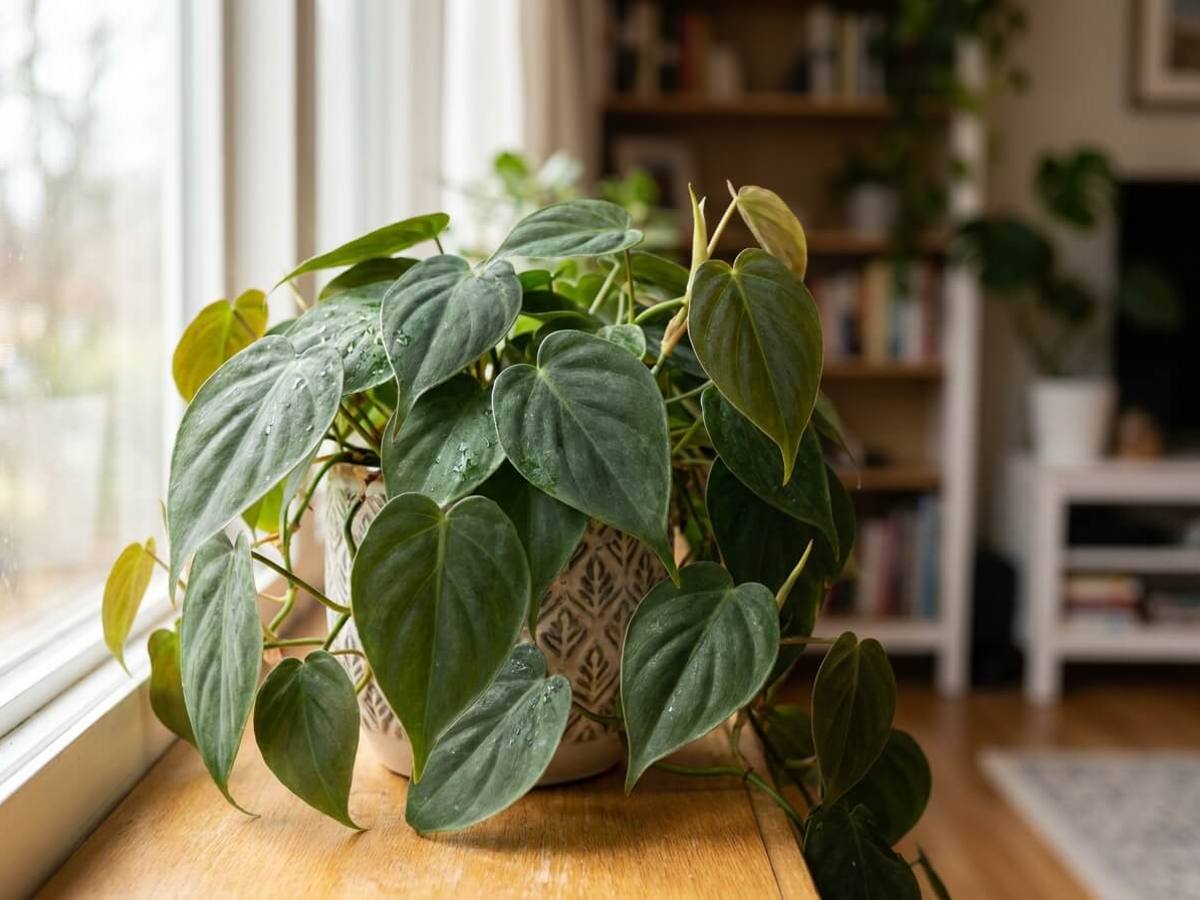
Philodendron hederaceum displayed as a houseplant in a home interior
Care through the seasons
Spring: As new growth appears, begin feeding every three to four weeks with a balanced liquid houseplant feed at half strength. This is the moment to repot pot-bound plants into a container one size larger, and to pinch the growing tips to encourage branching. Trailing stems that have gone bare at the top can be cut back hard — new shoots break from dormant nodes.
Summer: Water once the top few centimetres of compost feel dry, which may mean weekly in warm rooms. Mist or group plants together if humidity falls below about 40 per cent, and wipe the leaves with a damp cloth to keep them glossy and free of dust. Tie climbing stems to their moss pole as they extend, keeping the pole damp to encourage anchor roots.
Autumn: Taper off feeding from early October and reduce watering as light levels fall. Take any final cuttings in early autumn whilst temperatures are still high enough for rooting. Move plants closer to a window to compensate for shorter days.
Winter: Growth pauses almost entirely; water sparingly, perhaps every two to three weeks, and never leave the pot standing in water. Keep away from draughts, unheated porches and radiators, and do not let the temperature drop below 13 °C.
Best varieties to grow
Several distinct forms are widely available, differing chiefly in leaf colour and texture.
Philodendron hederaceum var. hederaceum ‘Micans’ — bronze-flushed leaves with a velvety, light-absorbing surface that catches the light beautifully.
Philodendron hederaceum ‘Brasil’ — each glossy leaf splashed with an irregular central band of chartreuse and cream; keep it brighter than the plain green form to hold the variegation.
Philodendron hederaceum ‘Lemon Lime’ (also sold as ‘Aureum’ or ‘Neon’) — uniformly acid-yellow young foliage maturing to lime green, superb against dark furniture.
Philodendron hederaceum ‘Rio’ — a more stable, narrower-leaved sport with a silvery-cream central stripe flanked by grey-green.
Pests, diseases and common problems
Yellowing lower leaves: Usually overwatering or compost that stays sodden. Let the top third of the pot dry out between waterings, empty saucers promptly and repot into a grittier mix if the compost smells sour.
Mealybugs and scale: White woolly tufts in leaf axils or brown limpet-like bumps on stems, often with sticky honeydew. Dab them off with a cotton bud dipped in surgical spirit, then spray with an organic soap-based insecticide weekly for three weeks.
Leggy stems with small, widely spaced leaves: A symptom of too little light. Move to a brighter spot, cut the bare stems back to within 10 cm of the compost and use the trimmings as cuttings.
🌿 Nature & Garden Newsletter
Gardening tips, recipes & seasonal advice, twice a week.