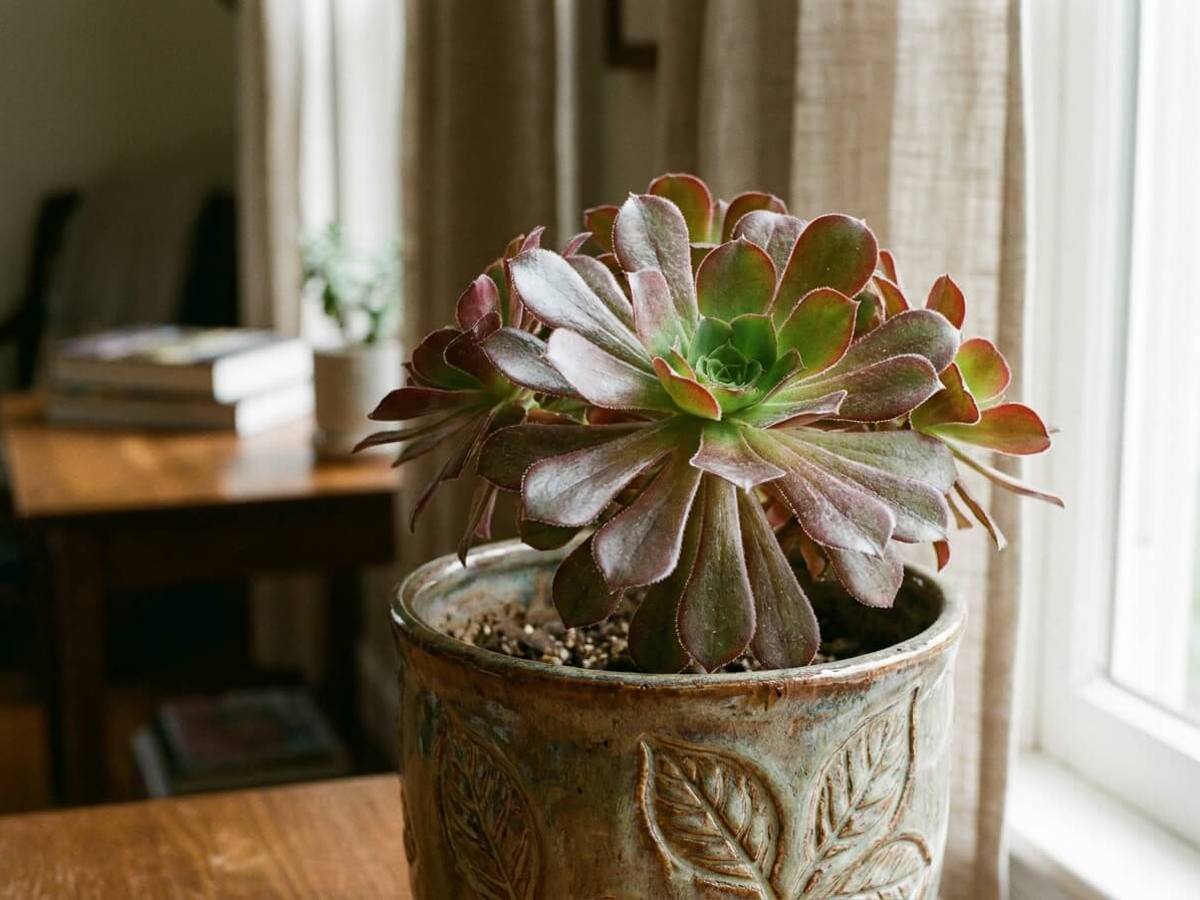
With its rosettes of fleshy, spoon-shaped leaves held aloft on bare, branching stems, Aeonium arboreum looks more like a living sculpture than a shrub. It is the backbone of gravel gardens, Mediterranean-style borders and summer patio displays, where the dark-leaved forms in particular make striking contrast against silver foliage and pale gravel. Most curiously of all, it grows through the winter and rests in the heat of summer — the reverse of almost everything else in the garden.
Growing conditions
Give aeoniums the brightest position you can offer. Full sun produces compact rosettes and, in the purple cultivars, the deepest colour; in shade the leaves stretch, the stems become lanky and dark forms fade back towards green. In regions with ferocious summer heat, light midday shade prevents scorching of the leaf tips.
Drainage is non-negotiable. Use a gritty, free-draining compost — roughly two parts loam-based compost to one part horticultural grit or perlite — or a sandy, stony garden soil. A neutral to slightly alkaline pH suits them, and poor soil gives sturdier growth than rich soil ever will.
These are frost-tender plants from the Canary Islands. Outdoors they are only reliable in frost-free coastal and Mediterranean gardens; elsewhere grow them in pots and move them under glass once night temperatures fall below about 5 °C.
How to plant Aeonium
Plant or pot on in early spring, as the growing season gathers pace and roots establish quickly. Avoid planting during the summer rest period, when damaged roots are slow to recover.
Space plants 45–60 cm apart so each branching head has room to spread without shading its neighbour.
Set the stem at the same depth it sat previously, keeping the lowest leaves clear of the soil surface to prevent rot.
Fork plenty of grit, sharp sand or fine gravel into heavy ground, or plant on a raised mound or in a gravel bed.
Water in lightly rather than soaking, then wait until the compost has nearly dried out before watering again.
Propagate from stem cuttings: sever a rosette with 5–10 cm of stem, let the cut callus in a dry, shaded spot for three to seven days, then insert into gritty compost.
Aeonium arboreum displayed as a houseplant in a home interior
Care through the seasons
Spring: This is peak growing time. Water whenever the top few centimetres of compost dry out, and feed monthly with a half-strength balanced liquid feed or a cactus fertiliser. Remove the spent flower spike and its dead rosette once the display fades, cutting back to a healthy side branch.
Summer: Expect growth to slow or stop as temperatures climb and rosettes to shrink into tight, cabbage-like buds. Water sparingly — perhaps once every two to three weeks for container plants — and withhold feed altogether. Shade cloth or a position in dappled light helps plants in hot inland gardens.
Autumn: As temperatures ease, growth resumes and rosettes open out again; gradually increase watering. It is an excellent moment to take cuttings from leggy stems and to reshape plants that have become top-heavy. Move containers under cover before the first frost.
Winter: Under glass or on a bright windowsill at 7–12 °C, plants continue slow growth and need only occasional watering. Keep the compost barely moist and the atmosphere airy to avoid stem rot.
Best varieties to grow
A handful of cultivars dominate gardens, chosen mainly for leaf colour and habit.
Aeonium ‘Zwartkop’ (also sold as ‘Schwarzkopf’) — near-black rosettes on tall stems; holder of the RHS Award of Garden Merit and the classic choice for dramatic contrast.
Aeonium arboreum var. atropurpureum — deep bronze-purple foliage that greens in shade, a little more vigorous and branching than ‘Zwartkop’.
Aeonium arboreum ‘Luteovariegatum’ — green rosettes edged and splashed creamy yellow, often flushing pink at the margins in strong light.
Aeonium arboreum var. holochrysum — bright apple-green rosettes and a tall, well-branched frame; the most forgiving of lower light.
Pests, diseases and common problems
Vine weevil: Larvae eat the roots, causing plants to wilt or topple despite moist compost. Drench pots with nematodes (Steinernema kraussei) in early autumn and repot into fresh compost, inspecting the rootball.
Mealybugs: White, cottony clusters hide in the heart of rosettes and along stems, leaving sticky residue. Dab colonies with a cotton bud dipped in alcohol-based insecticidal soap and repeat weekly until clear.
Stem and root rot: Blackened, soft stem bases follow overwatering or cold, wet winter conditions. Cut back to firm, clean tissue, let the cutting callus and re-root it, and water far less at temperatures below 12 °C.