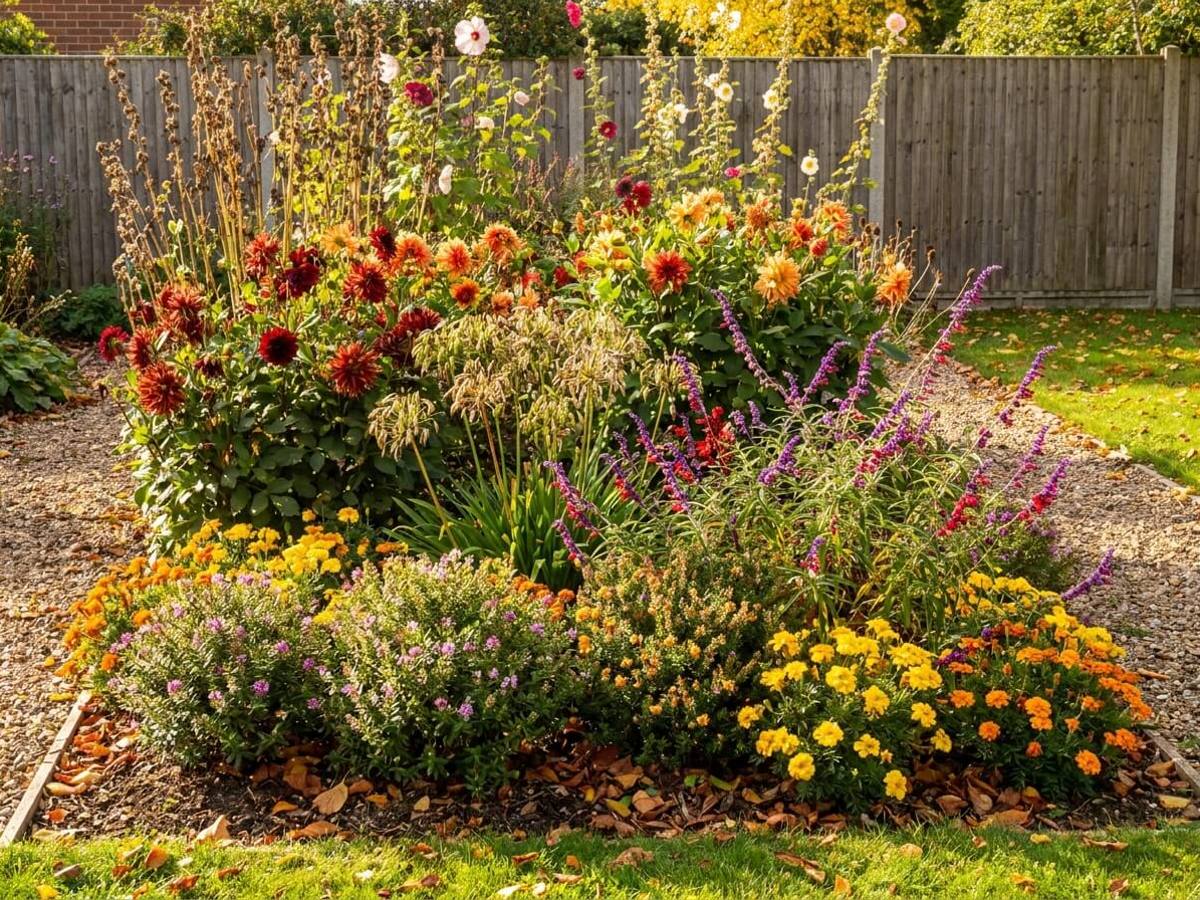
A bed in full sun, backed by a wall or a fence and open to the sky from mid-morning onwards, bakes hard by August and often runs out of colour just as the light turns golden. The soil dries fast, the heat lingers, and anything that peaked in June looks tired by September. A good autumn scheme here leans on plants that hold their nerve in dry heat and save their best for the last warm weeks, layered from tall and woody at the back to low and generous at the front.
From back to front: Hibiscus, Hollyhock, Dahlia, Lily of the Nile, Penstemon, Hebe, Marigold.
Use Hibiscus as the backbone of the bed: an upright, slow-growing shrub that carries wide, flat flowers from late summer well into autumn, long after most shrubs have finished. Its bare lower stems are no problem, because everything in front of it is there to hide them. It casts only light shade, so the perennials below still get the sun they need.
Hollyhock gives the vertical line that a flat bed badly needs, with flower spikes opening from the bottom up and still throwing out blooms at the tip in early autumn. Set it against the wall or fence, where the stems get support and shelter from wind. Its narrow footprint lets it slot between the woody shrubs without crowding them.
Dahlia is the engine of the autumn display, flowering harder in September and October than it did in July, provided you keep cutting the spent heads off. The dense, dark foliage fills the gap between the tall shrubs behind and the lower perennials in front. Plant it in groups rather than singly, so the colour reads as a block from a distance.
Lily of the Nile brings rounded flower heads on clean, leafless stalks, and its strap-shaped leaves make a strong contrast with the cut foliage of its neighbours. It thrives on heat and poor drainage is its only real enemy, so this sunny bed suits it well. Leave the seed heads standing once flowering ends — they hold their shape into autumn and catch low light beautifully.
Penstemon flowers in loose spires of tubular bells from midsummer until the first frosts, which makes it one of the most reliable autumn performers in a dry, sunny spot. It is airy enough to sit in front of the heavier Dahlia without looking blocky. Deadhead it regularly and it will keep producing side shoots right through the season.
Hebe is the evergreen anchor near the front: a tidy dome of foliage that keeps the bed furnished through winter, when the Dahlia and Penstemon have been cut back. Several types flower late, adding short spikes among the leaves in autumn. Placed in two or three spots along the edge, it stops the scheme collapsing into bare soil once the frosts arrive.
Marigold finishes the front edge with hot orange and yellow that holds until the first hard frost. It tolerates heat and drought better than almost anything else you could use here, and it spills gently over the path or lawn edge to soften the line. Sown or planted in a continuous ribbon, it ties the whole scheme together visually.
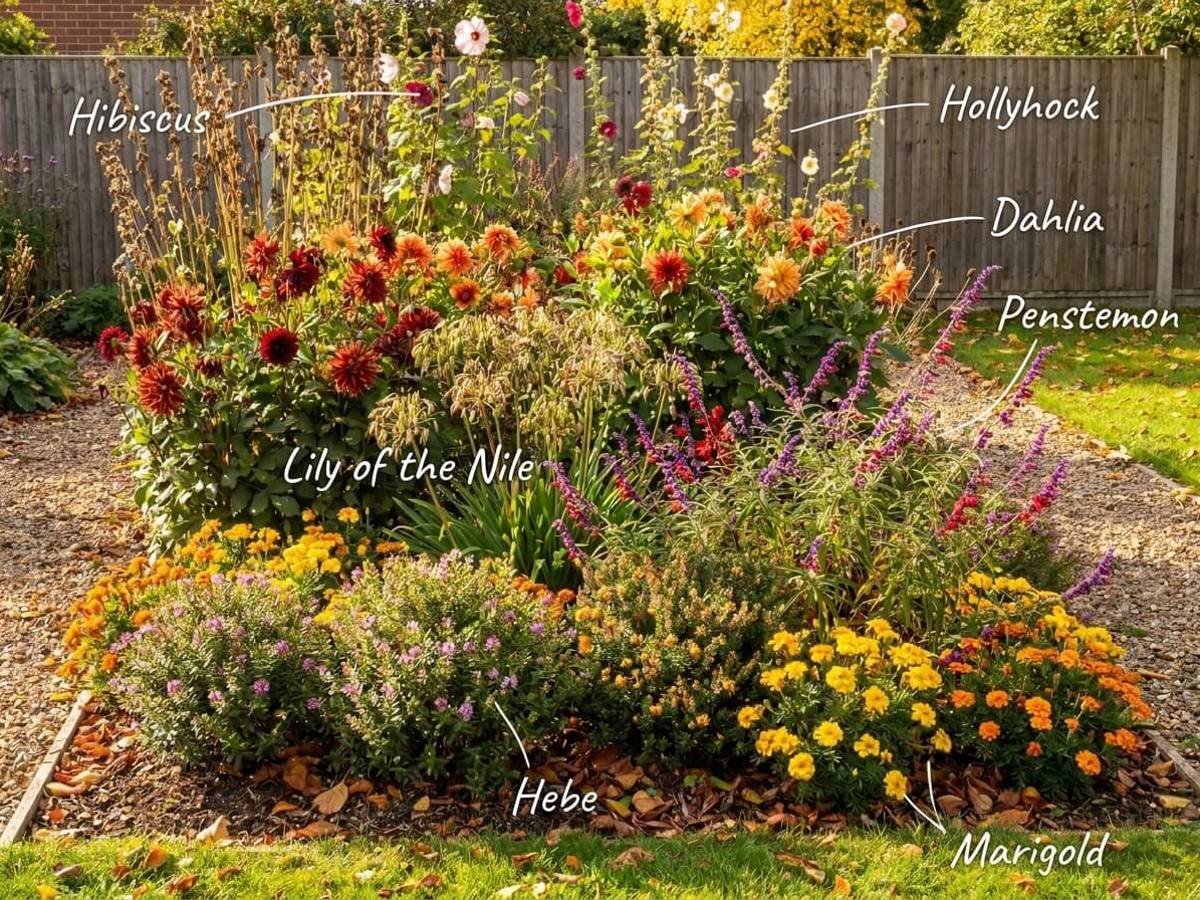
Work in four bands. Set Hibiscus at the back, one plant every 1.5 m, with clumps of three Hollyhock slotted into the gaps between them against the wall. In front, plant Dahlia in groups of three, roughly 60 cm apart within each group, and place Lily of the Nile in drifts of five on either side so the strap leaves frame the Dahlia blocks. Then run Penstemon in groups of three at 40 cm spacing along the middle front, break the edge with three Hebe spaced about 1 m apart, and fill every remaining pocket at the front with Marigold at 25 cm.
In spring the bed is mostly green: Hebe already full, Lily of the Nile pushing up fresh leaves, Hollyhock building its rosettes and Hibiscus leafing out late. Summer brings the first Hollyhock spikes, the Lily of the Nile heads and the opening Penstemon, with Dahlia and Marigold starting to warm up. Autumn is the peak — Hibiscus, Dahlia, Penstemon and Marigold all flowering at once over the seed heads of Lily of the Nile. In winter, once the perennials are cut back, the Hebe domes and the bare framework of Hibiscus carry the bed until spring.