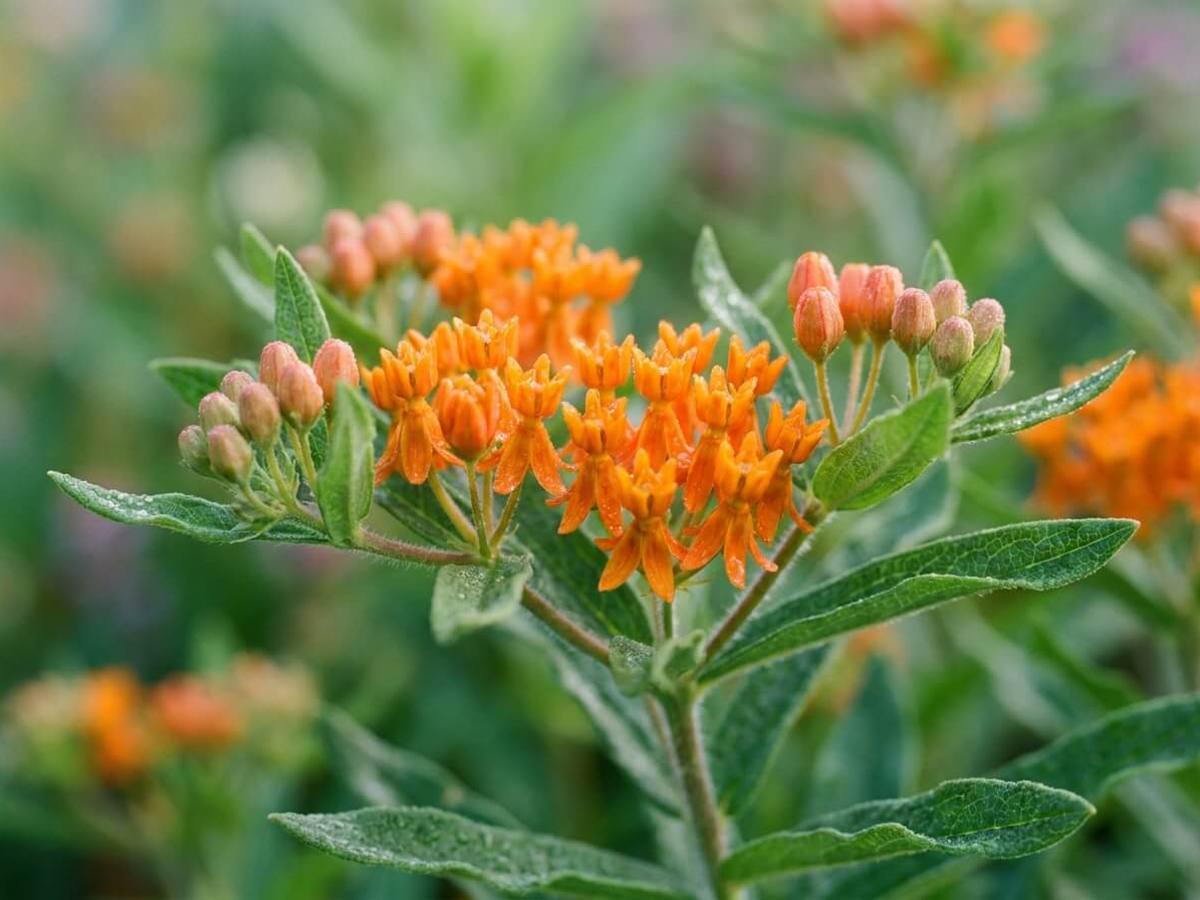
With its clusters of flat-topped, blazing orange flowers held above narrow, dark green leaves, Asclepias tuberosa is one of the most striking hardy perennials for a hot, dry border. It is a magnet for bees, hoverflies and butterflies from midsummer onwards, and follows its flowers with slender, upright seed pods that split to release silky-tailed seeds. Unlike most milkweeds, it forms a deep woody taproot rather than running roots — so it stays exactly where you put it.
Growing conditions
Give butterfly weed the sunniest, most open spot you have — a minimum of six hours of direct sun, and ideally all day. In shade or crowded amongst taller neighbours it flops, flowers sparsely and rarely persists beyond a season or two. It copes well with wind and reflected heat from paving or gravel.
Drainage matters far more than fertility. Sandy, stony, gritty or chalky soils suit it perfectly, and a slightly acid to slightly alkaline pH (roughly 6.0–7.5) is fine. Heavy, wet clay is the single biggest killer, so on such soils dig in plenty of horticultural grit or plant on a raised mound or slope.
Once established, it is exceptionally drought-tolerant and needs no summer irrigation in most temperate gardens. In cooler, wetter maritime climates a gravel mulch and a south-facing aspect will make all the difference to winter survival.
How to plant Asclepias
Plant container-grown specimens in mid to late spring, once the soil has warmed and the risk of waterlogging has passed. Spring planting gives the taproot a full growing season to establish before winter; autumn planting on cold, damp soils frequently fails.
Spacing: set plants 40–45 cm apart so air circulates freely around the stems and each clump has room to build a broad, self-supporting crown.
Depth: position the crown level with the surrounding soil — never buried, as a sunken crown collects water and rots.
Soil preparation: fork the base of the hole deeply to let the taproot descend, and mix in grit rather than manure or compost; rich soil produces soft, floppy growth.
Watering in: water thoroughly once at planting, then only during prolonged dry spells in the first summer. Keep the crown itself dry.
Propagation: raise from seed after 4 weeks of cold, moist stratification at about 4 °C, or take 8 cm root cuttings in early spring. Avoid dividing mature plants — the taproot resents disturbance.
Asclepias tuberosa growing in a naturalistic garden border
Care through the seasons
Spring: Butterfly weed is notoriously late to break dormancy, often waiting until mid or even late May, so mark the position clearly in autumn to avoid hoeing it out. Clear any smothering leaf litter from the crown, but skip the fertiliser — feeding encourages weak, sappy stems. A light top-dressing of grit around the neck helps keep it dry.
Summer: Established clumps need virtually no watering; container plants are the exception and should be watered when the compost dries out. Deadheading spent umbels can trigger a second, lighter flush in late summer, though leaving a few pods gives handsome autumn interest. Never stake — if it flops, the site is too shady or too rich.
Autumn: Collect seed once the pods turn papery brown and begin to split, before the silk carries it away. Leave the stems standing until they have fully withered, then cut back to about 5 cm. Avoid heavy organic mulches over the crown, which trap moisture and promote rot.
Winter: The plant dies back completely and disappears until late spring, which is entirely normal. No protection is required in most gardens, as cold is far less of a threat than winter wet.
Best varieties to grow
The wild species is superb, but a handful of selections offer different colours and habits.
Asclepias tuberosa (species) — the classic burnt-orange form, reliably robust and the best choice for a naturalistic prairie planting; holds an RHS Award of Garden Merit.
‘Hello Yellow’ — clear, soft golden-yellow umbels on compact 45–60 cm stems, excellent with blue salvias and grasses.
‘Gay Butterflies’ — a seed-raised mixture producing plants in orange, red and yellow, ideal for a lively, informal drift.
‘Blonde Bombshell’ — a bright, uniform lemon-yellow selection with sturdy stems and a long midsummer display.
Pests, diseases and common problems
Oleander aphid (Aphis nerii): dense colonies of bright yellow-orange aphids on stem tips and buds. Dislodge them with a firm jet of water or squash by hand, and leave ladybirds and hoverfly larvae to finish the job — avoid sprays that harm butterfly larvae.
Crown and root rot: stems blacken at the base and the plant collapses, almost always on wet or compacted soil. There is no cure, so prevent it by improving drainage, planting on a mound and mulching with grit rather than compost.
Failure to reappear in spring: gardeners routinely assume the plant is dead by April and dig it out or plant over it. Wait until at least late May before giving up, and always label the crown position in autumn.