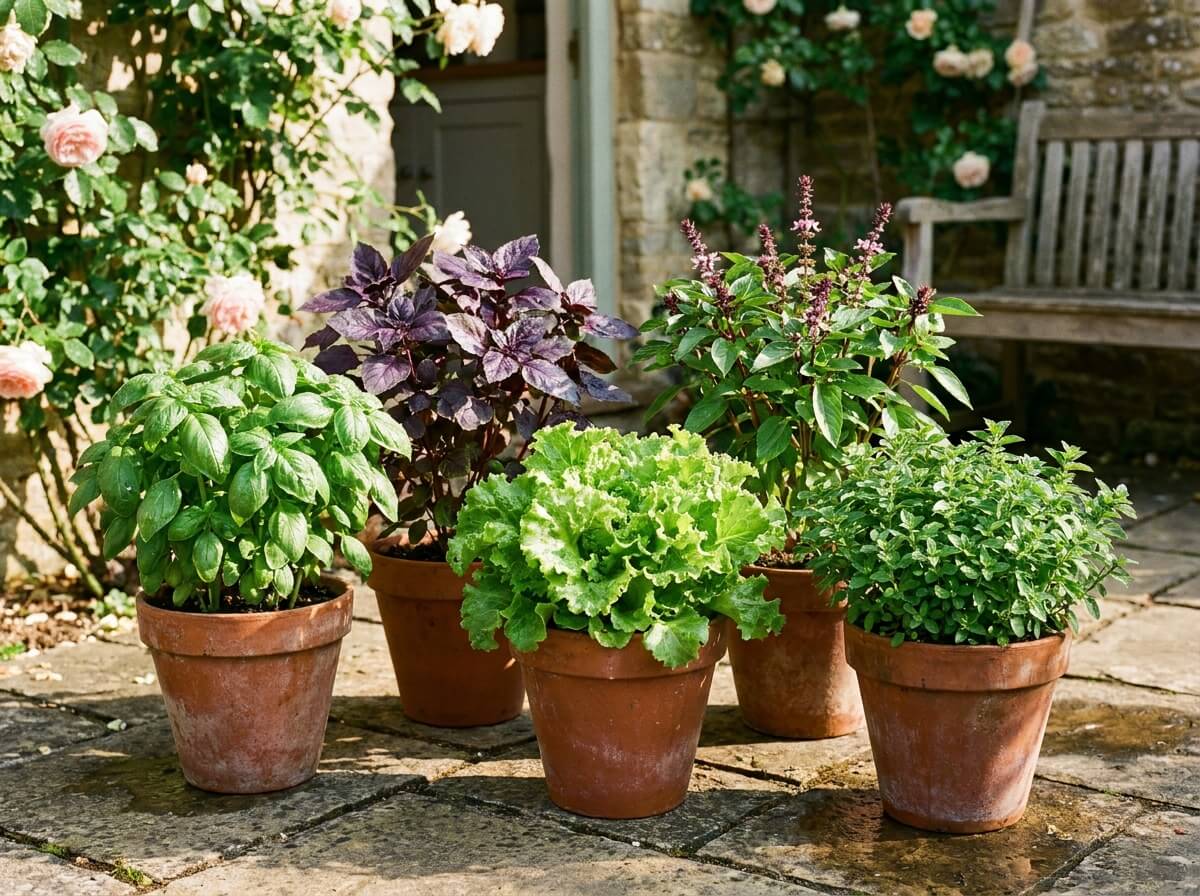
Mid-summer is the single best moment of the year to shoot up basil in a container. The combination of long days and sustained heat above 25°C pushes essential oil production to its absolute maximum — that sharp, almost peppery warmth when you brush a leaf at noon is the plant performing at full capacity. Most gardeners shoot up one variety. Growing four or five in the same space transforms a window ledge into something genuinely spectacular.
Basil is a tropical annual from South Asia and Central Africa. It evolved under punishing sun and warm nights, and its leaf chemistry reflects that origin.
The volatile compounds responsible for flavour and fragrance — chiefly eugenol, linalool, and estragole — are synthesised most rapidly when soil temperature stays above 18°C overnight and air temperature peaks between 25–30°C during the day.
Below those thresholds, which is exactly what spring basil faces, the same plant produces noticeably less intense oil. Rub a leaf from a pot that has been on a warm south-facing terrace for three weeks in peak summer.
Then rub one from a plant that was grown under a cloche in late spring. The difference is night and day.
And the really useful news: containers amplify this effect. Terracotta pots absorb heat through the afternoon and radiate it back through the night, keeping root temperature elevated even when evenings cool. The RHS confirms that basil in containers with good drainage and full sun outperforms in-ground plantings in most UK summers precisely for this reason.
Standard sweet basil (*Ocimum basilicum*) is the baseline — large, glossy leaves, classic Italian flavour, extremely reliable in a pot. Shoot it up in a 25cm container with good-quality multipurpose compost and it will produce harvest after harvest from now through early autumn if you pinch it properly.
But the varieties that will genuinely stop visitors in their tracks are these:
Shoot up all five in a row and the visual contrast alone is striking. The fragrance when you water them on a warm evening — that warm green wave that rises from the pots as moisture hits the leaves — is something hard to describe and completely worth experiencing. Worth it.
Pinch every flower spike the moment it emerges. This is non-negotiable. Once basil commits to flowering, leaf oil content drops sharply within 5–7 days as the plant redirects energy into seed production. Check daily — flower buds in midsummer heat can appear overnight.
Watering: basil in containers in summer heat needs water every 2 days at minimum. Water deeply at the base — not on the leaves, ever — until water drains freely from the bottom.
Wet foliage in summer triggers black spotting fast, and there is no recovering a badly spotted plant.
Feed every 10 days with a diluted liquid seaweed fertiliser (half the recommended dose). Never use a high-nitrogen feed — it produces lush, pale growth that tastes of almost nothing.
The goal is not maximum leaf mass. The goal is maximum oil.
Harvest no more than one-third of any plant at a single session. Cut just above a leaf node, leaving at least two pairs of leaves below the cut. The plant will branch at that point within 8–10 days. See the succession planting guide for timing a rolling sow of fresh plants every 3 weeks — the most reliable way to keep harvests continuous right through to the first frost.
Yellow lower leaves almost always mean overwatering or a pot sitting in a saucer of standing water. Empty saucers after every watering in summer — basil roots rot properly fast in waterlogged compost.
Pale, yellowish new growth with green veins suggests an issue of iron deficiency — common in pots where compost has been exhausted. A single dose of chelated iron, available at most garden centres, corrects this within two weeks. And it gets it sorted.
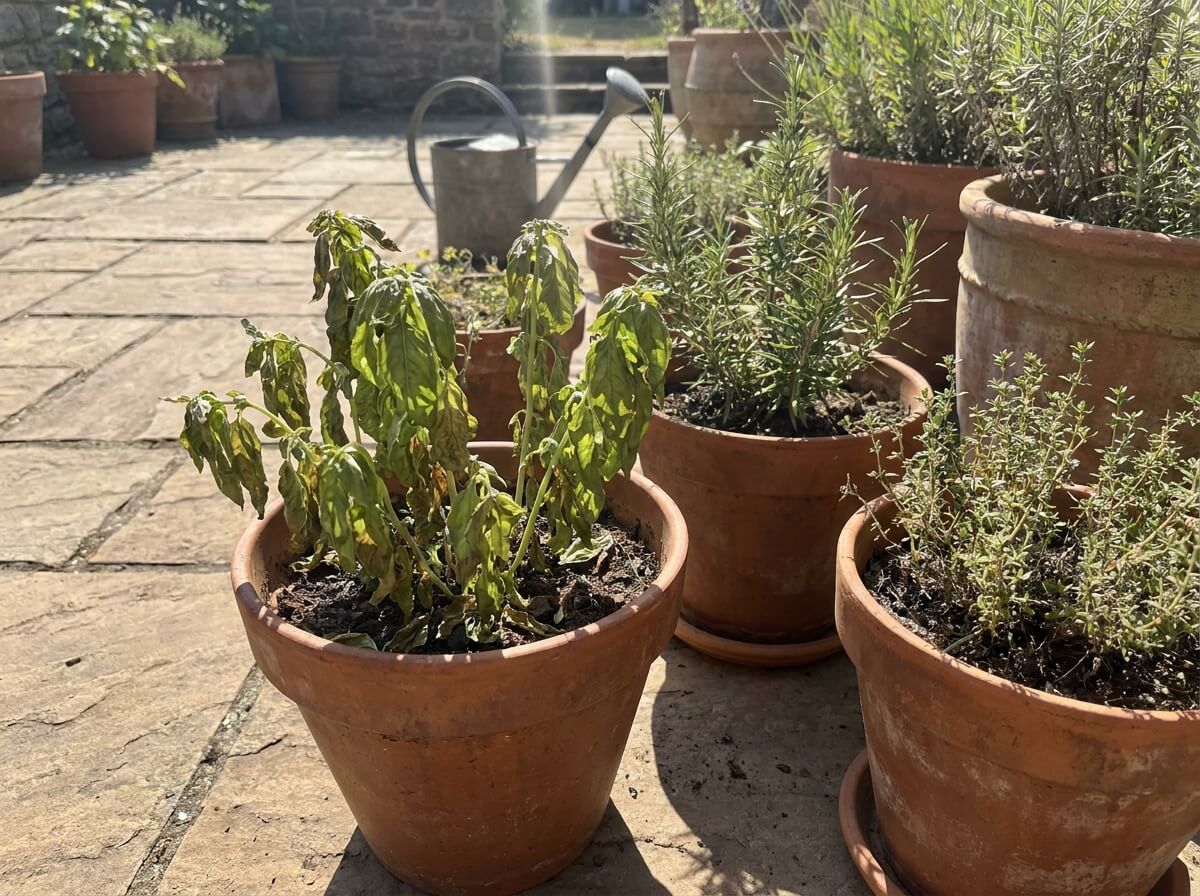
Wilting at midday despite moist soil is heat stress, not drought. Move the pot to a position that receives slight shade between 1pm and 3pm. Full morning sun with afternoon shelter is actually ideal for flavour and plant health in prolonged heatwaves. The science of deep watering and mulching applies directly to pots too — a thin layer of gravel mulch on the surface of a basil pot does wonders for reducing evaporation by around 30%.
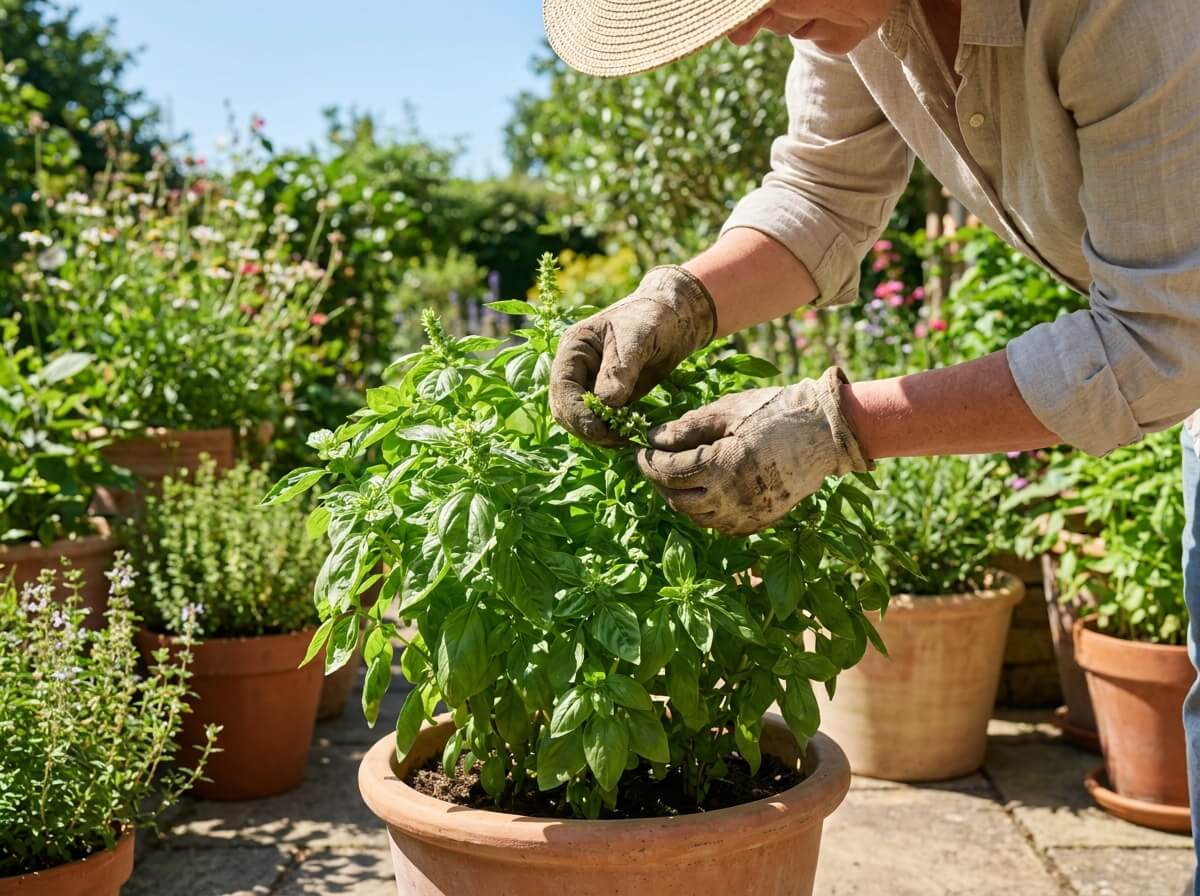
Smart tip: Always harvest basil in the morning — essential oil concentration peaks before noon and drops through the afternoon.
Yes, but only if the pot is at least 40cm wide. Basil roots compete aggressively and cramped plants bolt faster.
One variety per 25cm pot is cleaner and more productive.
Water landed on the leaves in direct sun or the pot has poor drainage causing root rot. Water at the base only, and always in the morning rather than midday or evening.
Not at all. A pinch of seed in a small pot of moist compost germinates in 5–7 days in current temperatures.
Plants will be harvest-ready within 5 weeks and will produce until the first frost.
Genovese has broader, flatter leaves with a higher eugenol content — that is what gives authentic pesto its characteristic depth. Standard sweet basil is perfectly good but noticeably lighter in flavour.