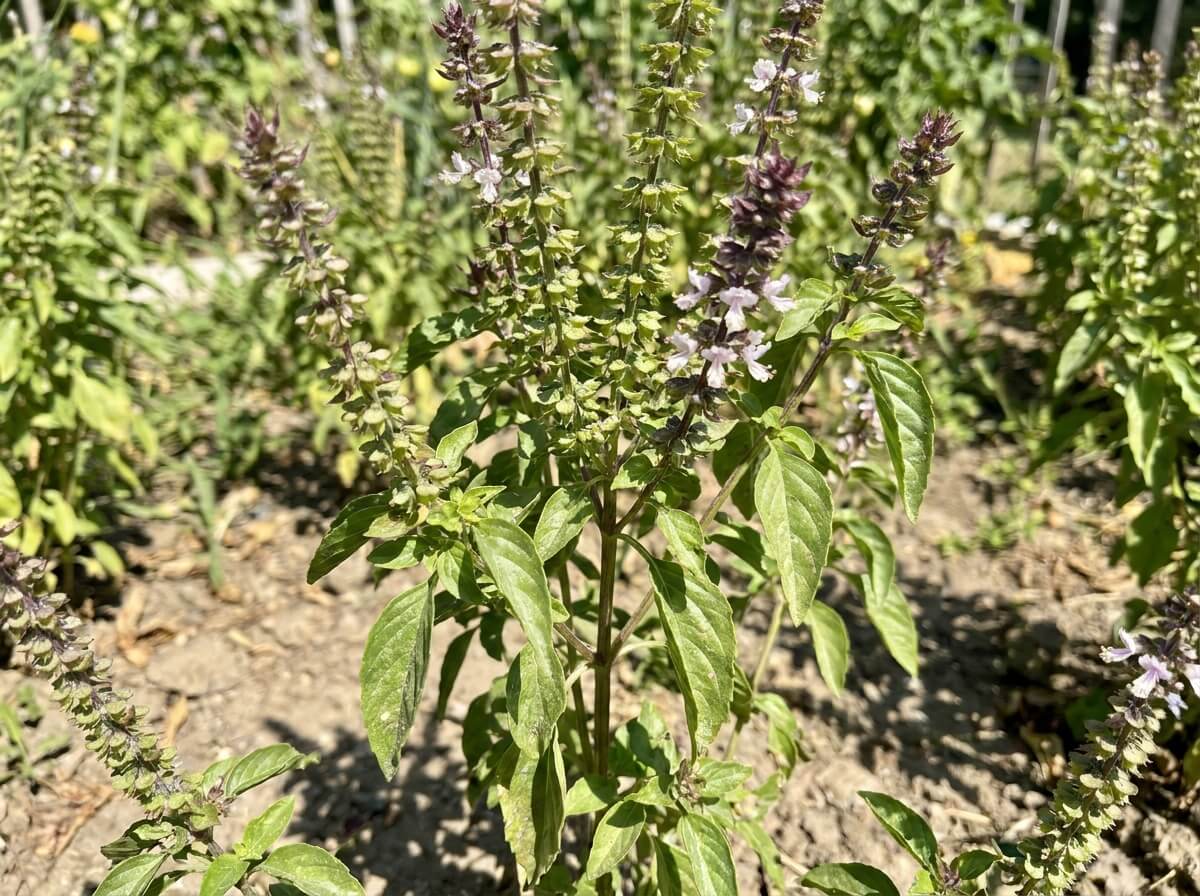
Your basil has shot upward. Tiny white flower buds are forming at each growing tip. This is bolting. It means the clock is running out on your harvest. Once those flowers open, the leaves turn bitter. Essential oil production crashes. And the plant stops putting out new growth. Pull those spikes off today, not tomorrow. Your basil will rebound fast.
Basil is a tropical annual with one biological mission: survive long enough to set seed. When temperatures climb and day length peaks, the plant reads those signals as, ‘the season is ending — reproduce now.’ It happens shockingly fast. That is the bang on signal for the plant to reproduce.
A sustained run of warm nights above 18°C (65°F) can trigger bolting in as little as 7–10 days.
It has nothing to do with substandard soil or dodgy care. Even a perfectly fed, well-watered plant will bolt in summer heat.
The trigger is hormonal — specifically a surge in florigen, the protein that propels flowering. No amount of extra feeding stops it once the signal fires.
Only physical intervention does.
Varieties matter too. Standard sweet basil (Ocimum basilicum) is highly susceptible. Lemon basil and Thai basil bolt even faster. So, if you want a variety that fights back, look for RHS Award of Garden Merit cultivars or the Everleaf series, deliberately engineered for bolt resistance. That is your cultivation sorted.
The deterioration is swift and irreversible on that stem.
A neglected bolting plant can go from lush and fragrant to spent and woody in under three weeks. And once the main stem has flowered fully, no amount of pinching rescues that stem.
You can still trigger new growth from side shoots — but you will have lost weeks of prime harvest.
Go out and look at your basil. If you see any stem that has elongated into a thin spike topped with tiny clustered buds — even ones not yet open — that is your target. Pull it off with your fingers back to just above the nearest pair of healthy leaves. Not just the tip. The whole spike, right back to the node. Get this done properly.
Yes, it is fiddly. Worth it.
Here is the full routine that keeps basil producing until autumn:
If your basil already has open flowers, harvest every leaf you can right now, then pinch hard. The plant often regenerates from lower side shoots within 10–14 days. University of Minnesota Extension confirms that repeated pinching does wonders for the productive life of sweet basil, extending it by 6–8 weeks beyond what an unpinched plant produces.
Herbs behave differently under summer stress. If your thyme is also flowering right now, the same principle applies. The fix is almost identical.
Bolting is not the only summer issue to watch for. While you are out there pinching, check for these:
Southern Hemisphere gardeners: this applies to your December and January, when your summer heat peaks and bolting pressure is highest.
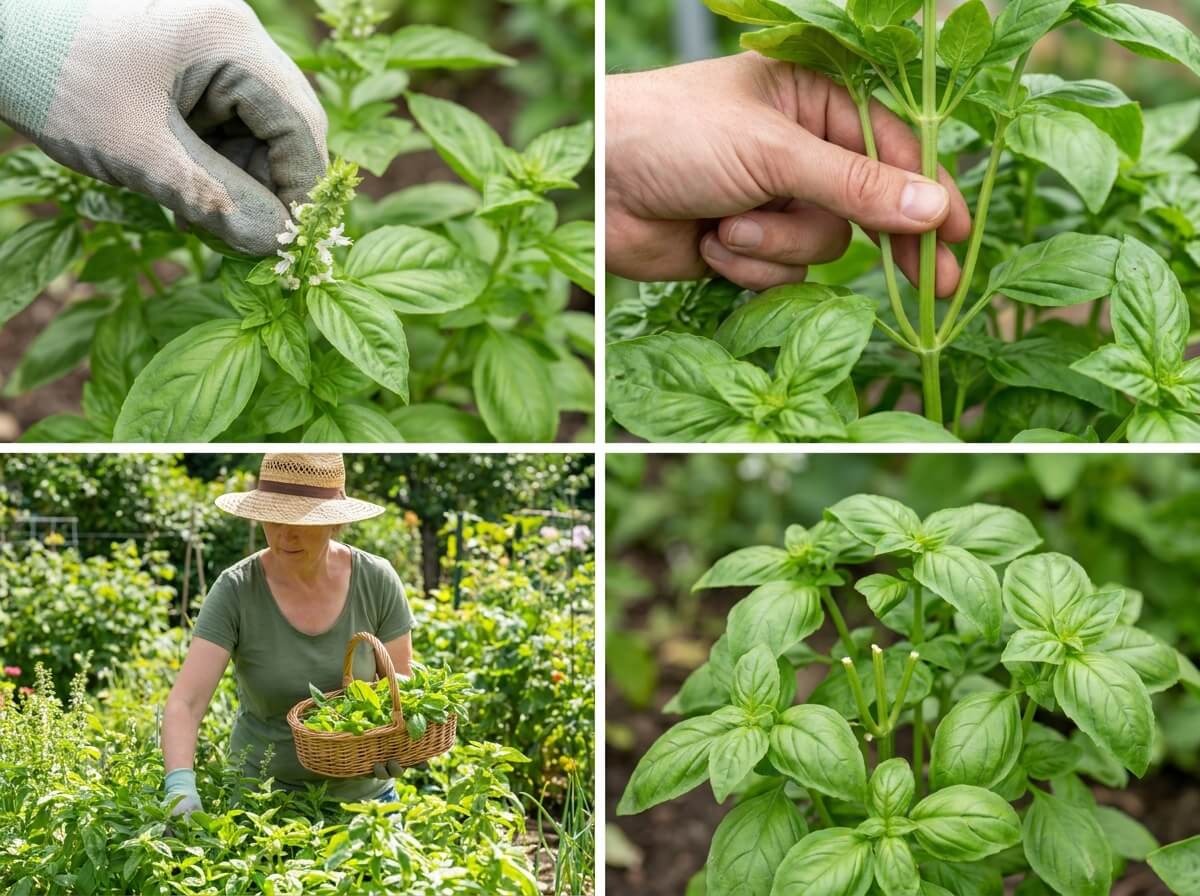
Smart tip: Pinch basil every 3–4 days in summer heat — miss a fortnight and you will be chasing flowers the whole season.
Yes — the flowers are edible and have a mild, slightly spicy basil flavour. Scatter them over salads or pasta.
But removing them promptly keeps the leaves far tastier.
Not necessarily. Cut it back hard to the lowest set of healthy leaves. Water well. Give it a half-strength liquid feed.
New side shoots often appear within 10–14 days, especially if the roots are still healthy.
Only if you have at least two other plants actively producing leaves. One sacrificed plant for seed collection is fine. But do not let them all bolt at once or you will have nothing to cook with.
Every 2 days for pot-grown basil. Every 3 days in the ground. Always at the base, never overhead. Check soil moisture at 3cm depth. If it is dry there, water immediately.