Most kitchen gardens follow the same frustrating pattern: a glut of lettuce in early summer, a gap of bare soil in midsummer, and the quiet realisation that the season has slipped by. Succession planting is the method that breaks that cycle entirely.
Sow little. Sow often. Your kitchen garden becomes a machine that delivers something harvestable almost every week from late spring right through to the first frosts.
Succession planting is not the same as companion planting; it is not about cramming more plants into a small space. It is about staggering your sowing dates so that crops reach maturity at different times. This gives a steady trickle of harvests. No more enormous piles.
There are two versions of this, and they serve different purposes:
Both approaches work. The best kitchen gardens use both simultaneously.
One non-negotiable rule: no bed should sit empty for more than four or five days in summer. Not a chance. Bare soil loses moisture, invites weeds, and wastes the longest, warmest days of the growing year.
Not every vegetable suits succession sowing. Slow crops like parsnips, celeriac, and winter squash are sown once, grown once, harvested once.
But a wide range of fast-turnaround crops are properly built for this approach.
The most reliable succession crops for summer sowing:
For a continuous supply of French beans specifically, check out the complete French bean growing guide — it covers the exact window for successive summer sowings.
The instinct is to sow in big batches. Resist it.
A full packet of lettuce sown on the same day will give you 30 heads maturing within 72 hours of each other. This is not abundance. It is a proper issue.
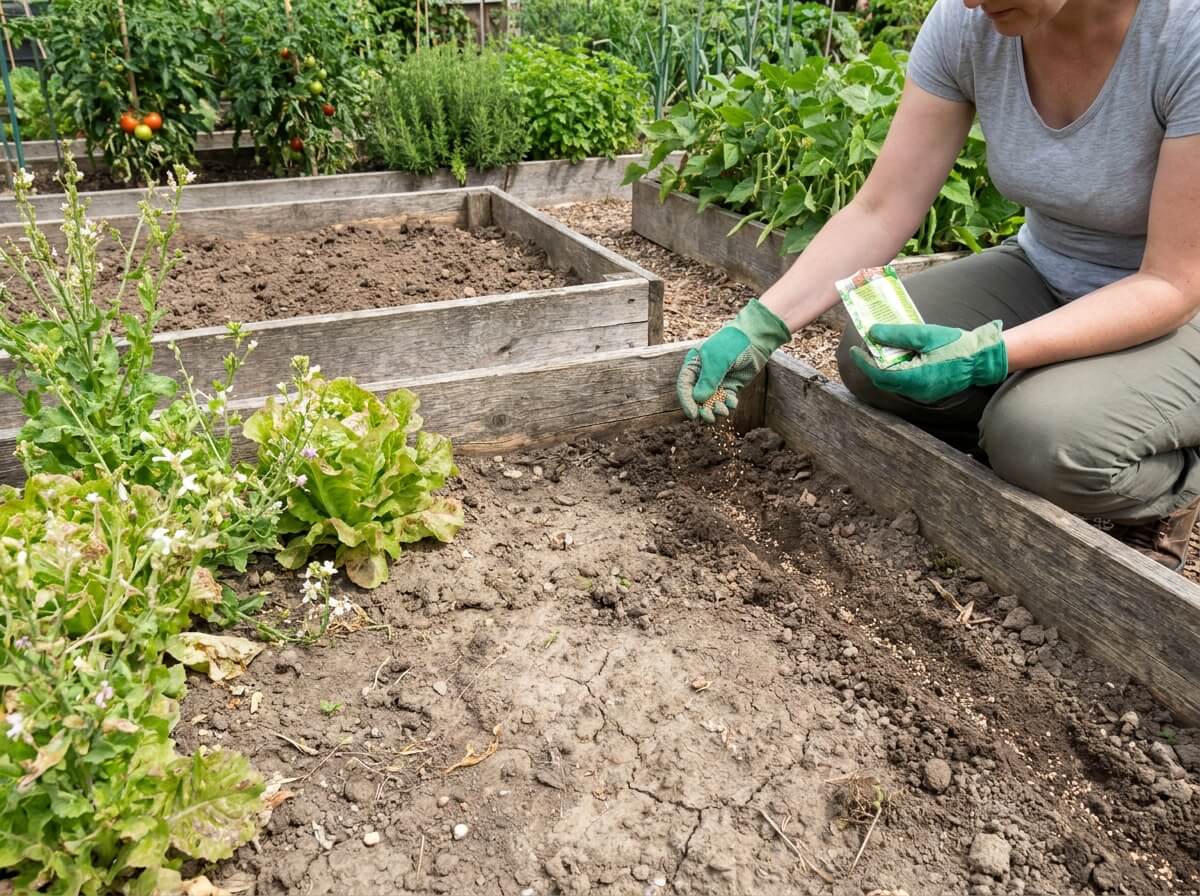
The thing is, adopt this instead: the 14-day rule. Every fortnight, sow one short row (30–40cm is enough for two people) of whichever fast crop you are running low on. Write the sowing date directly on a lolly stick or label pushed into the soil. Not in a notebook you will lose. In the soil. Visible every time you walk past.
Yes, it feels fiddly to sow such a small amount. Worth it. The difference between a continuous harvest and a midsummer gap is exactly this discipline.
For root crops like beetroot, stretch the interval to 21 days. So, for crops that falter in peak heat — spinach, coriander — skip the hottest 4–6 weeks entirely. Resume sowing in late summer. Nights must cool below 18°C again.
The moment a crop is finished — garlic lifted, a lettuce row bolted, early peas pulled — that ground is an opportunity. The window between “harvested” and “resown” should be measured in hours, not days.
The sequence is straightforward:
One non-negotiable rule here: do not follow a crop with the same plant family. Do not put salad after salad. And do not sow turnips where you just shot up rocket. Rotating families — even informally within a single season — slows the build-up of soil-borne diseases and clubroot in brassicas. A quick look at the principles of crop rotation will sharpen your thinking on this.
Midsummer sowing has constraints that early spring does not. The days are long, heat is high, and germination of cool-season crops becomes unreliable above 25°C soil temperature.
Lettuce, for example, goes into thermodormancy above 20°C — it simply refuses to germinate, and no amount of watering will fix it.
The workaround is simple: pre-germinate lettuce seed in a damp paper towel inside the fridge (12–15°C) for 48 hours before sowing. Germination rate jumps dramatically.
Alternatively, switch to heat-tolerant varieties: ‘Cos’ types and ‘Batavian’ lettuces cope far better than butterhead varieties in hot summers.
What to sow directly now with confidence:
What to hold back until late summer:
Southern Hemisphere gardeners: this applies to your early winter and midwinter sowings, when the logic of what bolts in heat and what thrives is identical.
Successive sowing puts pressure on soil in a way that a single spring planting does not. The same ground is being asked to perform again and again, often in heat, with shorter recovery time between crops.
Germinating seeds need consistent moisture in the top 2–3cm of soil. In summer, that means watering the seedbed twice daily — morning and evening — until germination is visible. After that? Switch to a deep weekly soak. Provide 20 minutes at the base. Avoid frequent light sprinkles. Shallow watering in summer shoots up shallow roots. And shallow-rooted plants are the first to wilt and bolt.
Mulching between rows with 4–5cm of well-rotted compost or straw does wonders for reducing moisture loss. It also feeds the soil gently. Successive crops draw on the same ground. The natural fertiliser guide for the vegetable patch is worth reading alongside this if you are managing fertility across multiple back-to-back sowings.
The RHS guide to successional sowing and the University of Minnesota Extension both confirm that consistent soil moisture is the single biggest factor in summer germination success — more than variety choice, more than soil prep.
This is the least glamorous part of succession planting. And the most non-negotiable.
A sowing log does not need to be complicated. A notebook, a phone note, or a whiteboard in the shed works equally well.
Record:
That last column is the game-changer. When you can see that your current French bean row peaks in 18 days and the next sowing is not in yet, you sow immediately rather than that dodgy “getting round to it next weekend” idea. The log turns intention into action.
After one full season of keeping this record, you will have a personalised succession calendar for your specific garden, climate, and eating habits. No book or online chart can give you that.
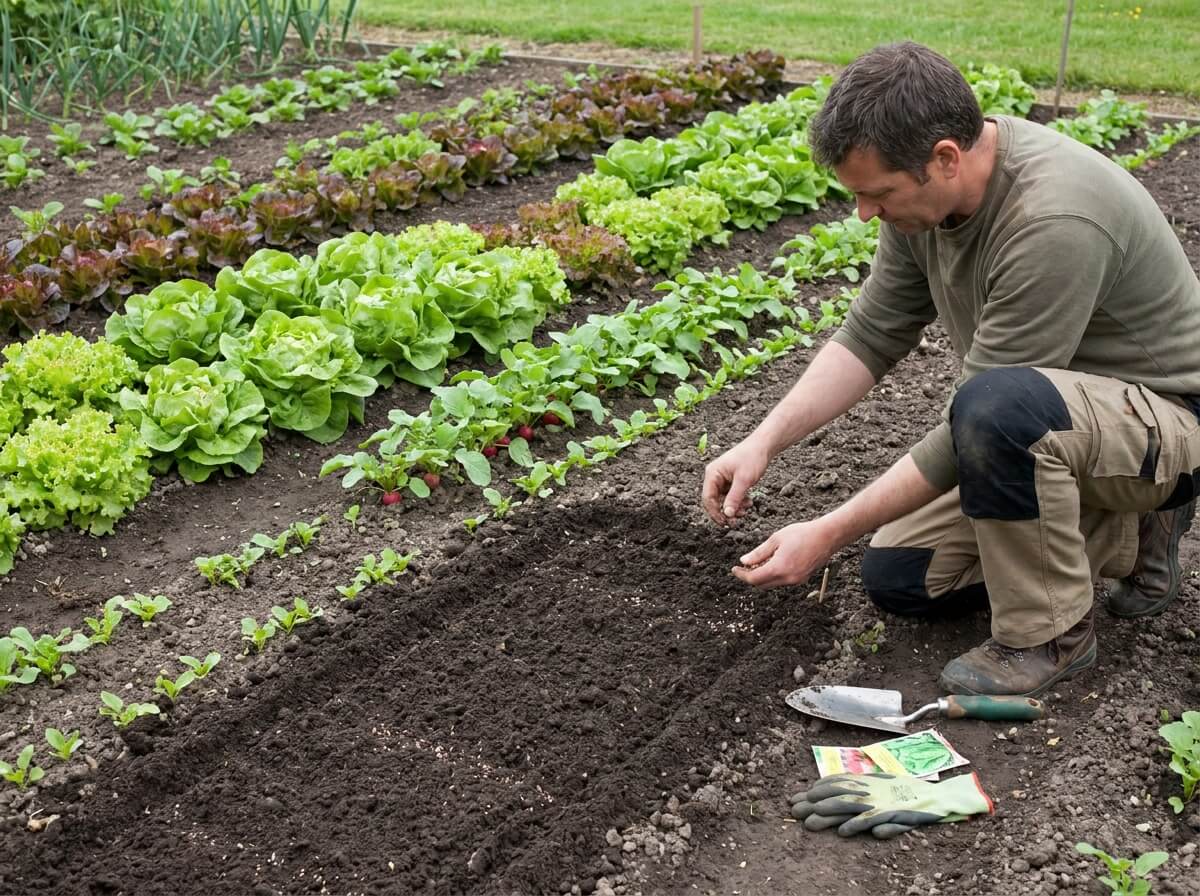
Smart tip: Sow a 30cm row every fortnight, never an entire packet at once.
No. Fast crops like radishes (25 days), dwarf French beans (55 days), and beetroot (65–70 days) all have enough season left for at least two or three more rounds before autumn frosts arrive.
Lettuce enters thermodormancy above 20°C soil temperature and refuses to sprout. Pre-germinate seeds on a damp paper towel in the fridge for 48 hours before sowing, or choose bolt-resistant varieties like ‘Little Gem’ or any Batavian type.
Sow the next batch when the current planting is roughly two-thirds of the way to harvest — not when the bed is already empty. Keeping a simple sowing log with expected harvest dates makes this automatic.
Yes, and raised beds are actually ideal — they warm up faster, drain better, and make it easy to clear and replant quickly. Refresh the top 5cm of compost between successions rather than doing a full refill each time.
Lightly fork the top 10–15cm, rake in a small amount of balanced granular fertiliser, water, and sow within 24 hours. Never leave soil bare and unwatered in summer heat — it crusts over and makes germination far harder.