Blueberries are returning to gardens across the UK, US, Canada, and Australia. Not as a mere trend. This is a long-overdue correction. Gardeners who once dismissed them as fussy specialists discover one soil secret unlocks decades of effortless, generous harvests. Get the acidity right, and a single blueberry bush will outlast most fruit trees you plant. This shrub is non-negotiable for any serious fruit garden. Period.
For decades, blueberries languished in the “too difficult” pile. Wrongly. Their dodgy reputation originated from gardeners planting them in ordinary borders, watching them yellow and stall, and ultimately giving up.
So, the truth is simpler, and more fixable, than anyone admitted.
Blueberries are ericaceous plants, cousins to heathers and rhododendrons. They demand a soil pH between 4.5 and 5.5 — genuinely acidic; certainly not “slightly acidic.” In neutral or alkaline soil, they cannot absorb iron or manganese. Leaves pale, then yellow. Fruiting slows to almost nothing. That is not a difficult plant; that is a plant in the wrong soil, plain and simple. And, frankly, that issue is completely fixable.
Once gardeners understood the fix was contained — a bag of ericaceous compost, a suitable pot, and a switch to rainwater — blueberries became one of the most satisfying fruit crops in the garden. A mature highbush variety (Vaccinium corymbosum) can yield 4–5 kg of fruit per season. From one single shrub. The RHS now specifically recommends them for container growing on patios, balconies, and even small gardens, particularly where existing soil conditions are otherwise unmovable. This works. They love it.
The soil is everything. Proper. Fill a large container — minimum 40 cm diameter — entirely with ericaceous compost.
Never mix in regular multipurpose compost. Even a small proportion pushes the pH up and defeats the entire purpose.
Watering matters more than most people properly expect. Tap water, especially in hard-water areas, carries dissolved calcium and magnesium. These gradually alkalise your growing medium. It is a slow issue.
Use only rainwater. Collect it, store it, prioritise it for your blueberries above anything else in the garden. Check the pH annually with a basic soil meter; anything creeping above 5.5 needs a proper drench of diluted sulphur chips or an ericaceous liquid feed.
Southern Hemisphere gardeners: This applies to your August–September. That is when you come out of winter dormancy and begin spring preparation.
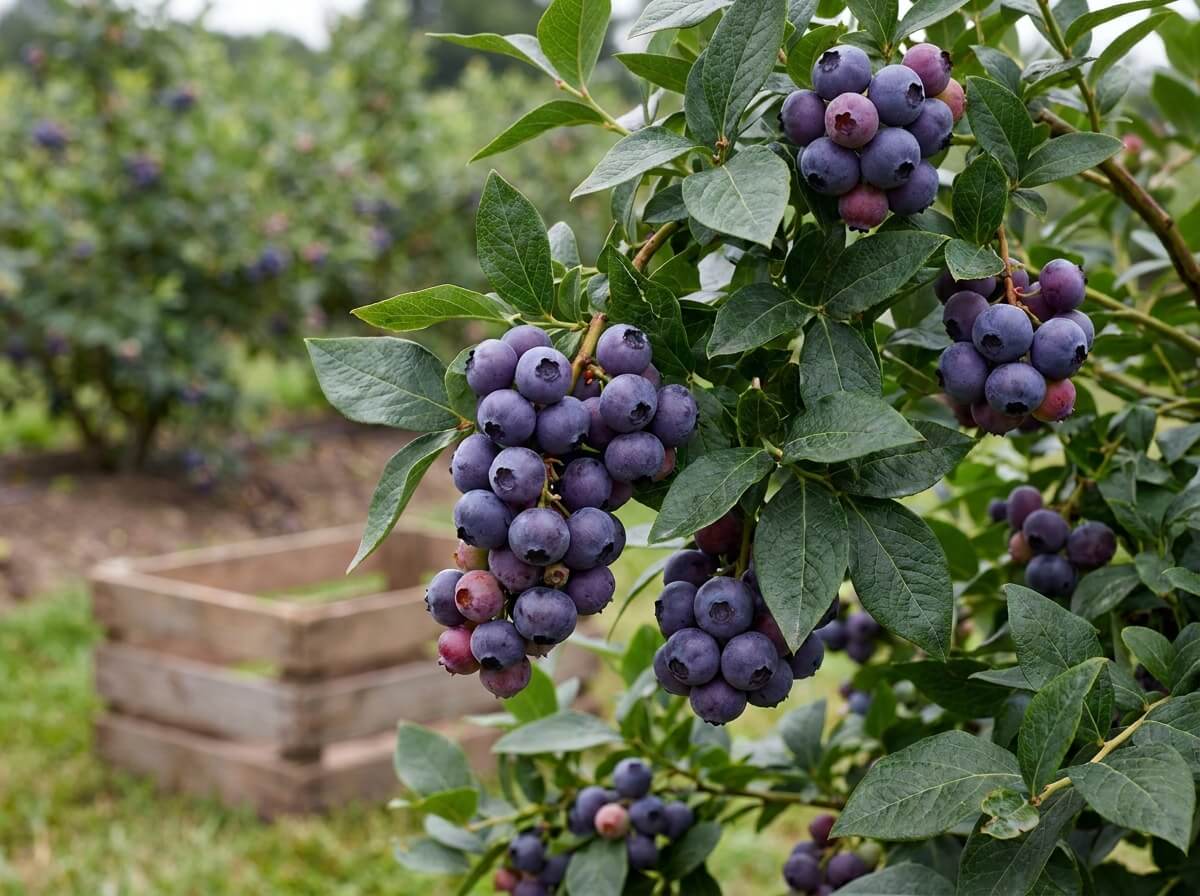
The colour lies to you. A blueberry turns blue 4–7 days before it is actually ripe. Do not trust your eyes alone.
The real signal is the starburst. That flared, five-pointed crown sits at the base of each berry. When the starburst opens fully, and the berry pulls free with zero resistance, it is at peak sugar content. Bang on, every time.
Taste one first thing in the morning, before the sun warms the fruit; the flavour is sharpest then, faintly cool, with that dusty bloom on the skin that disappears the moment you handle it. It is pure joy.
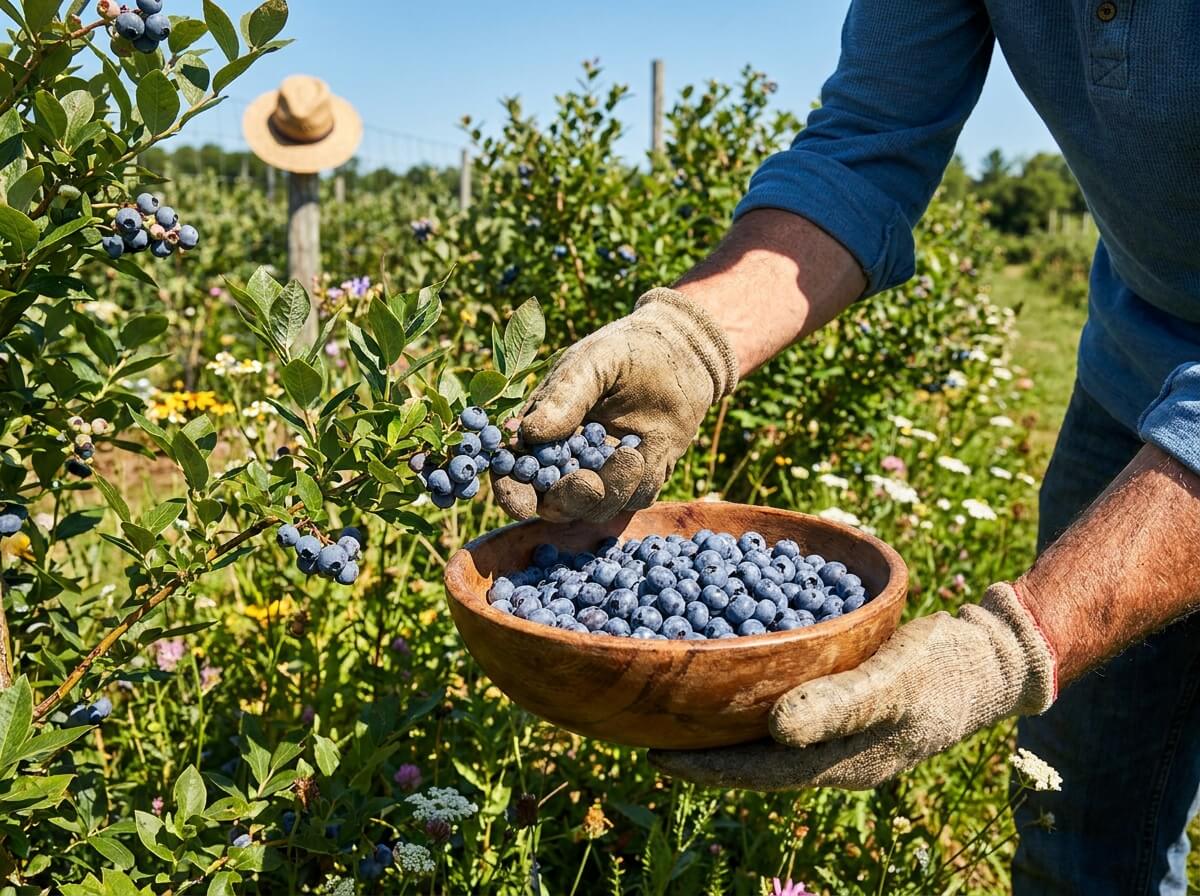
Do not harvest in one sweep. Pick the fully ripe berries every 4–5 days and leave the rest; blueberries on the same cluster ripen over a 2–3 week window. Rushing a full harvest means a third of your fruit is underripe and tart. This is a bit much. Patience here pays, directly in flavour.
For maximising what your fruit bushes can achieve, the techniques in best practices to enhance fruit harvest apply directly to blueberries — particularly thinning and precise feeding timing. And if you are building out a proper full summer fruit garden, red berries for the summer pairs perfectly with blueberries for a comprehensive July harvest rotation. Consider a fortnight of focused picking.
Not all blueberries perform equally across all climates. Choosing the right type is non-negotiable.
The University of Minnesota Extension states that planting two compatible varieties within 1.5 metres of each other is the single most reliable way to increase yield. This is more impactful than any feed or pruning technique. This is not quite right if you just plant one.
Smart tip: Always water your blueberries with collected rainwater. Tap water in hard-water areas slowly kills fruiting over two to three seasons. It does not simply inhibit it.
Yes, they absolutely thrive in containers. Use a minimum 40 cm pot filled entirely with ericaceous compost. Water only with rainwater. Compact varieties like Northblue or Sunshine Blue are built for exactly this, shooting up strong. It is perfectly sorted.
Yellow leaves almost always mean the soil pH is too high. This prevents iron uptake. Test the pH immediately; if it is above 5.5, drench with an ericaceous liquid feed and switch to rainwater only. This does wonders for them.
Strictly speaking, most varieties are self-fertile. But planting two different varieties dramatically increases fruit set. You should expect yields to roughly double compared to a single isolated bush. This is a non-negotiable step.
In the Northern Hemisphere, most varieties ripen between late June and August, depending on the cultivar. Early varieties like Bluetta peak in late June; late varieties like Sweetheart carry on into August. In Australia and New Zealand, peak harvest falls between December and February. This provides you with options.