Robinia pseudoacacia ‘Umbraculifera’ is a special variety of black locust tree. It sprouts dense twigs and leaves from the crown of the tree and forms a shrubby, umbrella-like canopy that is very dense.
Planting and growing tips listed here will help you take proper care of your Robinia ‘Umbraculifera’, whether grown in containers or in the ground.
| Name | Robinia pseudoacacia ‘Umbraculifera’ |
|---|---|
| Family | Fabaceae |
| Height | max 20 feet (6 m) |
| Exposure | full sun |
| Leafage | deciduous |
| Soil type | ordinary |
Read also:
Full sun is where Robinia pseudoacacia ‘Umbraculifera’ will thrive.
There isn’t any special requirement for this variety to grow.
Stake the young trunk at planting: the dense mophead head catches wind, and although mature robinia timber is strong, its fast-grown young shoots and graft union are brittle and prone to breaking.
Soak the root ball in a bucket until bubbles stop before it goes in the ground.
Mophead black locust (Robinia pseudoacacia ‘Umbraculifera’) is commonly described as reaching about 4–6 m (13–20 ft) tall with a dense, rounded crown of roughly comparable width, so allow planting space accordingly.
The same tree asks for very little in open ground and rather more in a pot. This table sets out each task, its season and how often it comes round.
| Task | When | How often | Applies to |
|---|---|---|---|
| Planting | Autumn, or spring | Once | Ground and containers |
| Staking the young trunk | At planting | Once | Ground and containers |
| Pruning in open ground | Dormant season, midwinter | Only to reduce the tree’s size | Ground |
| Pruning in a pot | Late autumn to midwinter | Yearly | Containers |
| Repotting | — | Every two years | Containers |
| Replenishing soil nutrients | — | Once the pot can no longer be upsized | Containers |
In open ground, only the first two lines really apply: no fertiliser and no shaping are needed.
The shape of this ‘Umbraculifera’ false acacia is perfectly natural. There is no need for any pruning.
The only exceptions are:
Never shorten the trunk itself: the whole rounded head grows from the graft point at its top.
Wear gloves when pruning and keep the trimmings away from grazing animals, since the bark and seeds of Robinia are toxic.
Robinia pseudoacacia is usually a tree that grows rather tall. Luckily, this particular ‘Umbraculifera’ variety retains its magnificent round shape in all growing situations.
This makes it ideal for growing in a container, garden box, or large pot on a balcony or terrace.
Growth will slow in a pot, but to make sure the plant survives for many years, you must perform two tasks every year or two: pruning and repotting (or replenishing soil nutrients).
For the shape to stay round, you must prune the tree-turned-shrub yearly.
Retain the round shape: prune long branches that extend too far out to one side or the other. At the end of the pruning, the shape must look like a sphere from all sides.
Upsize the pot every two years until it becomes difficult to do so.
From that point on, do your best to replenish soil nutrients. There are several ways of doing this:
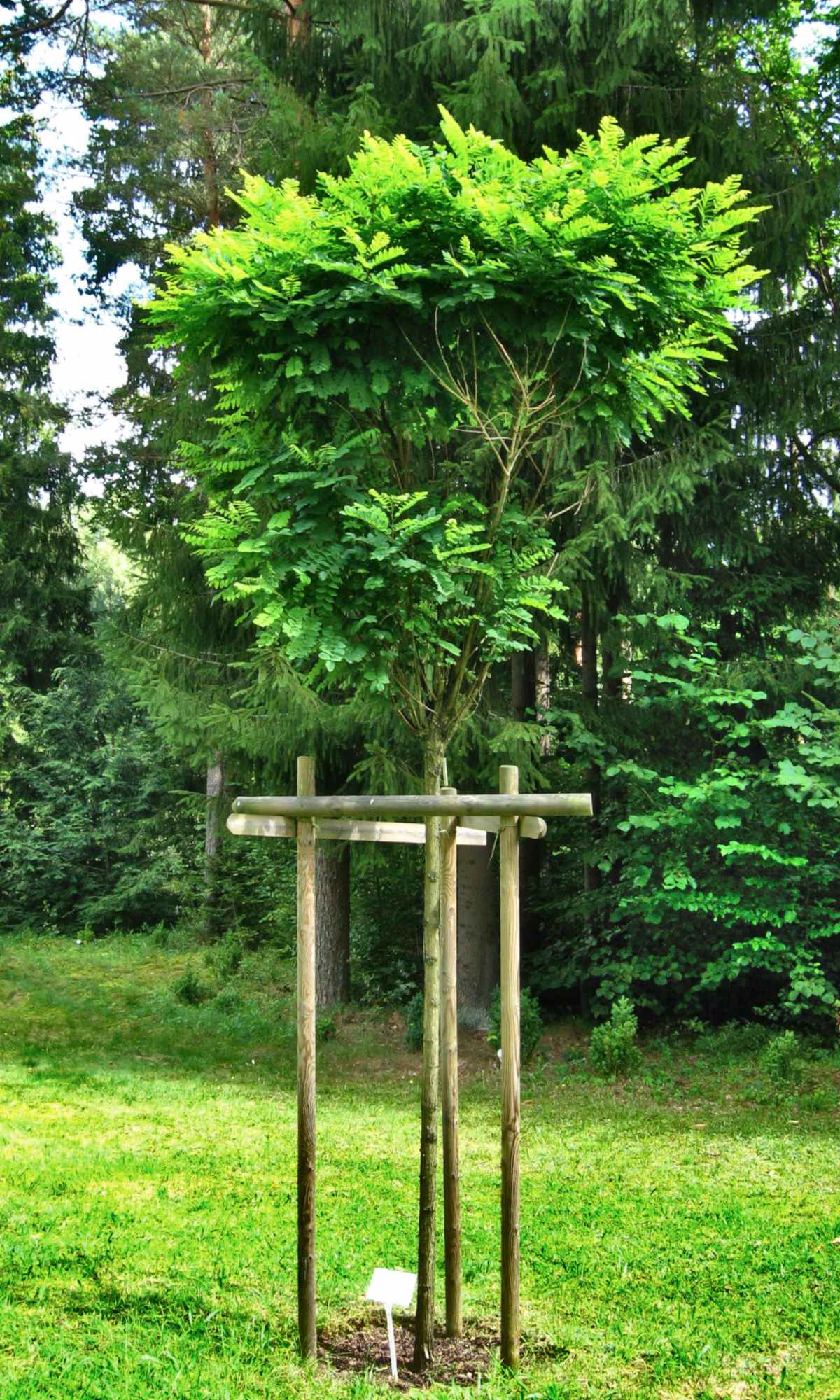
“Umbraculifera”, the scientific name of this variety of Robinia pseudoacacia, means “like an umbrella”. This is because of the silhouette of the tree, which is like a dense, round clump. As the tree ages, the shape shifts from a near-perfect sphere to an umbrella-like form.
The best way to highlight this tree is to plant it alone in its own growing bed, in full sun. That way, it can fill out naturally in all directions without being pressed by neighbors.
Both plant mulch and mineral mulch will make this even more appealing. The definite shape will be highlighted against the uniform background!