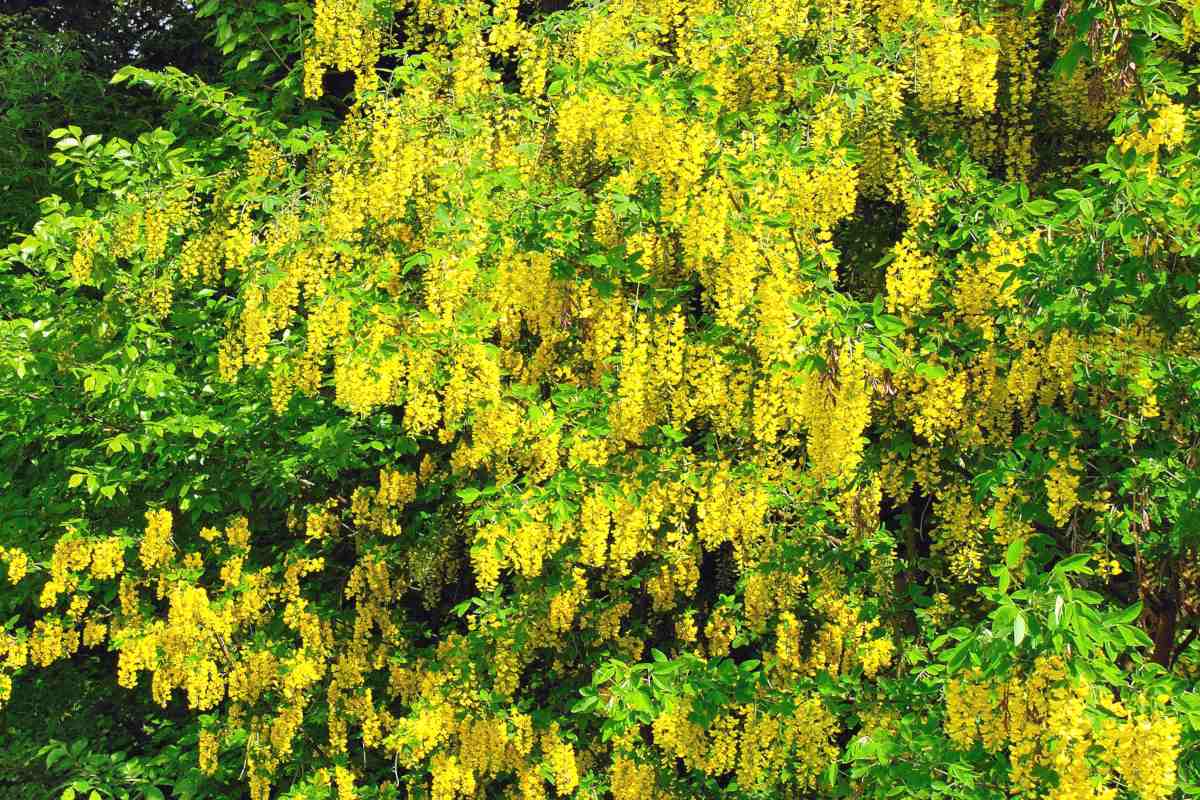
Gold yellow flowers hang in long drooping panicles, fragrant in a way that recalls yellow wisteria, on a deciduous tree reaching 24 feet. Scotch laburnum earns its place as a fast screening hedge, a standalone or even a potted specimen: give it full sun and the bunches are spectacular, but remember every part is poisonous.
| Name | Laburnum |
|---|---|
| Family | Fabaceae |
| Type | tree |
| Height | 24 feet (7 meters) |
| Exposure | full sun |
| Soil | ordinary |
| Foliage | deciduous |
| Flowering | mid-spring to midsummer |
Ideal for hedges, garden boxes and as standalones, it will honorably decorate any garden thanks to its great ornamental value.
Planting your scotch laburnum is an important step for the life of your shrub because it determines your laburnum’s proper growth and flowering.
How to plant a scotch laburnum
A scotch laburnum is indifferently planted either in spring or fall but, like all shrubs, fall should always be considered best for optimal root development before winter and better growth in spring.
If you’re planting in spring, you’ll need to remember to water often over the first year.
Planting scotch laburnum in pots or containers
Because it grows slowly in constricted spaces, scotch laburnum is actually well suited to growing in pots or garden boxes.
Sowing scotch laburnum
Sowing scotch laburnum is quite easy and can be performed with seeds collected in fall.
Scotch laburnum can be planted in the ground in either of two seasons, grown in a container, or raised from its own seed. Here is what each route asks of you and what it gives back.
| Method | When | What it needs | Best for |
|---|---|---|---|
| Planting in the ground, autumn | Early to mid-autumn | Full sun, ordinary soil | Optimal root development before winter and better growth in spring |
| Planting in the ground, spring | Early to late spring | Frequent watering through the first year | Gardeners who missed the autumn window |
| Growing in a pot or garden box | Spring or autumn | A good-sized pot, a drainage hole, a bed of rocks or clay beads | Terraces and confined spaces, where growth stays slow |
| Sowing seed | Collect in autumn, sow in spring | A 24-hour soak, seedling soil mix kept moist | Raising several plants, transplanted out the following autumn |
Whichever route you take, full sun exposure is what decides the quality of the blooming.
Pruning is not a necessity at all, but, if you with to reduce or even out the shrub’s bearing,
Caring for scotch laburnum is very easy and is basically summed up as removing dead wood regularly.
For scotch laburnum grown in pots, remember to water often, usually as soon as the surface soil is dry.
Adding flower shrub fertilizer in spring spurs blooming and proper scotch laburnum growth.

Scotch laburnum is a little tree that unfurls remarkable blooming thanks to its wonderful bunches of flowers.
The gold yellow flowers are shaped in beautiful drooping panicles and are fragrant in a way that is reminiscent of yellow wisteria.
Growth is rapid in proper soil which makes it the ideal hedge shrub if you want to block bystanders from checking your property out.
Its possible to also set it as a standalone, and mixed hedges or alignments look nice, too.
Growing scotch laburnum in pots or garden boxes is perfectly possible and even recommended, the only caveat is to provide a pot that is large enough.
This tree is vulnerable to caterpillars. It’s important to burn colonized leaves if you can spot the infestation.
Never let anyone ingest scotch laburnum seeds because they’re poisonous, as are all other parts of the tree.
Read also:
The scotch laburnum tree is vulnerable to caterpillars.