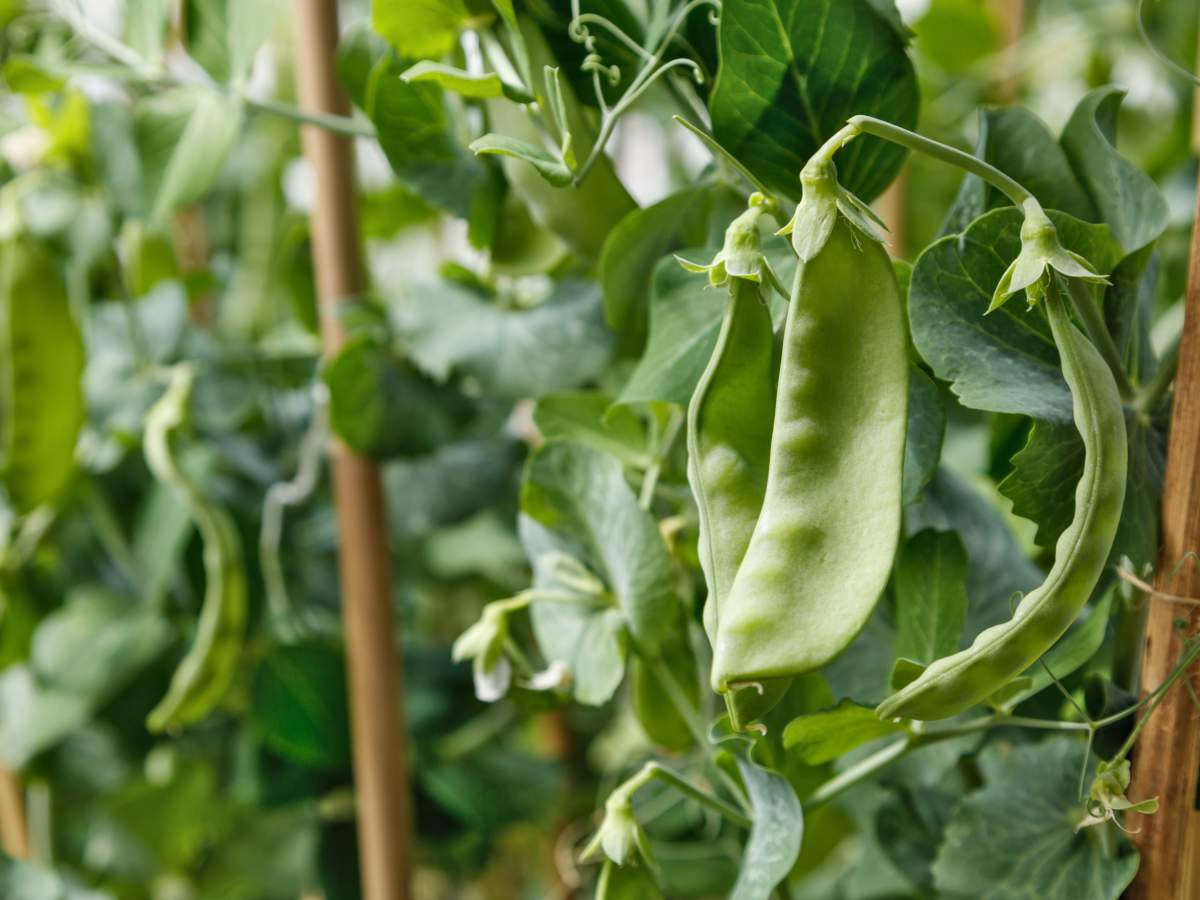
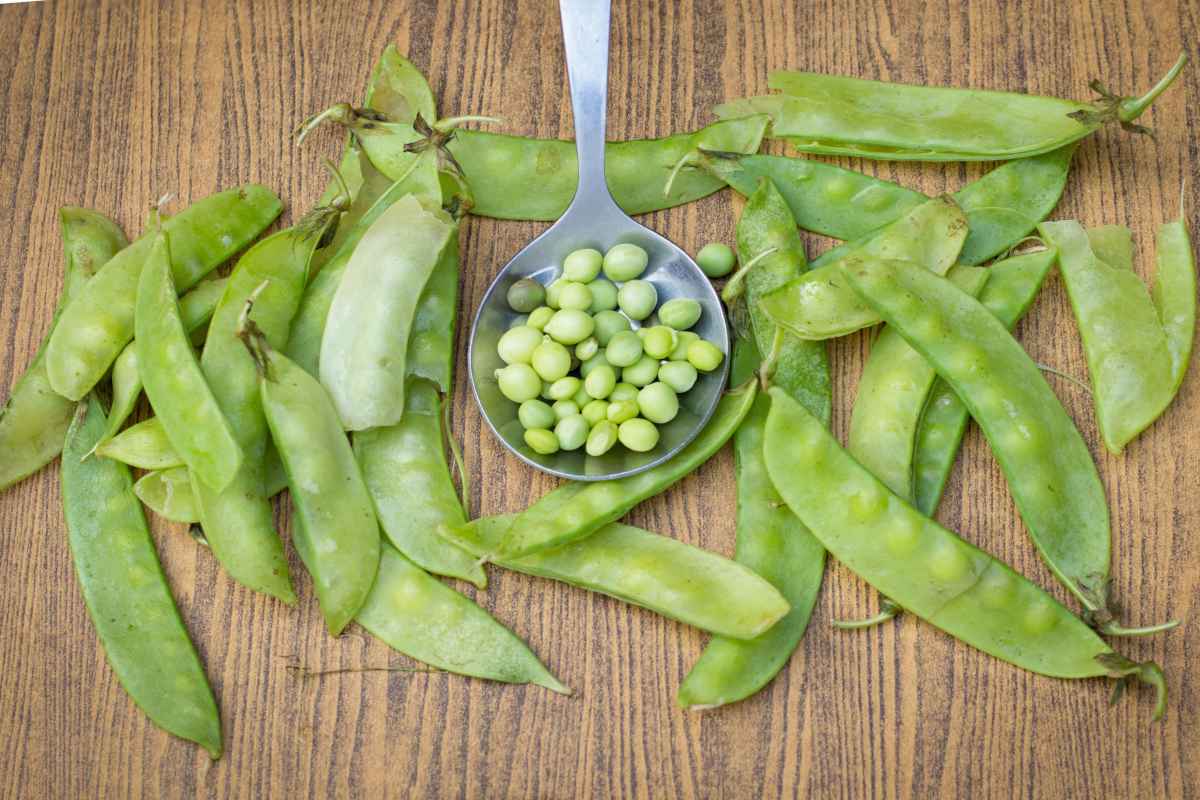
Flat, tender pods eaten whole, seed and casing together, on plants that run from knee-high to four metres: that is snow pea (Pisum sativum var. macrocarpum), valued for its fibre, plant protein and vitamins. Give it light, well-drained soil and full sun, and it repays twice — sweet pods, then nitrogen left in the soil for the next crop.
| Name | Pisum sativum var. macrocarpum |
|---|---|
| Family | Fabaceae |
| Type | bean vegetable |
| Height | 1 ⅓ to 13 feet (40 cm to 4 m) |
| Soil | light, not soggy |
| Exposure | full sun |
| Harvest | 2-4 months after sowing (depends on variety) |
To gobble these sweet ones up until you burst, plant some in your vegetable patch!
Belonging to the Fabaceae family, snow pea or « snap bean » is a fine vegetable that King Louis the XIVth of France was virtually addicted to. Today, it is also very much appreciated for its nutritional qualities: it produces fiber, plant protein and vitamins.
In the vegetable patch, it adapts well to almost any type of soil, except perhaps excessively moist and chalky soil. Like the other legumes, it is a very good plant to grow just before sowing a more demanding vegetable, since it actually stores nitrogen extracted from the air into its roots, in the soil.
Other heirlooms worth sowing are ‘Carouby de Maussane’ and ‘Golden Sweet’, both grown, like every snow pea, for pods eaten whole with the seed inside; train their tendrils along a wire fence and pick twice weekly.
Choose heirloom varieties such as the ‘Corne de Belier’ which is vigorous and productive, or the ’40 days bean’ which is earlier and more tender. Sow as soon as the soil has warmed up a bit, and if you can, even start under a tunnel greenhouse to sprout earlier still. Snow pea needs air and light: sow the seeds at least 2 inches (5 cm) from the next, at a depth of 2 inches (5 cm) again. Between rows, keep at least 20 to 30 inches (50 to 75 cm) depending on if you’re planting a dwarf or a pole variety.
As soon as the peas are vigorous enough, ridge them up and set them along a wire fence firmly bound to stakes, so that the tendrils of the dwarf or pole varieties can attach.
Most snow pea failures come down to sowing too deep, too close, or harvesting too late. Here are the figures given above, gathered in one place.
| Operation | Figure to keep | Why |
|---|---|---|
| Sowing depth | 2 inches (5 cm) | Seeds go in at the same depth as the spacing between them |
| Space between seeds | At least 2 inches (5 cm) | Snow pea needs air and light |
| Space between rows | 20 to 30 inches (50 to 75 cm) | Wider for pole varieties, narrower for dwarf ones |
| Height to plan for | 1 ⅓ to 13 feet (40 cm to 4 m) | Decides the support and the row width |
| Harvest | Twice a week, 2-4 months after sowing | Picking often stops the pods hardening |
| Crop rotation | 5 years | Breaks the cycle of pea pests such as weevil and midge |
Sow early, space generously and rotate: those three habits replace most treatments.
Hoe and water if the weather is dry, and mulch as soon as the plants have grown tall enough. Three months later, harvest your peas twice a week to avoid letting the pods harden. As soon as temperatures rise, if the plants start developing powdery mildew, remove infected parts or specimens immediately, and spray sulfur-based organic treatment product.
To avoid green aphids, pea leaf weevil, pea midge and other enemies, apply these three major guidelines: sow early, space your plants well, and most important never sow the same crop in the same place for the following five years.
M.-C. H.
What’s your best home-grown snow pea recipe?