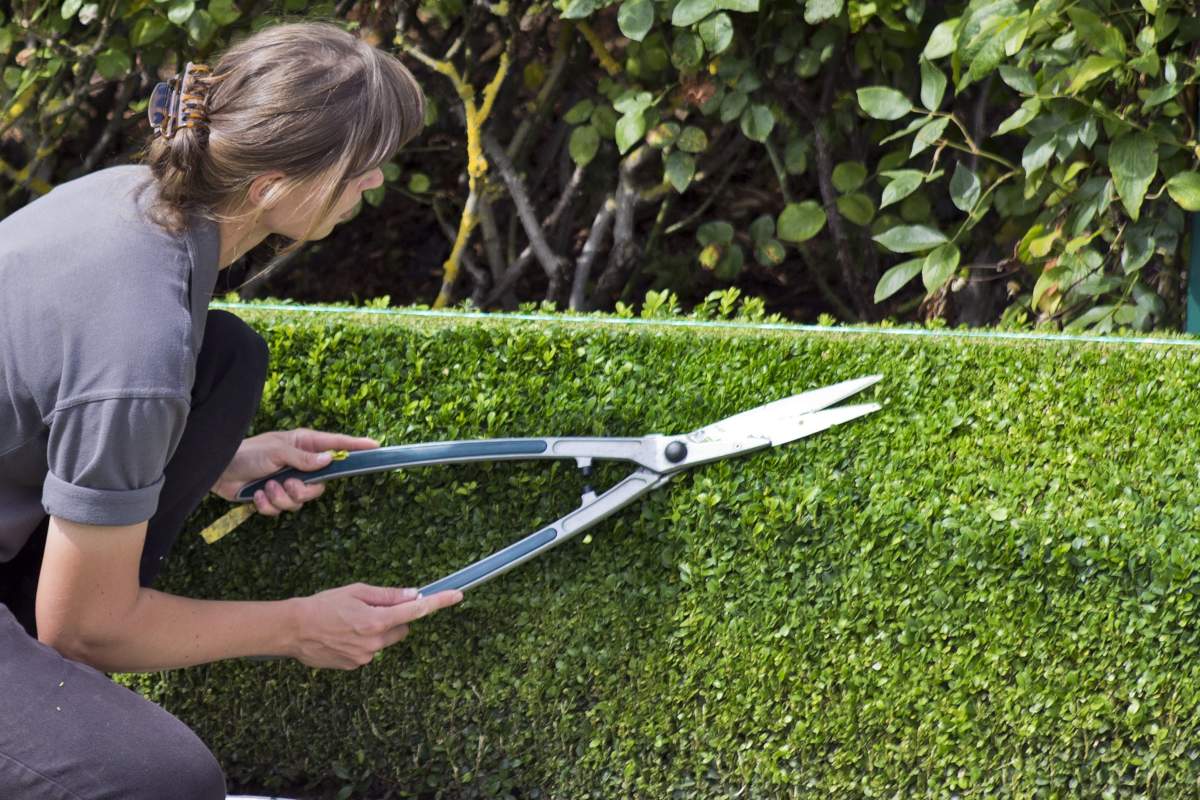
Clipped a little at a time, box renews its leaves and grows denser than ever, holding a ball, a cone or a level hedge top for years on end. Pruning shapes the shrub rather than weakening it: keep off winter and strong sun, work with sharp blades, and the plant comes back more vigorous than before.
Pruning boxwood is a practice that helps shape this magnificent shrub, while giving it a chance to renew its leaves and grow denser than ever before.
Don’t be afraid to prune it, this will also make the plant more vigorous!
For those boxwood shrubs shorter than about 3 feet (1 meter): the best time to prune is around April-June and August-October.
So, in short, they are pruned twice, and a tip to remember this is that these are the “A” months, from the letter that the month begins with.
It is possible to prune during other months, too, but not in winter nor during the vegetation phase of your boxwood.
For boxwoods that form a hedge and aren’t being modeled into any specific shape, pruning once before summer is enough.
Note, however, that in some places, for some types of hedges, trimming is unlawful in Spring. This is to ensure birds aren’t disturbed during the nesting season.
Which pruning job does your boxwood need?
A small shaped box, a young plant being trained, a plain hedge and an overgrown specimen are not cut at the same moment or with the same blade. Find your situation below before you pick up the shears.
Which pruning job does your boxwood need?
Situation
When to cut
Tool
What the cut achieves
Shaped box under 3 feet (1 m)
Twice a year: mid-spring to early summer, then late summer to mid-autumn
Topiary scissors or shears
Removes part of the new growth so the shape stays crisp
Young plant being trained to a ball or cone
From the first year, at any prune outside winter
Topiary shears, guided by a wire frame
Builds the general silhouette over several years
Hedge with no set shape
Once, in late spring before summer
Hedge trimmer or long-bladed shears
Keeps the top level and the base wider than the top
Overgrown box to be reduced
Early spring, staged over two or three years
Loppers or a pruning saw
Lets light into the centre so new branches sprout there
Whichever job you tackle, work on a cool, overcast day and rake the clippings away from the foot of the plant.
Tools needed to prune boxwood
Special scissors or shears have been developed for pruning topiary, they are perfect for boxwood.
For hedge-bound boxwood, any hedge trimmer or long-bladed shears will do fine.
Wipe your blades with alcohol before moving from one boxwood to the next.
Keep the cutting edges sharp, because blunt blades crush boxwood leaves and leave a fringe of brown, torn edges that stays visible for weeks.
Shears and trimmers work best on soft, current-season growth and thin twigs, so keep loppers or a pruning saw handy for the thicker old branches taken out during hard pruning.
Spread a sheet under the shrub before you start, as clippings left at the foot of a boxwood shelter blight spores and moth caterpillars.
Giving your boxwood a round, conical or other shape
During the first year, start giving your boxwood the shape you’re aiming for.
At the beginning, simply go for the general silhouette rather than pruning in great detail.
It will take you several years before you’ll make it to the final shape.
Afterwards, every time you prune, you’ll only remove a portion of the new growth added since the previous pruning.
As time goes by, your shrub will grow in size but retain the shape that you wish it to have.
Slip a wire ball or cone frame over a young box and clip back to it as the shoots poke through.
Clip on a dry, overcast day, since the cut leaf edges of box scorch brown when strong sun hits them straight away.
Shake the clippings out of the crown and rake them off the ground, because box blight survives on fallen leaves.
Pruning a boxwood hedge
A taut line keeps the hedge top level
In a hedge, it is important that the lower portion of the hedge be wider than the top, kind of like a narrow pyramid with a cut top.
That is how the entire shrub will receive sufficient light.
If the lower part is thinner than the top, it will grow sparse.
For low-lying hedges, set one plant every 4 to 6 inches (10 to 15 cm), to ensure full density.
Stretch a taut string line between two stakes at the finished height and trim along it, so the top of the hedge stays level instead of dipping in the middle.
Gardeners commonly recommend trimming boxwood on cool, overcast days, since shearing exposes tender inner foliage that was previously shaded and can bleach or burn when suddenly hit by hot, direct sun.
Rake up every clipping from the foot of the hedge.
Fallen box leaves left lying at the base can harbour blight spores that splash back up onto the new growth.
Hard pruning of boxwood
Has your boxwood grown too large? Reduce it to the size you need over a few years with the following technique:
Early Spring, cut one in two or one in three branches back to about a foot shorter than your target size (30 cm).
This will make the boxwood look like a swiss cheese with lots of light reaching the center.
New branches will sprout in the center of the shrub.
In Spring of the following year, you can cut back the remaining branches.
From then on, you can trim and prune your boxwood regularly to keep it at a manageable shape.
Cutting the entire tree back in one go might kill the shrub, which is why it’s best to stage it over at least two years (ideally three).
Some people recommend cutting back to a stump. Though some box shrubs do recover, it isn’t at all guaranteed. The gradual reducing of the shrub will make sure it survives.
Image credits (edits Gaspard Lorthiois):
CC BY-SA 2.0: La Citta Vita
Written by Gaspard Lorthiois | Loves helping out, especially when it comes to growing things. Worked in herbal medicine, runs a farm, and dabbles in tech. Master's degree and engineer.