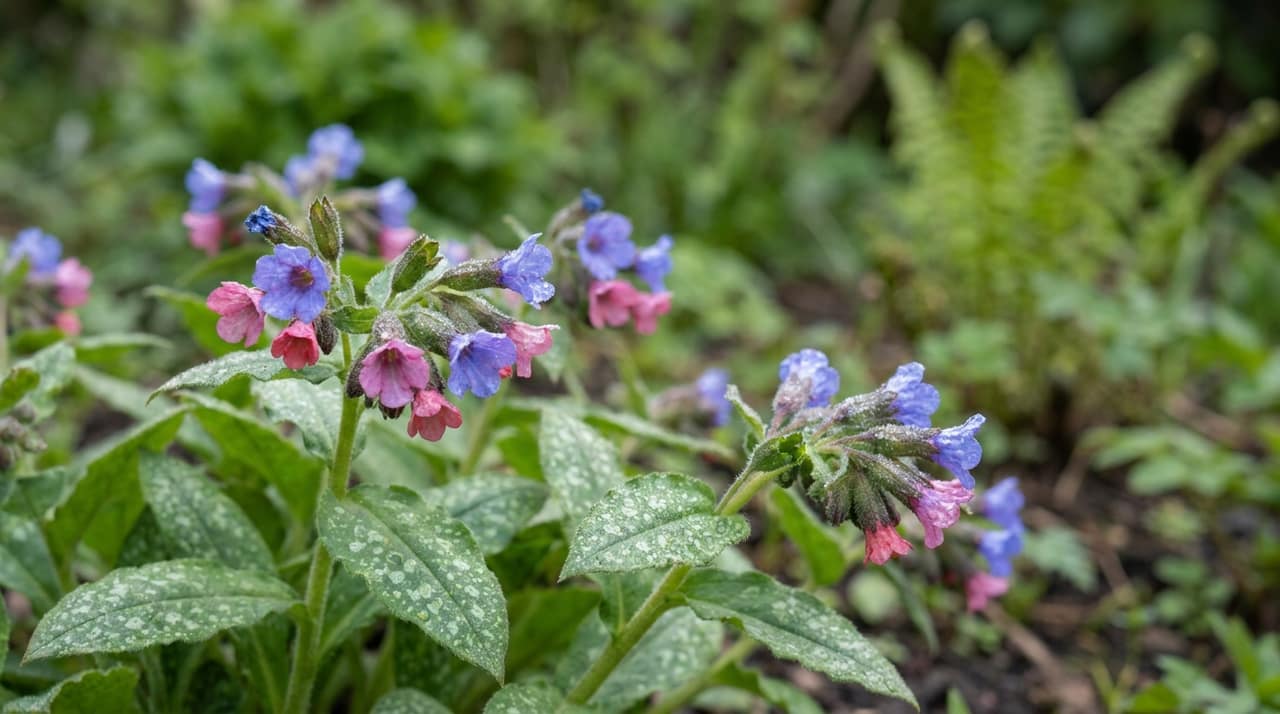
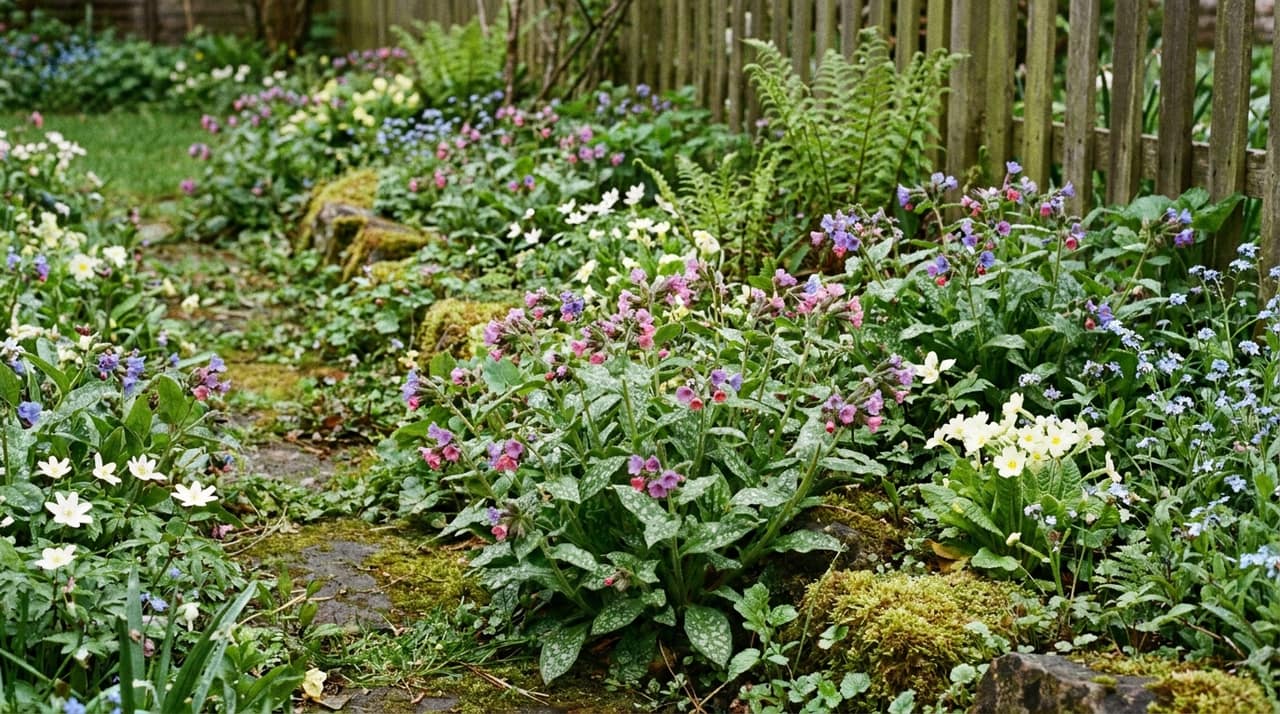
Pulmonaria officinalis, commonly known as lungwort, is a charming woodland perennial prized for its speckled, silver-mottled foliage and delicate early spring flowers that shift from pink to blue. It thrives in shaded borders and beneath deciduous trees, providing essential nectar for bees and hoverflies when little else is flowering. Its distinctive spotted leaves persist throughout the year, offering ornamental interest long after the blooms fade.
Lungwort performs best in partial to full shade, making it an ideal choice for north-facing borders, woodland gardens, and the dappled light beneath trees. Direct afternoon sun can scorch the leaves, particularly in warm summers, so avoid south-facing positions in hotter regions. A site with morning shade and afternoon shelter is ideal.
This plant favours moist, humus-rich soil that drains well and does not become waterlogged. It tolerates a wide pH range but prefers slightly acidic to neutral conditions; chalk soils are acceptable provided organic matter is worked in generously. Avoid compacted clay or sandy soils lacking organic content, as these stress the plant.
Lungwort is fully hardy across the British Isles and much of northern Europe, thriving in USDA zones 4–9. It tolerates cold winters with ease and requires no special protection, though it may slow its growth in very dry or exceptionally hot summers.
Plant in autumn or early spring when the soil is moist and the plant can establish roots before summer. Spring planting is preferable in heavy clay soils where autumn waterlogging may cause rot.
Lungwort asks for very little, but the few jobs it does need each fall in a particular season. This table sets out what to do and when, so you can see the whole year before reading the detail below.
| Season | Main job | Feeding or mulching |
|---|---|---|
| Late winter to early spring | Deadhead spent flower clusters and strip off winter-damaged or yellowed outer leaves | Balanced granular fertiliser as new growth emerges |
| Early summer to midsummer | Water deeply during dry spells; pull away excess rosettes at the margins | 5 cm of leaf mould or compost to cool the roots and suppress weeds |
| Early autumn to mid-autumn | Lift and divide congested clumps, replanting the vigorous outer sections | 7–10 cm mulch of leaf mould to protect the crown |
| Midwinter | Nothing: the plant lies dormant, keeping some foliage in milder areas | None needed |
With those four moments covered, lungwort largely looks after itself from one year to the next.
Spring: Feed with a balanced, granular fertiliser in late February as new growth emerges. Deadhead spent flower clusters to encourage a tidier appearance, though leaving some flowers encourages self-seeding. Remove any winter-damaged or yellowed outer leaves to reveal fresh, variegated foliage beneath.
Summer: Water deeply during dry spells to maintain consistently moist soil; lungwort is a woodland plant and dislikes drought stress. Mulch around the base with 5 cm of leaf mould or compost in June to cool the roots and suppress weeds. If the plant spreads vigorously, gently pull away excess rosettes at the margins to control its footprint.
Autumn: Cut back flowering stems once they have finished in June, reducing height by half. In September or October, divide congested clumps by digging up the entire plant, teasing the roots apart, and replanting vigorous outer sections. Apply a 7–10 cm mulch of leaf mould around the plant to protect the crown during winter and enrich the soil.
Winter: Lungwort is deciduous in very cold regions but often retains some foliage in milder areas. No winter protection is necessary; the plant lies dormant and requires no supplemental watering unless the soil dries out entirely.
Several outstanding cultivars extend the colour range and improve disease resistance beyond the species type.
Most lungworts sold in garden centres are either forms of Pulmonaria officinalis or closely related hybrids grown in exactly the same way. The table below sets the widely available names side by side so you can choose on flower colour, leaf marking and habit.
| Variety | Flower colour | Leaf markings | Size band | Particular strength |
|---|---|---|---|---|
| ‘Sissinghurst White’ | Pure white | Broadly spotted, heavily silvered green | Compact | RHS AGM; lights up deep shade and brightens shaded corners |
| ‘Opal’ | Palest ice blue | Lightly spotted green | Compact | Subtle colour for pale shade schemes |
| ‘Cambridge Blue’ | Clear pale blue | Distinctly spotted green | Compact | Soft colour, reliable in borders and disease-resistant |
| ‘Silver Bouquet’ | Coral pink ageing violet | Wide, near-solid silver | Compact | Brightest foliage of the group |