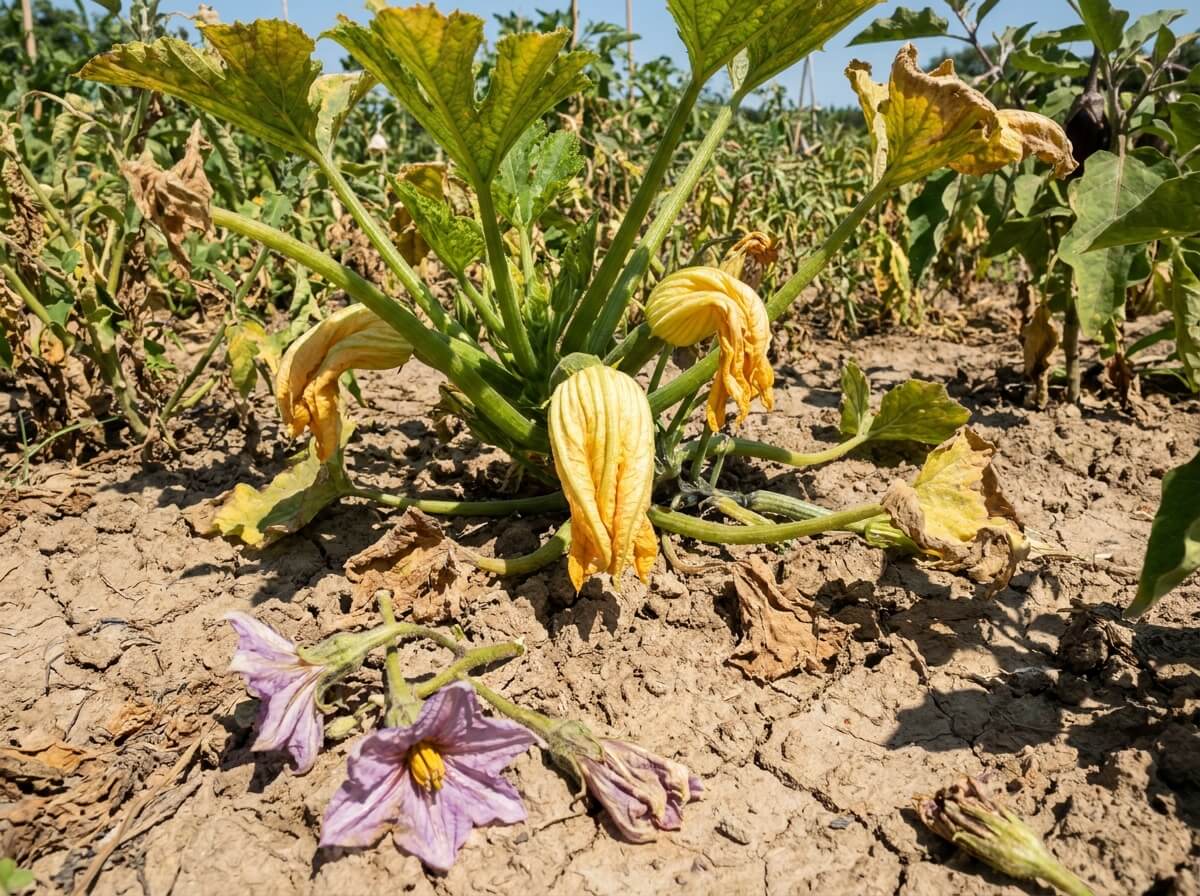
Courgettes (zucchini) and aubergines (eggplants) are meant to be summer’s most generous producers. But there’s a window — usually a few brutal weeks of peak heat — when both simply halt.
Flowers open. Flowers drop. Nothing swells. Understanding why this happens, and acting on it quickly, is the difference between a second flush of harvest stretching into early autumn and a bed that gives up entirely by late summer.
The mechanism is physiological, not mysterious. When daytime temperatures consistently exceed 32°C (90°F), pollen in both courgette and aubergine flowers becomes non-viable. The anthers produce it; the flower opens on schedule. Bees may even visit. But fertilisation doesn’t happen. The flower drops cleanly, and nothing forms behind it.
Aubergines have a slightly higher heat tolerance than courgettes and can push through to around 35°C before pollen quality collapses entirely. But the principle is the same. And both crops face a second issue layered on top of the heat: pollinator absence.
Bees largely stop flying above 35°C, retreating from the garden during the hottest part of the day — which is precisely when courgette flowers are open and receptive.
There’s a third factor that’s almost always overlooked. Inconsistent soil moisture sends a stress signal that causes the plant to abort developing fruitlets before they’re visible to the eye.
You water heavily after a dry spell, the plant gets confused, and the tiny embryo behind the flower fails at 3–4mm. You never see it happen.
Before anything else, walk the plant and look hard. If there’s even one courgette that has shot up enormous and woody — the kind that looks more like a marrow — pull it off immediately.
A single over-mature fruit sends a hormonal signal through the whole plant that fruiting is complete. The plant shifts energy toward seed maturation inside that one fruit and shuts down new production entirely.
This isn’t a watering issue or a feeding issue. It’s a biological priority override.
Cut the mature fruit off cleanly with a sharp knife, right at the stem. Within 5–7 days you’ll see the plant redirect energy back to new flower production.
The same logic applies to aubergines that’s been on the plant past their harvest window. A purplish-black fruit that’s been there too long develops a dull, slightly bronzed skin. The flesh inside starts to turn bitter and seedy. Pull it off. You can read more about proper aubergine growing and care for context on fruit development timing.
The instinct when plants aren’t producing is to feed them more. But the wrong kind of feed makes things worse. That’s a crucial point.
Nitrogen-heavy general fertilisers push vegetative growth — big, lush leaves at the expense of fruit. In midsummer, both courgettes and aubergines need potassium and phosphorus to support flower formation and cell development in forming fruits.
The RHS advises feeding courgettes weekly with a high-potash fertiliser once plants are in full production, and increasing to twice weekly if fruiting slows.
Deep, consistent moisture is non-negotiable. But “consistent” is the word that matters most.
Courgettes and aubergines both react badly to the boom-bust cycle: bone dry for three days, then a heavy soak. That pattern triggers blossom drop and micro-fruitlet abortion regardless of temperature.
What they need? Steady soil moisture at a depth of at least 20–25cm.
Water deeply every two days during sustained heat, directly at the base of the plant — never overhead. Overhead watering in summer heat does nothing for roots. It encourages powdery mildew on leaves. It can cause scorch on foliage if water droplets sit in full sun. A soaker hose or drip irrigation set to run for 25–30 minutes every two days is close to ideal.
Mulch at 7–8cm depth around the base — straw, wood chip, or even cardboard — keeps soil temperatures down and dramatically reduces moisture evaporation. On a 30°C day, unmulched soil around a courgette can reach 45°C at the surface. That temperature at root level stresses the plant more than the air temperature ever could. Proper mulching makes all the difference.
When bees disappear during a heatwave, manual pollination isn’t optional — it’s the only way to get fruit set.
Courgette flowers are large and unmistakable. The male flower sits on a straight stem; the female has a tiny proto-fruit behind the petals.
Both are usually open between 7am and 10am, before the heat builds. That window is your target.
The method is simple. Take a small, dry, soft paintbrush. Or just pull a male flower entirely. Peel back its petals to expose the pollen-dusted anther.
Touch the anther gently to the centre of the female flower. Once.
Twice. Done.
Yes, it’s fiddly. Do it anyway — the difference is night and day.
Aubergines are self-fertile but still need vibration to release pollen from their tubular anthers. In the absence of bees, hold a battery-powered electric toothbrush against the stem just behind each open flower for two seconds. The buzz transfers directly. This is the same principle as buzz pollination, which bumblebees perform naturally.
By midsummer, courgette plants in particular become enormous. A tangle of huge leaves shades the crown, restricts airflow, and hides developing fruits. Pull off the oldest, largest leaves at the base: anything yellowing, anything touching the soil, anything more than 50cm wide that’s blocking light from reaching the centre of the plant.
Take no more than 3–4 leaves per week. Dramatic defoliation shocks the plant and sets production back.
But gradual, strategic removal opens up the crown and does wonders for air circulation (reducing powdery mildew risk). This allows the plant to focus resources on fruiting, rather than maintaining a canopy it doesn’t need.
For aubergines, pinch out the growing tip once the plant has 4–5 fruit-bearing laterals. At that point, the plant has enough productive branches, and allowing further vertical growth simply dilutes energy away from the fruits already forming.
Realistic expectations matter here. Plants don’t reset overnight. Be patient, but be diligent.
Aubergines need a longer run-up than courgettes. So the timing pressure is real. If you’re in a climate with early autumn frosts (much of the UK, Canada, New Zealand’s South Island), get intervention underway now — delay of even a fortnight can mean aubergines don’t reach harvest size before the cold arrives.
Southern Hemisphere gardeners: this applies to your early winter and midwinter — the same heat-driven fruiting collapse happens in Australian and South African summers.
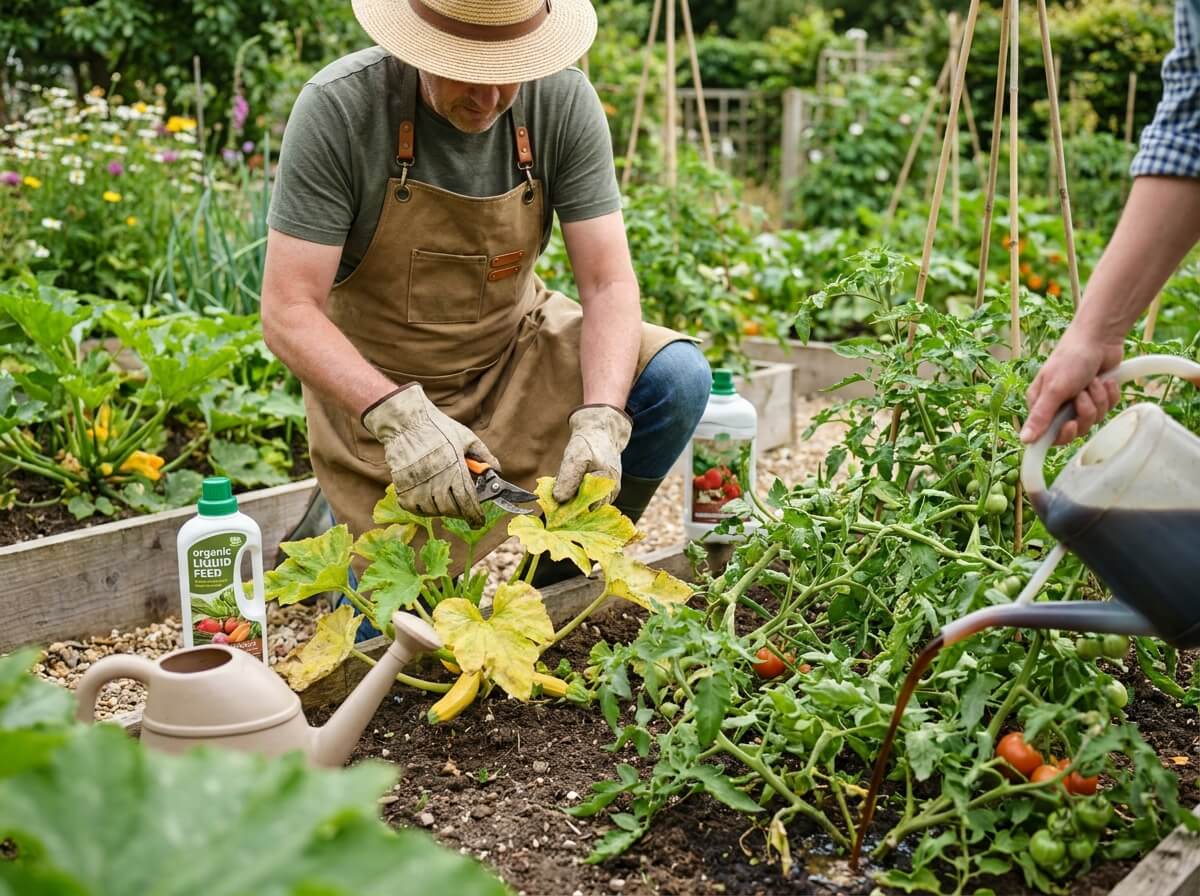
Smart tip: Pull off every oversized, overmature fruit before changing feeding or watering — it’s always the first step.
Either the flowers are male (which never form fruit), pollen has become sterile in temperatures above 32°C, or there are no pollinators present during the narrow morning window when flowers are receptive. Hand-pollinate between 7am and 10am using a dry paintbrush.
Yes, if you act within the next 2–3 weeks. Pull off overmature fruits, switch to a high-potash feed twice weekly, and hand-pollinate using an electric toothbrush against the flower stem.
Expect small fruitlets within 10–14 days.
The oldest, lowest leaves yellowing is normal and those should be pulled off. If yellowing spreads to mid-plant leaves, it usually indicates a magnesium deficiency — apply a dilute Epsom salt solution (1 tablespoon per 5 litres of water) once at the root zone.
Heat stress shows as wilting and leaf curl that recovers after sunset. Powdery mildew produces a distinctive white, flour-like coating on the upper surface of leaves that doesn’t disappear — pull off affected leaves immediately and increase airflow around the plant.