A patio or balcony that faces full sun is one of the brightest growing spots you have, and also one of the harshest: pots heat up fast, compost dries out by midday, and reflected light off walls and paving pushes temperatures higher still. Spring is when this corner is at its most generous, because the soil is still moist and the heat has not yet become punishing — but it is also when many containers sit empty and bare. A good scheme builds a permanent evergreen backbone that can take the glare all year, then threads bulbs and early perennials through the gaps so the whole group comes alive from March onwards.
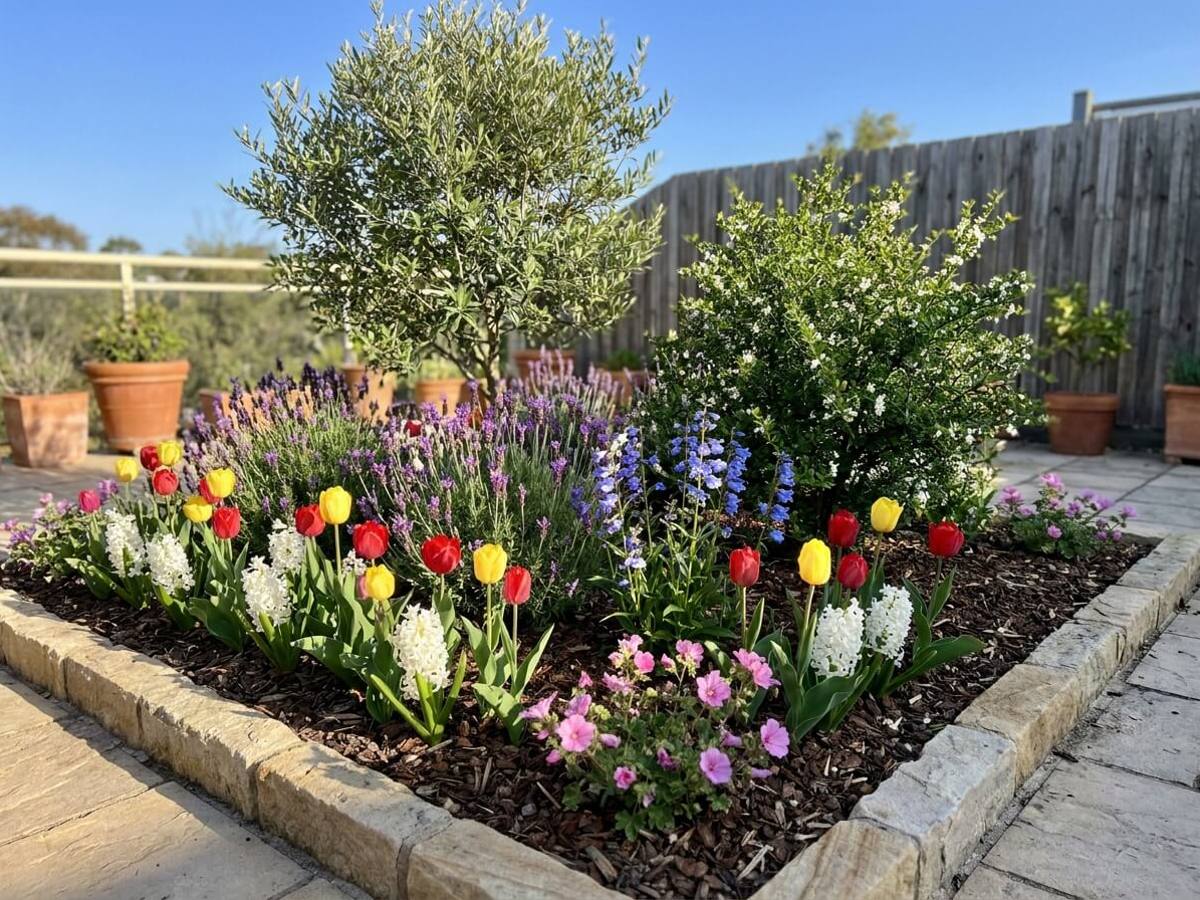
From back to front: Picholine olives, Cape mallow, Australian finger lime, French lavender, Beardtongue, Tulip, White Pearl hyacinth.
Put Picholine olives at the very back as the tallest, most permanent element of the group. The narrow silver-grey leaves catch the light all year and never scorch, no matter how fierce the afternoon sun becomes on a south-facing wall. That cool grey tone is what makes the spring colours in front of it read so clearly — pink, blue and white all gain against silver.
Cape mallow sits just in front and to one side, forming a loose, airy shrub smothered in small mallow flowers from early spring onwards. It flowers for an extraordinarily long season in a hot spot, so it carries the display long after the bulbs have gone over. Keep it slightly off-centre so it softens the stiff vertical line of the Picholine olives rather than competing with it.
Australian finger lime brings a different kind of evergreen: dense, finely divided, dark glossy foliage with a thorny, slightly wild outline. Its small white spring flowers are quietly scented, and in a sunny sheltered corner it is perfectly happy in a pot. Placed on the opposite side to the Cape mallow, it balances the back row with weight and deep green.
French lavender is the earliest of the lavenders to flower, and its tufted purple flowerheads open in mid-spring just as the bulbs are fading. The grey-green foliage echoes the Picholine olives and ties the two ends of the scheme together. It wants the hottest, driest pot in the group, so give it the most exposed position in the middle row.
Beardtongue fills the middle ground with upright stems of tubular bells in pink, purple or white from late spring. It has a looser, more relaxed habit than the shrubs behind it, which stops the group looking like a row of clipped evergreens. It also takes over exactly as the tulips collapse, hiding their yellowing leaves.
Tulip is the spring headline act here, giving strong upright colour in April at roughly knee height. In full sun the flowers open wide each afternoon and close again in the evening, which keeps the display changing through the day. Grow them in their own pots so they can be shuffled forward when in bud and tucked behind once they go over.
White Pearl hyacinth goes right at the front edge, where its scent reaches you as you pass or sit down. The pure white spikes are short and solid, exactly the low full stop the scheme needs after all that height behind. White is also the colour that holds up best against the glare of a sunny patio, when pastels tend to bleach out.
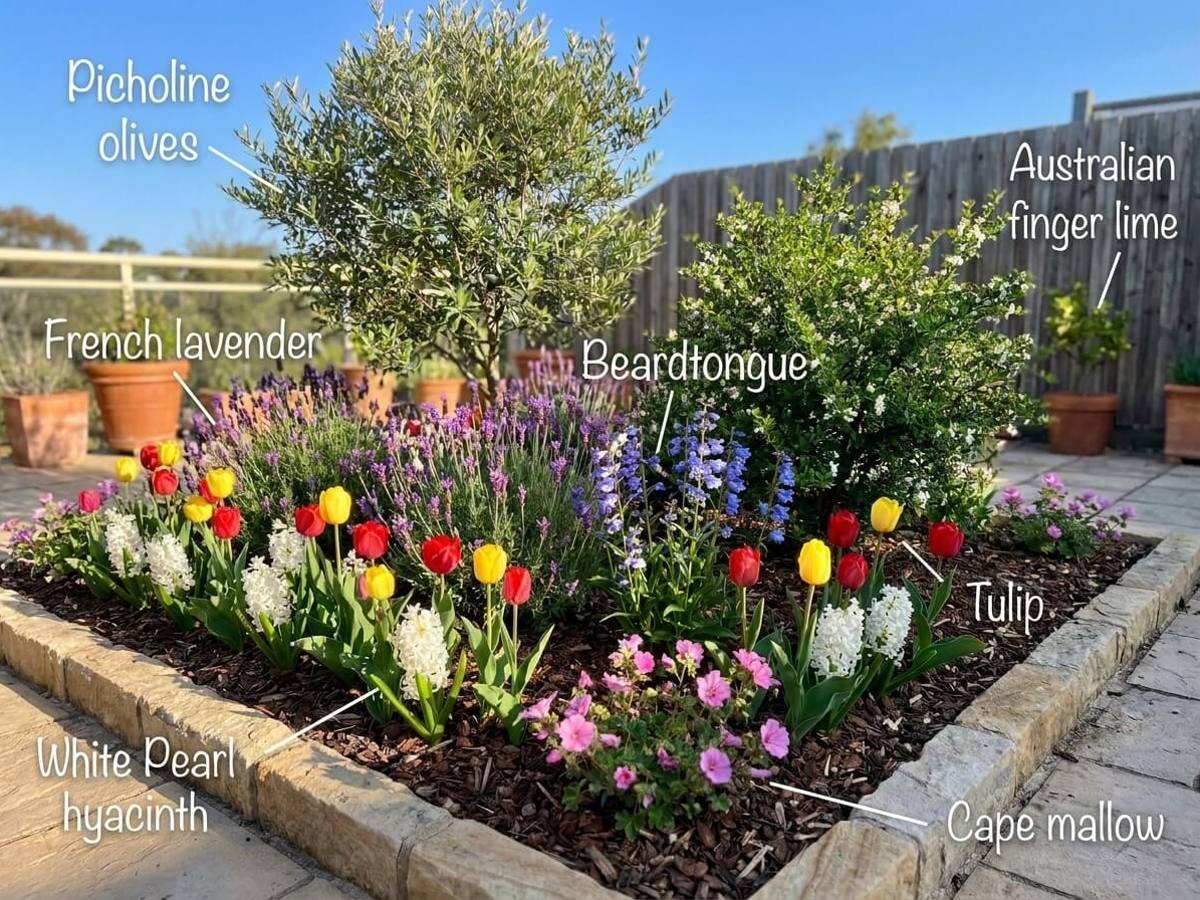
Work with three depths of pot. At the back, give the Picholine olives a container of around 50 cm across, with the Cape mallow and the Australian finger lime in 40 cm pots either side of it, set 30 to 40 cm apart so air moves between them. The middle row takes two or three pots of 30 cm for the French lavender and the Beardtongue, staggered rather than lined up. At the front, use 25 to 30 cm pots with 7 to 9 Tulip bulbs each, planted 15 cm deep in autumn, and 20 cm pots holding 3 to 5 White Pearl hyacinth bulbs at around 10 cm deep. Group the small front pots in odd numbers — threes and fives — rather than spacing them evenly along the edge.
In late winter the group is all structure: silver, grey-green and dark glossy evergreen, with the first Cape mallow flowers appearing. March and April bring the White Pearl hyacinth and then the Tulip, with scent at the front and strong colour just behind. May and June hand over to the French lavender and the Beardtongue, while high summer is carried almost entirely by the Cape mallow against olive-grey foliage. From autumn through winter nothing is in flower except the odd Cape mallow bloom, and the scheme falls back on the three evergreens — which is why it pays to buy the best-shaped Picholine olives and Australian finger lime you can find, and to keep the front pots clean and well grouped even when the bulbs are underground.