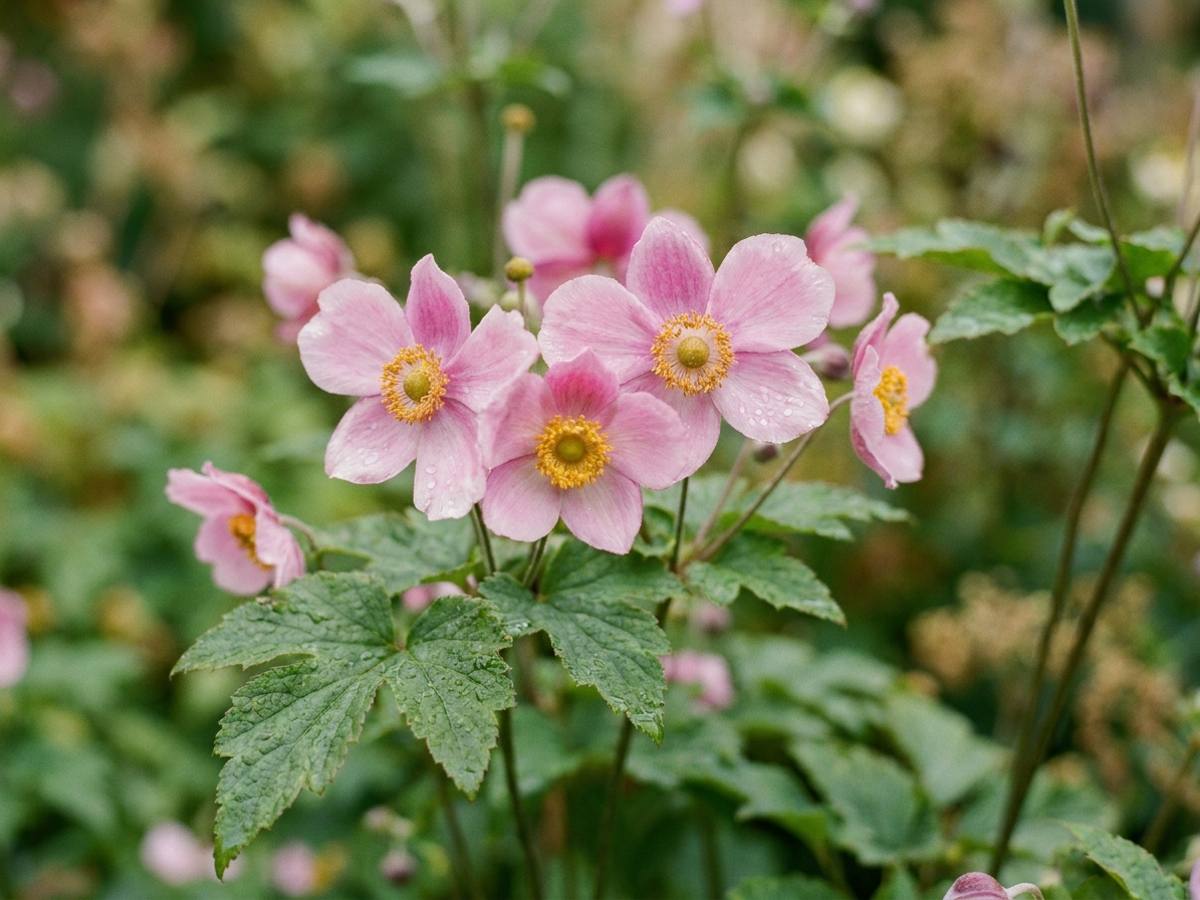
Few perennials lift the late-season garden quite like Anemone hupehensis, whose wiry stems hold saucer-shaped pink flowers well above a mound of dark, vine-like foliage. Flowering from late summer into mid-autumn, it fills the awkward gap after the roses fade and before the asters peak. Its distinctive trait is a running rootstock that gradually colonises ground — a gift in a large border, a nuisance in a small one.
Growing conditions
Chinese anemones are happiest in dappled or partial shade, particularly where summers are hot and dry. They will flower generously in full sun provided the roots never bake, so a spot shaded during the fiercest afternoon hours is ideal. In deep shade the stems stretch and flop, and flowering thins noticeably.
Give them a deep, fertile soil enriched with leaf mould or garden compost. They dislike two extremes above all: waterlogged winter soil, which rots the crowns, and thin, drought-prone sand. Any pH from mildly acid to alkaline suits them, and they cope well with chalk and improved clay.
Hardiness is excellent across the whole of the British Isles and much of northern Europe. In colder continental gardens (zone 4–5) a winter mulch is worthwhile, whilst in Mediterranean climates plant on the shady side of a wall and mulch heavily to conserve moisture.
How to plant Anemone
Spring is by far the best planting season, giving the roots a full growing year to establish before their first winter. Autumn planting is possible in mild areas, but young crowns set out in October often sulk or rot in wet ground.
Spacing: allow 45–60 cm between plants; they knit together quickly and crowded clumps mildew more readily.
Depth: set the crown level with the surrounding soil — burying it invites rot, whilst exposing it dries the roots.
Soil preparation: fork a bucketful of well-rotted compost or leaf mould into the planting area, digging at least a spade’s depth.
Watering in: soak thoroughly after planting and keep the soil evenly moist for the first full season; new plants are slow to settle.
Propagation: lift and divide established clumps in early spring, or take 5 cm root cuttings in late autumn and lay them horizontally in a tray of gritty compost.
Anemone hupehensis growing in a naturalistic garden border
The anemone year: one job and one mistake per season
The year with a Chinese anemone divides neatly into four phases. Each has a single job worth doing well, and a single error that costs flowers or whole plants.
The anemone year: one job and one mistake per season
Season
Main jobs
What to avoid
Early to mid-spring
Feed, mulch 5 cm around the shoots, divide congested clumps, dig out unwanted runners
Hoeing the crowns: growth appears very late, so mark the position
Early to late summer
Water deeply in dry spells; insert twiggy supports for tall cultivars
Drought stress, which browns leaf margins and spoils the buds
Early to mid-autumn
Deadhead to prolong flowering or leave silvery seed heads; cut stems to 5 cm after frost
Dividing now, the commonest cause of losses
Early to late winter
Nothing in most gardens; a loose bark or leaf-litter mulch in very cold spots
Waterlogged winter soil, which rots the crowns
Spring is the only safe moment to lift, divide or move these fleshy roots.
Care through the seasons
Spring: Growth appears late, often not until mid-April, so mark the position to avoid accidentally hoeing the crowns. Apply a balanced general fertiliser and a 5 cm mulch of compost around — but not over — the emerging shoots. This is also the moment to divide congested clumps or to dig out unwanted runners.
Summer: Water deeply during dry spells, especially on light soils, as drought stress causes brown leaf margins and poor flower buds. Tall cultivars in exposed sites benefit from discreet twiggy supports inserted in June. Keep an eye on spreading roots and slice through them with a spade before they reach neighbouring plants.
Autumn: Deadhead spent flowers to prolong the display, or leave the last of them to form decorative silvery seed heads. Once the foliage blackens after frost, cut the stems back to about 5 cm. Avoid dividing now — autumn division is the commonest cause of losses.
Winter: The plant disappears completely below ground and needs no protection in most gardens. Where temperatures fall below −15 °C regularly, cover the crowns with a loose mulch of bark or leaf litter.
Best varieties to grow
A handful of named forms outperform the plain species, offering better colour, sturdier stems or a longer season.
‘Hadspen Abundance’ — deep rosy-pink semi-nodding flowers with unevenly sized petals, compact at around 75 cm; holds an RHS Award of Garden Merit.
var. japonica ‘Prinz Heinrich’ — richly coloured, semi-double magenta-pink blooms with narrow quilled petals; another AGM winner.
‘September Charm’ — soft silvery-pink flowers with darker reverses, flowering reliably late into October.
‘Splendens’ — vigorous and generous, with large single flowers in a warm rose-pink over handsome dark leaves.
Pests, diseases and common problems
Powdery mildew: a white bloom on leaves in dry, still conditions late in summer. Improve air flow by thinning stems, water at the base rather than overhead, and remove badly affected leaves.
Leaf and bud eelworm: dark brown wedges appear between leaf veins, spreading upwards from the base. There is no organic cure — remove and bin affected stems promptly and avoid wetting the foliage.
Slugs and caterpillars: young spring shoots and buds can be shredded overnight. Patrol on damp evenings, use wildlife-safe ferric phosphate pellets sparingly, and encourage ground beetles with leafy mulch.
Invasive spread: suckers appearing metres from the parent plant. Sever runners with a spade each spring, or plant within a sunken bottomless container to contain the roots.