The strip along a north-facing wall, or the ribbon of soil at the foot of a hedge where the sun only swings past for three or four hours, is one of the hardest places in a garden to furnish. Light is thin, the soil is often dry at the back and damp at the front, and anything leggy will lean out towards the brightness and collapse over the path. A good edging scheme here leans on foliage for structure, keeps every plant under knee height except at the very back, and saves its flowers for the long middle stretch of summer when the border is actually being looked at.
From back to front: Ornamental tobacco, Hosta, Bellflower, Lady’s mantle, Perennial geranium, Alumroot, Saxifrage.
Ornamental tobacco gives the scheme its only real height, a loose column of soft green leaves topped with tubular flowers from midsummer until the first frosts. It tolerates the dappled light at the back of the border better than most summer bedding, and the scent carries on still evenings, which is exactly when a shaded border gets used. Its airy, upright habit reads as a backdrop rather than a block, so nothing in front of it is overshadowed.
Hosta is the anchor of the whole planting: broad, ribbed, architectural leaves that hold their shape from May through to autumn, with slender flower spikes in summer. In partial shade the foliage colours stay deep and unscorched, which is precisely where it does its best work. Its big, horizontal leaves are the visual opposite of the ornamental tobacco behind it, and that contrast is what stops the border looking like a single green mass.
Bellflower brings the blues and violets that shade planting needs to stop it reading as flat green. It flowers through high summer, carrying its bells on thin stems that weave between neighbours rather than crowding them. Planted just in front of the hosta, it softens the gap between that solid foliage and the lower layers ahead.
Lady’s mantle does two jobs at once here: pleated grey-green leaves that catch rain in beads, and frothy lime-yellow flower sprays in early and midsummer. That acid yellow lifts the blues of the bellflower and sharpens the whole scheme out of its shade-induced muddiness. It also knits the planting together at ground level, filling the awkward gaps where soil would otherwise show.
Perennial geranium is the workhorse of the middle-to-front layer, spreading into low cushions of deeply cut leaves smothered in flowers through summer. It copes with the drier shade under a hedge and keeps going when the lady’s mantle is cut back for a second flush. Let it spill slightly forward over the edge of the path, where it hides the stems of everything behind.
Alumroot earns its place on leaf colour alone — bronze, plum, amber or silver-marbled mounds that hold through winter when the rest of the border is bare soil. Slim wands of tiny summer flowers float above the clump and add a vertical flicker at a low level. Set against the plain green of the perennial geranium, the darker leaf tones give the front of the border a defined edge all year round.
Saxifrage is the final, lowest step, a tight evergreen carpet that hugs the path and takes the shade at the very front where taller plants cast their shadow. Its flowers arrive on short stems and its rosettes stay neat without any clipping. Tuck it where the soil runs thin against paving — it asks for very little root room and keeps the border’s edge crisp.
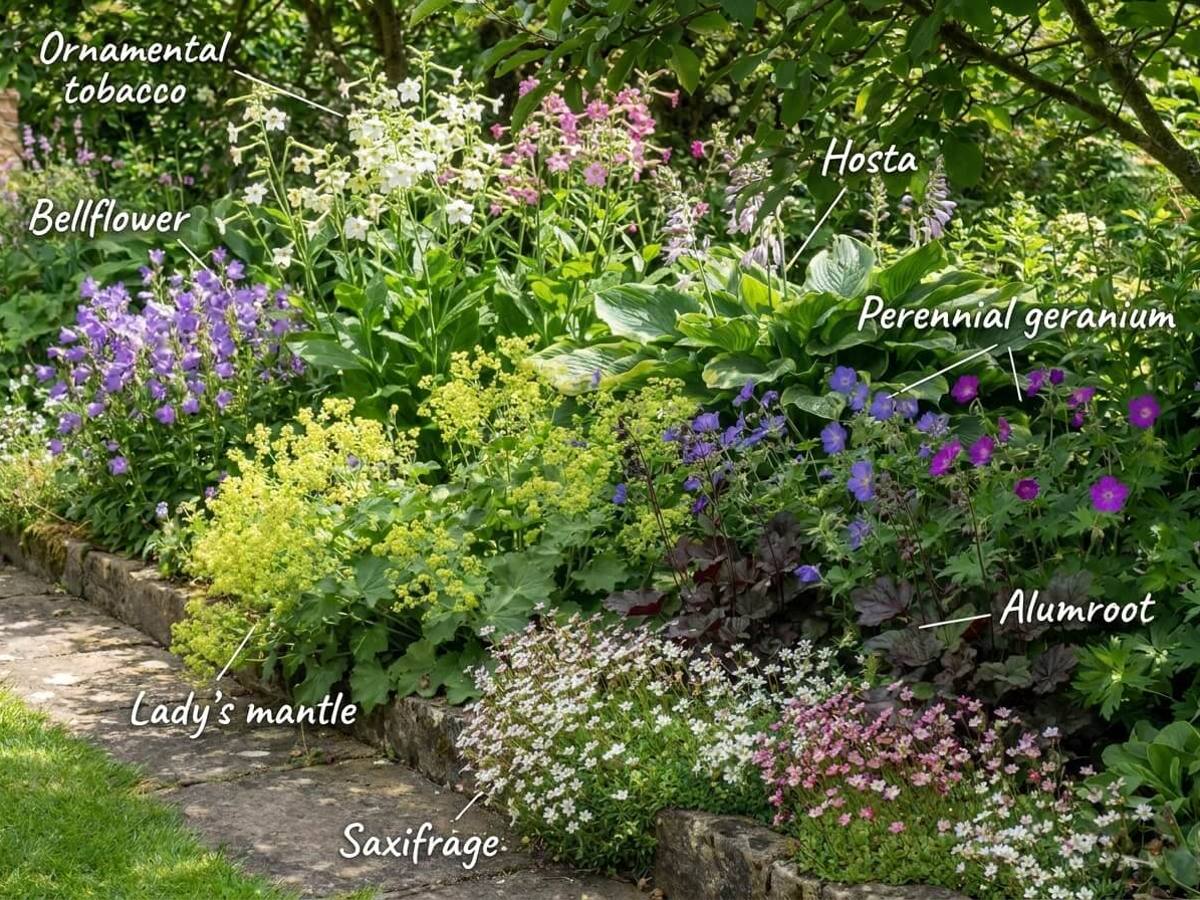
Work in a strip around 1 m deep and build it in four bands. At the back, set ornamental tobacco in a loose group of three to five plants about 30 cm apart, then a row of hosta at 50–60 cm spacing so each clump has room to fan out. The middle band takes bellflower and lady’s mantle in alternating drifts of three, roughly 35–40 cm apart, which keeps the blue and the lime from separating into stripes. The front two bands are perennial geranium at 40 cm, then alumroot in groups of three at 30 cm, with saxifrage planted 20–25 cm apart along the outer 20 cm of the edge. Odd-numbered groups and staggered rows always look more natural than straight lines.
In spring the border is pure foliage theatre: hosta shoots unfurling, alumroot already coloured, saxifrage and lady’s mantle greening up. Early summer brings the lime froth of lady’s mantle and the first perennial geranium flowers, followed by bellflower and the hosta spikes at midsummer, with ornamental tobacco scenting the evenings right through to the first frost. Autumn strips the scheme back to leaf shape and the tawny collapse of the hosta, and by midwinter only alumroot and saxifrage are left holding the edge — which is why those two matter as much as anything that flowers.