Along the foot of a north- or east-facing wall, or beneath the high canopy of a deciduous tree, you get a few hours of gentle morning light and shade for the rest of the day. It is a spot that defeats most summer bedding, and it can sit grey and sullen from autumn until midsummer if you plant it badly. The answer is to lean into spring: acid-loving shrubs that flower before the leaf canopy closes over, layered back to front, with bulbs threaded through the gaps for scent at ground level.
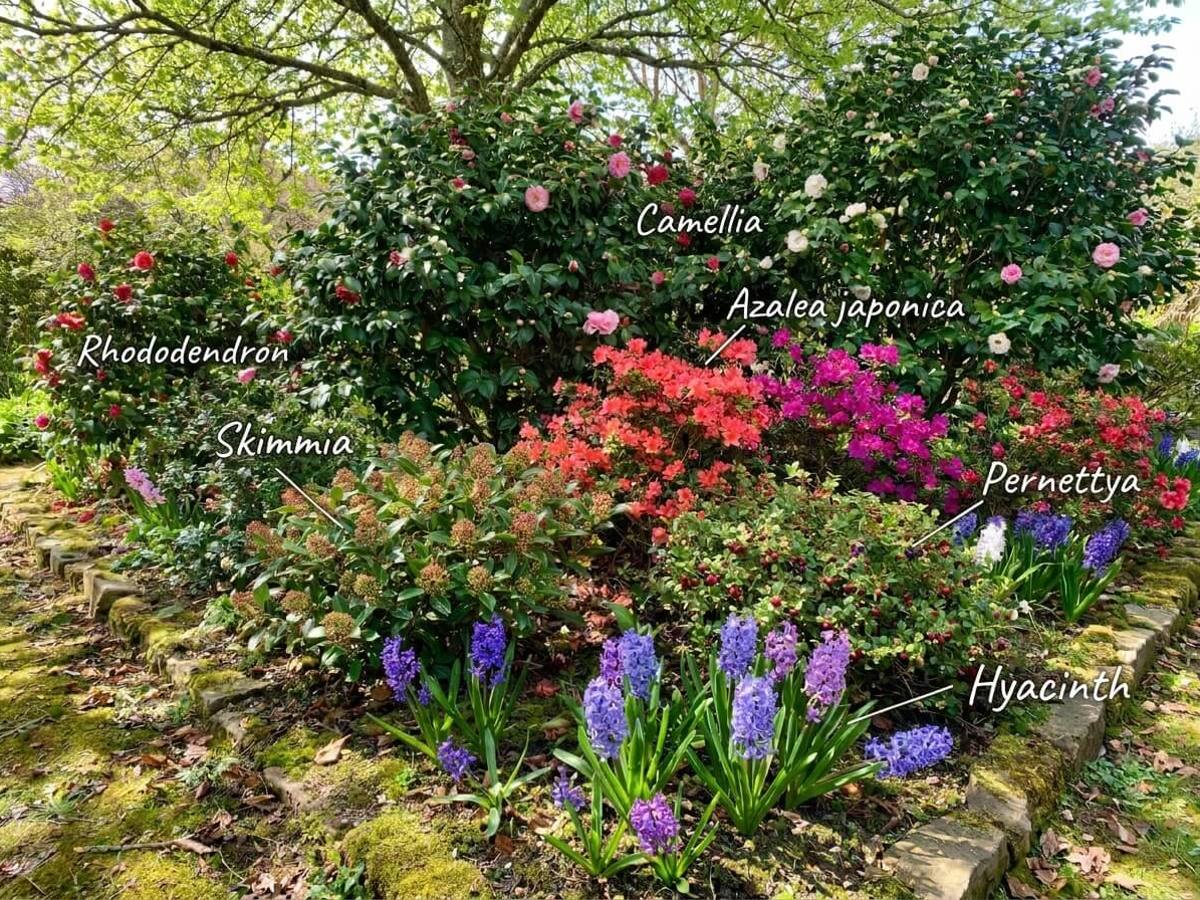
From back to front: Camellia, Rhododendron, Azalea japonica, Skimmia, Pernettya, Hyacinth.
At the back of the bed, Camellia does the structural work, building a tall column of dark, polished evergreen leaves that reads as a wall of green all year. It opens its flowers very early in spring, sometimes before winter has properly let go, so the scheme begins long before anything else wakes up. Those glossy leaves also make the perfect backdrop for everything planted in front, which is why nothing else belongs behind it.
Set just in front, Rhododendron gives the middle height and the big, full trusses of bloom that carry the bed in mid-spring. Its leaves are longer and more leathery than those behind it, so even out of flower the two shrubs read as different textures rather than one green mass. It wants the same acid, humus-rich, never-baked soil as the back of the scheme, which keeps the whole planting simple to look after.
Lower and denser, Azalea japonica steps the planting down from shrub height towards the path. Its small leaves and massed, smaller flowers give a fine texture that stops the bed looking top-heavy, and it tends to flower just as the trusses above it are fading, stretching the display by a fortnight or more. Keep it to the sunnier end of the partial shade and it flowers more freely.
Towards the front edge, Skimmia is the plant that holds the bed together in the months when nothing is doing anything. Tight buds colour up through winter, open into scented spring flowerheads, and the domed, neat habit never looks untidy. Female plants carry red berries through autumn and winter, so plant one male among them if you want fruit.
Right at the front, Pernettya is a low, wiry evergreen with tiny leaves and small bell flowers in spring, followed by marble-like berries that sit on the plant for months. It is the finest texture in the whole scheme, which is exactly what you want at the edge where you see the planting close up. Like everything else here, it insists on acid soil, so it slots in without changing a thing.
Threaded through the front and middle gaps, Hyacinth supplies the scent and the only strong block of colour at ground level in early spring. The flower spikes come up through bare soil while the shrubs above are still in bud, then the foliage dies back and disappears under the spreading evergreens. If you forced bulbs in pots over winter, they can be planted outdoors into these gaps once they have finished flowering indoors.
Work in four bands. Set a single Camellia against the wall, about 1 m out from it so air can move behind the leaves. Plant two or three Rhododendron in a loose group 1.2 m apart and 1 m in front. Then a drift of five Azalea japonica at 60 cm spacing, staggered rather than in a line, and in front of those a run of three to five Skimmia at 60 cm, with Pernettya filling the last 40 cm of edge at 40 cm apart. Drop Hyacinth bulbs in groups of five to seven, 10 cm deep and 10 cm apart, into the pockets between the two front bands.
From late winter the Camellia opens first, then Hyacinth pushes up with its scent at knee height, then Rhododendron and Azalea japonica take over through mid and late spring, with Skimmia flowering alongside them. Summer is a quiet green season of four different leaf textures, from the broad gloss at the back to the needle-fine front edge. Autumn and winter belong to the berries on Skimmia and Pernettya and to the fattening buds on everything else, so the bed is never bare, even in January.