Summer brings longer days in the garden and, for many rabbit owners, the joy of letting a pet rabbit roam on the grass. But a summer garden is also one of the most hazardous environments a rabbit can encounter.
Dozens of plants that are entirely normal in a well-tended border — plants you may have grown for years — are acutely toxic to rabbits. Some can kill within hours.
Knowing exactly which ones to pull off, and understanding why rabbits are so vulnerable, is non-negotiable.
Rabbits have a digestive system built for one thing: processing enormous quantities of high-fibre grass and hay. It’s highly efficient, but it has a critical weakness. Rabbits cannot vomit. Once a toxic plant is swallowed, there’s no ejecting it — the substance continues through the gut and into the bloodstream, often before any symptoms appear.
Domestic rabbits compound this issue further. Wild European rabbits (*Oryctolagus cuniculus*) develop behavioural aversions to dangerous plants over generations of exposure.
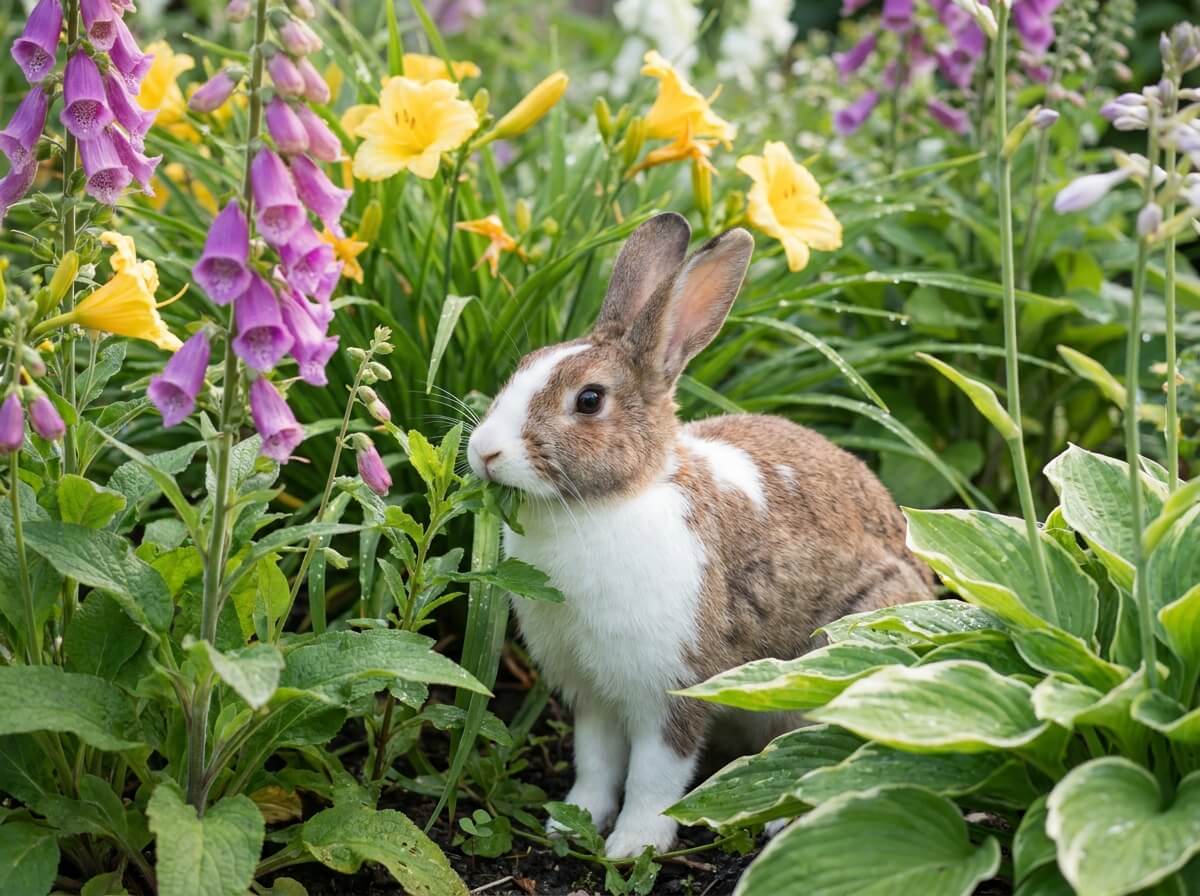
Pets raised indoors on pellets and hay have no such instinct. They will cheerfully nibble a foxglove as readily as a dandelion, with no warning signal telling them to stop.
The liver of a rabbit is also relatively small for the body’s mass, which limits its capacity to process and neutralise alkaloids and glycosides — the chemical groups responsible for toxicity in most dangerous garden plants. A dose that might cause mild discomfort in a larger animal can be lethal in a 2kg rabbit.
Some plants in this list are common to almost every garden. Don’t be surprised — the worst offenders are often the most beloved ornamentals.
See also the common mistakes gardeners make with toxic plants and pets — several principles there apply directly to rabbits.
These are the plants that catch owners off guard, because they appear harmless or even edible.
Tomato and potato plants — both members of the nightshade family — have leaves and stems that contain solanine. The ripe fruit of a tomato is generally considered low-risk, but the foliage isn’t.
If your rabbit has access to the vegetable patch, this matters.
Daffodil bulbs, leaves, and flowers (*Narcissus* spp.) contain lycorine and alkaloids that cause severe gut disturbance and, in sufficient quantity, cardiac issues. Rabbits occasionally dig, and a bulb pulled to the surface is a real hazard.
Tulips carry similar bulb-based toxins.
Iceberg lettuce is worth a separate mention. It isn’t poisonous in the way foxglove is, but it contains lactucarium in concentrations that cause loose stools and, with regular feeding, liver damage.
Many owners assume any lettuce is rabbit food. This is dodgy thinking. The varieties that are actually safe are dark-leafed: romaine, cos, and lamb’s lettuce in small quantities.
Lawn daisies are fine. Dahlias, however, are mildly toxic and best kept out of reach.
Walk the perimeter of any area your rabbit will access. Get low — literally crouch or kneel — and look at it from rabbit height.
What stems, fallen petals, or groundcover plants are within reach that you wouldn’t have noticed from standing height?
Pull off any plant from the list above entirely, not just from rabbit-level. A cut foxglove spike left to dry nearby, a yew clipping blown by the wind, a rhubarb leaf composted in an open heap — all remain hazardous.
Bag the material and bin it; don’t compost high-toxin plants if the heap is accessible to any animal.
Create a defined safe zone rather than trying to make an entire garden rabbit-safe overnight. A simple wire playpen — at least 60cm tall, secured at the base so it can’t be nosed underneath — gives a controllable perimeter.
Stock it with known-safe plants:
Get your outdoor area properly sorted. So, supervision is non-negotiable. Even in a well-audited space, a rabbit can reach through a fence, pull in a neighbouring plant, or find something you missed.
Thirty minutes of apparently calm grazing can still end in a call to the vet if something unexpected was within reach.
The thing is, the window for effective intervention is short. Symptoms of plant toxicity in rabbits include:
Don’t wait to see if symptoms pass. A rabbit showing two or more of these signs after outdoor access needs emergency veterinary care. Call ahead to confirm your vet treats rabbits — not all do. The Royal Veterinary College’s rabbit care resources include guidance on finding rabbit-specialist vets in the UK.
If you saw what the rabbit ate, take a sample — a photograph or a clipping in a bag — to the vet. Identifying the plant does wonders for the vet to target treatment, which matters when alkaloid toxins are involved and specific antidotes or supportive care protocols differ.
For gardeners in Australia, New Zealand, and South Africa, June is the middle of winter. Your rabbit’s outdoor access may be reduced, but many toxic plants remain in borders year-round — particularly rhubarb, yew hedging, and rhododendrons.
And remember, use the cooler months to audit and restructure your outdoor rabbit zones before spring, when growth accelerates and rabbits spend far more time outdoors.

Smart tip: If a rabbit stops eating hay within two hours of outdoor time, treat it as a potential poisoning emergency.
Yes — plain grass is safe and nutritionally similar to hay. Avoid grass treated with herbicides, pesticides, or lawn feed within the last 4–6 weeks.
It varies by plant. In foxglove, every part including dried flowers and water from cut stems carries cardiac glycosides.
In rhubarb, the leaves are toxic but the stalk is largely safe. Always research the specific plant, not just the genus.
Yes. Many toxins show a delayed onset of 30 minutes to several hours.
“Seeming fine” isn’t clearance. Call your vet and describe exactly what was eaten.
Fallen leaves from yew, rhododendron, and oak carry concentrated toxins and should be pulled off promptly. Fallen apple or pear leaves in small quantities are generally fine.