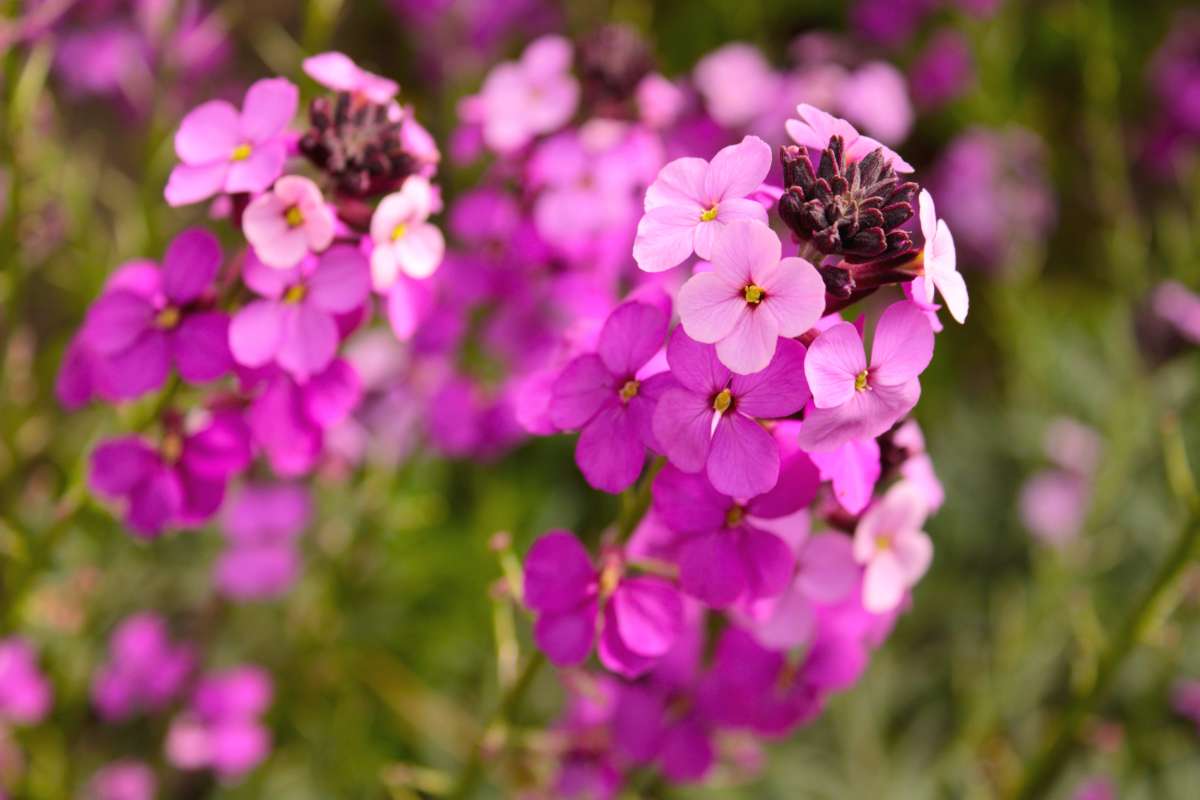
Clove-scented flowers crowd every stem, and the plant will seed itself into the crevices of an old stone wall as readily as into a bed or a garden box. Wallflower (Erysimum) is grown for that fragrance and for the sheer quantity of bloom; give it full sun and well-drained soil and it thrives where almost nothing else will.
| Name | Erysimum |
|---|---|
| Family | Brassicaceae |
| Type | annual or biennial |
| Height | 8 to 16 inches (20 to 40 cm) |
| Exposure | full sun |
| Soil | ordinary, well drained |
| Flowering | mid-spring to mid-autumn depending on the variety |
What you’ve got with this wallflower is a plant that will actually thrive where usually none of the other plants can grow.
When purchased in small pots, it is a good idea to plant in spring or in fall. Settling it down near a passing place is interesting since it releases a delightful fragrance.
Regarding any wallflower seeds you may want to sow, simply sow in a nursery starting from the month of early spring and transfer to the ground during late spring.
Summer wallflower, for its part, requires sowing in late winter to early spring in a sheltered place. After that, you can transfer it to the growing bed in late spring for it to bloom in summer.
But you can also sow directly in the ground, especially ravenelle wallflower, once any risk of frost is set aside, from late spring to midsummer.
Wallflower can be bought in pots or raised from seed, and the timing changes with the route you take. Here are the options described above, side by side.
| Method | When to start | Move to final spot | Good to know |
|---|---|---|---|
| Plants bought in small pots | Spring or fall | Planted straight where it will grow | Water over the first weeks after planting |
| Seed sown in a nursery | From early spring | Transferred to the ground in late spring | The standard route for garden seed |
| Summer wallflower, sown under shelter | late winter to early spring, in a sheltered place | Growing bed in late spring | Blooms in summer |
| Direct sowing in the ground | late spring to midsummer, once frost risk has passed | Sown where it will flower | Thin to 12 inches (30 cm) once several leaves show |
Whichever route you choose, a very sunny spot and well-drained soil matter more than any feeding.
Wallflowers split into two camps: the short-lived biennials sown for a spring display, and the shrubby evergreen perennials that flower for months on end. The table below sets out the varieties most often found on sale.
| Variety | Type | Flower colour | Main flowering | Habit |
|---|---|---|---|---|
| Bowles’s Mauve | Evergreen perennial, from cuttings | Mauve-purple | Late winter to autumn | Medium, bushy and woody-based |
| Harpur Crewe | Perennial, sterile, from cuttings | Double golden yellow | Spring | Low, compact |
| Ivory White | Biennial, from seed | Creamy white | Spring | Medium bedding |
| Primrose Bedder | Biennial, from seed | Soft primrose yellow | Spring | Dwarf, for edging and pots |
| Winter Orchid | Evergreen perennial, from cuttings | Orange opening, ageing purple-pink | Winter to spring | Low to medium, compact |
| Apricot Twist | Evergreen perennial, from cuttings | Apricot-orange | Spring into summer | Medium, bushy |
| Orange Bedder | Biennial, from seed | Bright orange | Spring | Dwarf, for edging and pots |
| Sugar Rush Orange | F1 seed, flowers in its first year | Orange | Spring, and again from a summer sowing | Dwarf, for pots and bedding |
| Fire King | Biennial, from seed | Orange-scarlet | Spring | Medium bedding |
| Tom Thumb Mixed | Biennial, from seed | Mixed shades | Spring | Dwarf, wind-resistant |
| Persian Carpet | Biennial, from seed | Mixed reds, golds and bronzes | Spring | Medium bedding |
| Blood Red | Biennial, from seed | Deep velvety red | Spring | Medium bedding |
| Cloth of Gold | Biennial, from seed | Golden yellow | Spring | Medium bedding |
| Constant Cheer | Evergreen perennial, from cuttings | Amber ageing to mauve | Spring into summer | Low to medium, spreading |
| Vulcan | Biennial, from seed | Crimson-purple | Spring | Low to medium bedding |
No specific care is required, but, to boost flower-bearing, remove wilted flowers often.
If your wallflower starts spreading too far, simply pull a portion of it out – but don’t do this when seeds are about to fall or you’ll be sowing a trail of wallflowers behind you!
If slugs and/or snails wreck havoc, you’ll have to find a way to make them flee… just as you’ll have to deal with the caterpillars of that elegant white butterfly, Pieris brassicae (otherwise called the cabbage moth).
Very aesthetic and bearing incredible amounts of flowers, this perennial grown as an annual or a biennial is aptly called flower of the wall.
Indeed, it settles right in any old stone wall, where it sows seeds in nooks and crannies year after year.
It also does great, however, in flower beds and garden boxes with its beautiful, short-lived but abundant blooming.
The flower definitely releases a fragrance that is close to that of cloves, quite intriguingly so.
It adapts to the most difficult growing spots, and decorates them in a transcending manner.
Cut off flowers that have finished blooming, this will trigger appearance of more flowers.