Stromanthe sanguinea: tropical foliage care and propagation
0
Few houseplants deliver colour quite like Stromanthe sanguinea, whose long, lance-shaped leaves are brushed with cream and green above and flushed a deep raspberry-pink beneath. Grown almost exclusively as an indoor or conservatory plant in temperate regions, it forms a dense, fountain-like clump of upright foliage. Like its relatives the prayer plants, it raises its leaves vertically at dusk, revealing the full blaze of pink undersides.
Growing conditions
Stromanthe evolved on the shaded forest floor, so it wants plenty of light without a single ray of hot sun. An east-facing windowsill, or a position a metre or so back from a south- or west-facing window, suits it perfectly. Direct midday sun scorches the pale variegation within days, whilst deep gloom makes the pink fade and the stems stretch.
Use an open, moisture-retentive compost: two parts peat-free houseplant compost to one part fine bark and one part perlite gives the balance of water retention and air that the fleshy rhizomes need. A slightly acidic mix, around pH 6 to 6.5, keeps the foliage a strong colour. Never let the plant sit in a saucer of standing water.
Humidity matters more than almost anything else — aim for 50 to 60 per cent and avoid draughts, radiators and cold glass. Outdoors it can only be grown year-round in frost-free, humid climates (USDA zones 10–12), though pots can summer outside in a sheltered shaded corner once nights stay above 15 °C.
How to plant Stromanthe
Pot or repot in spring, just as new leaf spears appear, so the plant can root quickly into fresh compost during its active growing season. Autumn and winter repotting often leads to sulking and root rot.
Allow 45–60 cm between plants in a grouped display or a conservatory bed; crowded clumps trap stale air and invite fungal leaf spotting.
Set the rhizome so the crown sits level with the compost surface — burying it causes rot, exposing it causes drying.
Choose a pot only 2–4 cm wider than the old one; stromanthes flower and clump better when slightly snug, and oversized pots stay wet.
Water in thoroughly with tepid rainwater until it runs from the drainage holes, then let the surface dry slightly before watering again.
Propagate by division in spring: tease the rhizome apart so each piece carries at least three healthy leaves and its own roots, then pot up and keep warm and humid for a fortnight.
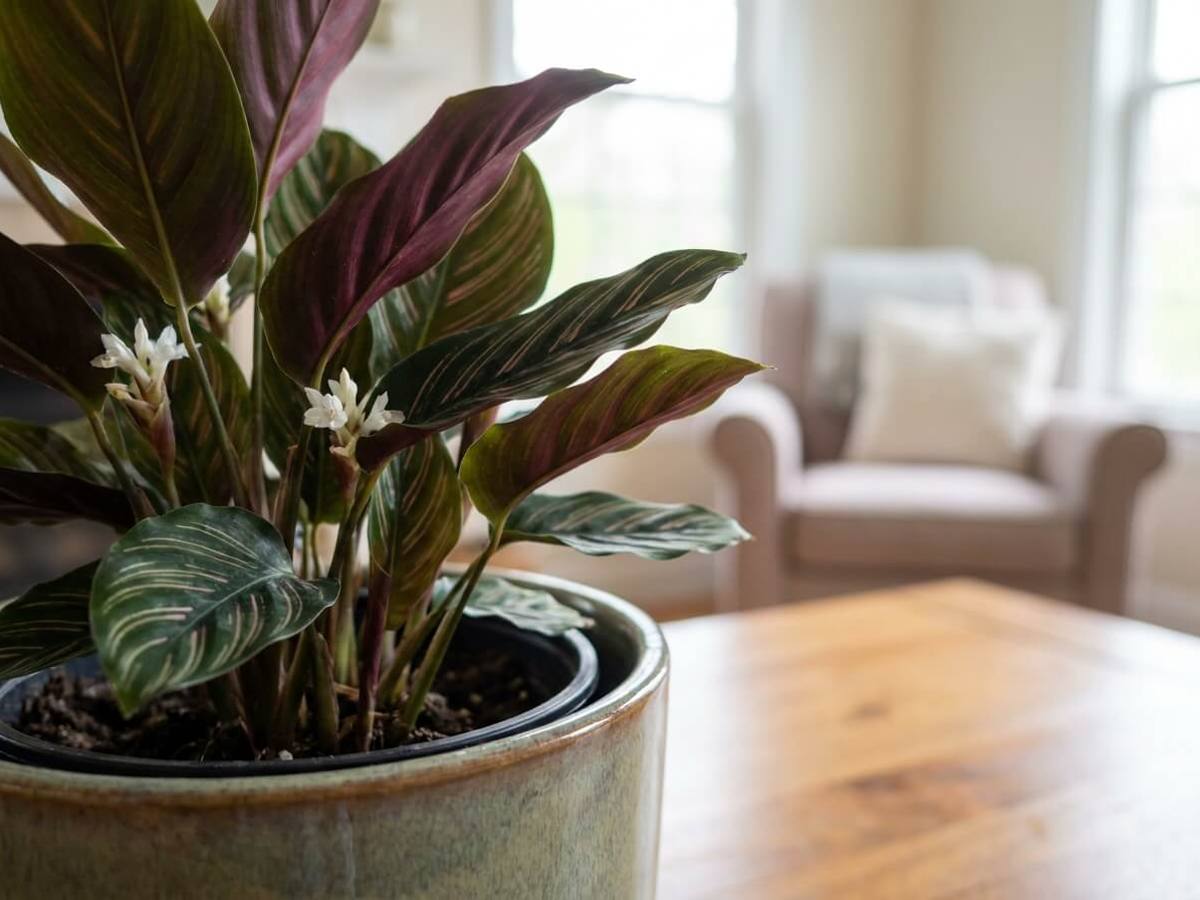
Stromanthe sanguinea displayed as a houseplant in a home interior
Care through the seasons
Spring: Growth restarts as light levels lift, so begin feeding every three to four weeks with a balanced liquid feed at half strength. This is the window for repotting and division, and for removing any leaves damaged over winter. Flower spikes with red bracts and small white flowers may appear on mature plants.
Summer: Water whenever the top 2–3 cm of compost feels dry — typically once or twice weekly — using rainwater or filtered water at room temperature. Mist in the morning, stand the pot on a damp pebble tray, or group plants together to raise humidity. Keep well away from air conditioning and open windows in heatwaves.
Autumn: Taper feeding off from late September and reduce watering as light fades and growth slows. Wipe dust from the leaves so the plant makes the most of weaker sunlight, and move it closer to a window if the room is dim. Remove faded flower bracts and any tired outer leaves at the base.
Winter: Keep the compost barely moist and the temperature above 15 °C, never below 12 °C. Central heating is the main enemy — raise humidity and keep foliage clear of hot, dry air.
Best varieties to grow
Almost all plants sold are selected variegated clones rather than the plain green wild species.
‘Triostar’ — the classic form, with irregular cream, pale green and deep green streaks over magenta-pink undersides; sometimes listed as ‘Tricolor’.
‘Multicolor’ — a boldly marbled selection with broader creamy-white sectors and strong pink reverses.
‘Stripestar’ — dark glossy green leaves with a slim pale midrib stripe and intense burgundy undersides, excellent in lower light.
‘Magicstar’ — finely speckled and splashed cream variegation on a compact, bushy plant, good for smaller rooms.
Pests, diseases and common problems
Red spider mite: Fine webbing in the leaf axils and a dull, stippled bronze cast to the foliage, always worst in dry heated air. Raise humidity, shower the leaves with tepid water, and treat undersides weekly with an organic soap spray.
Mealybug: White cottony tufts where the leaf stalks meet the stem, with sticky residue below. Dab each colony with a cotton bud soaked in surgical spirit, then follow up with a plant-based insecticidal soap for three weeks.
Brown, crispy leaf edges: Caused by dry air, erratic watering, or the fluoride and chlorine in tap water. Switch to rainwater or water left to stand for 24 hours, keep humidity above 50 per cent, and trim damaged tips with clean scissors.
🌿 Nature & Garden Newsletter
Gardening tips, recipes & seasonal advice, twice a week.