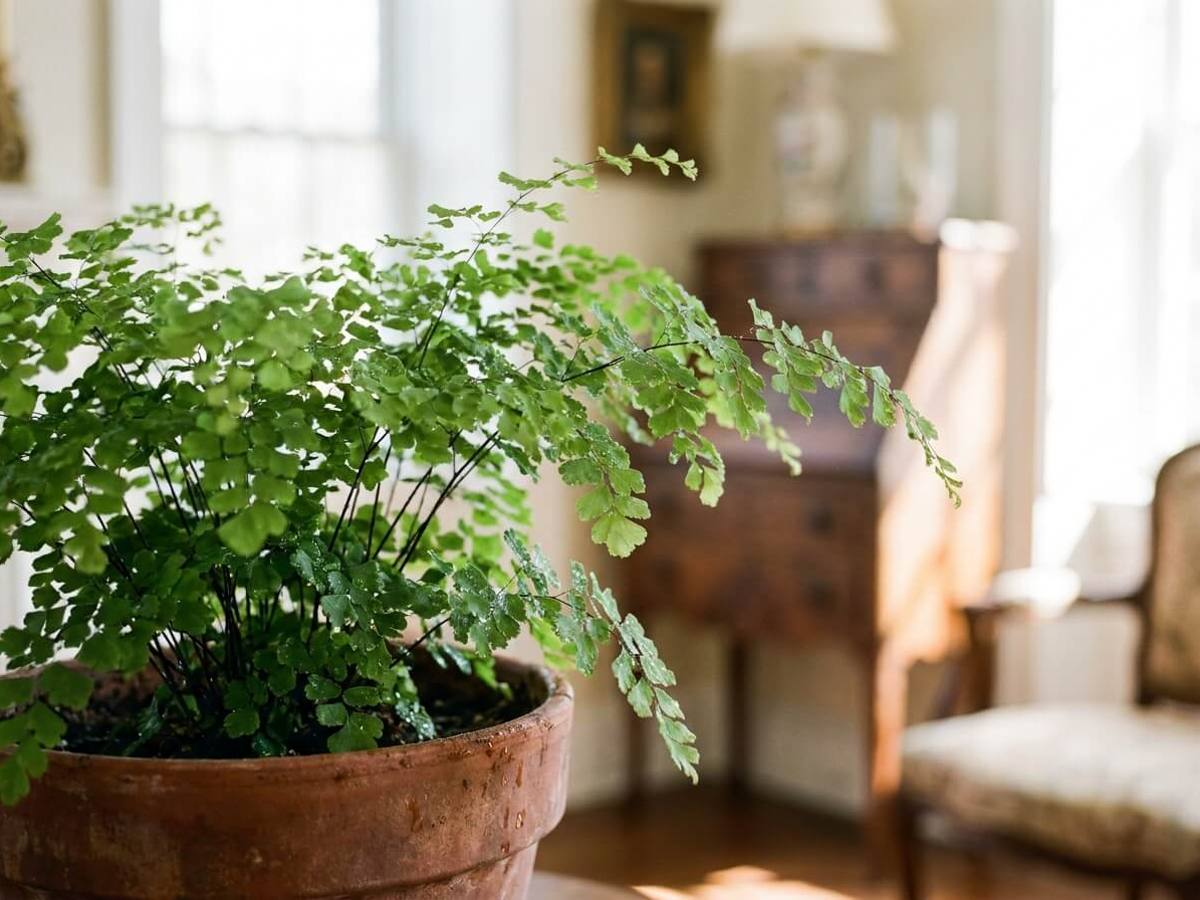
The delta maidenhair fern is the most delicate-looking of all the ferns commonly grown indoors, with fans of tissue-thin, fresh green pinnules held on glossy, wire-black stalks. It forms a softly arching mound that suits a shaded bathroom shelf, a shady conservatory or a sheltered patio corner in summer. Its most distinctive trait is that the foliage is water-repellent — rain and mist simply bead up and roll away.
Growing conditions
Think of the forest floor beneath a canopy: bright but filtered light, with no direct sun on the fronds at any point in the day. An east-facing windowsill or a position a metre back from a south-facing window suits it well. Direct summer sunshine scorches the pinnules within hours.
Use an open, humus-rich compost — a peat-free houseplant mix lightened with perlite and fine bark gives the free drainage the fine roots demand. A slightly acid to neutral pH of around 5.5 to 7.0 is ideal. The compost should stay evenly moist, never sodden and never bone dry.
This is a tender tropical species from Central and South America and will not survive frost. Keep it above 10 °C all year, with 16–24 °C the sweet spot, and give it humidity of 50 per cent or more. In mild, frost-free coastal gardens it can be grown outdoors in deep shade, but elsewhere treat it as an indoor plant that may holiday outside from June to early September.
How to plant Adiantum
Pot or repot in spring, just as the tightly coiled new croziers begin to unfurl, so the plant can root quickly into fresh compost. Avoid repotting in winter when growth has stalled.
If grouping several plants in a trough or terrarium, space them 25–30 cm apart so air can move between the crowns and discourage rot.
Set the rhizome so its top sits level with the compost surface — burying the crown is the commonest cause of collapse.
Mix a handful of leaf mould or fine composted bark into the potting mix to hold moisture whilst keeping the blend open.
Water in thoroughly with tepid rainwater until it runs from the drainage holes, then let the surplus drain away completely.
Propagate by dividing congested clumps in spring: tease the rhizome apart into sections, each with several fronds and healthy roots, and pot on individually.
Adiantum raddianum displayed as a houseplant in a home interior
Care through the seasons
Spring: New fronds appear as dark, fiddle-like croziers; handle the plant as little as possible whilst they expand, as they bruise easily. Begin feeding every three to four weeks with a balanced liquid feed diluted to half strength. Trim away any fronds that browned over winter, cutting the stipe right down at the base.
Summer: This is the thirsty season — check the compost every two or three days and water before the surface dries out. Stand the pot on a tray of damp gravel or group it with other plants to lift local humidity, and keep it away from open windows and draughts. If the plant goes outdoors, choose a shaded, sheltered spot with no midday sun.
Autumn: Bring any plants that summered outside back under cover well before night temperatures fall below 12 °C. Stop feeding by mid-autumn and reduce watering gradually as light levels drop. Autumn is also a reasonable time to divide an overgrown clump if you missed the spring window.
Winter: Growth slows almost to a standstill; water sparingly but never let the rootball dry out entirely. Move the plant away from radiators and cold glass, both of which crisp the foliage within days.
Best varieties to grow
Several cultivars offer different frond textures and growth habits, all needing identical care.
‘Fritz Luth’ — vigorous and arching with broad, overlapping pinnules, and the holder of the RHS Award of Garden Merit.
‘Fragrantissimum’ — a robust, fast-growing form with a faint sweet scent to the foliage and good tolerance of average room humidity.
‘Micropinnulum’ — finely divided with tiny, closely set pinnules giving a lacy, almost mossy appearance.
‘Kensington Gem’ — larger fronds with a slightly bluish cast and a distinctly upright, shuttlecock-like habit.
Pests, diseases and common problems
Crisp brown frond tips and margins: almost always dry air, dry compost or fluoride and salts in tap water. Switch to rainwater or cooled boiled water, raise humidity, and snip off the damaged fronds at the base.
Scale insects and mealybugs: look for sticky residue and brown bumps on the black stipes. Wipe them off with a cotton bud dipped in dilute soft soap solution — avoid spraying oils or strong insecticidal soaps over the fronds, which maidenhairs resent.
Root rot and crown collapse: blackening stalks and a sour-smelling compost mean the plant has sat in water. Repot into fresh, open compost, trim away mushy rhizome, and always empty the saucer after watering.