
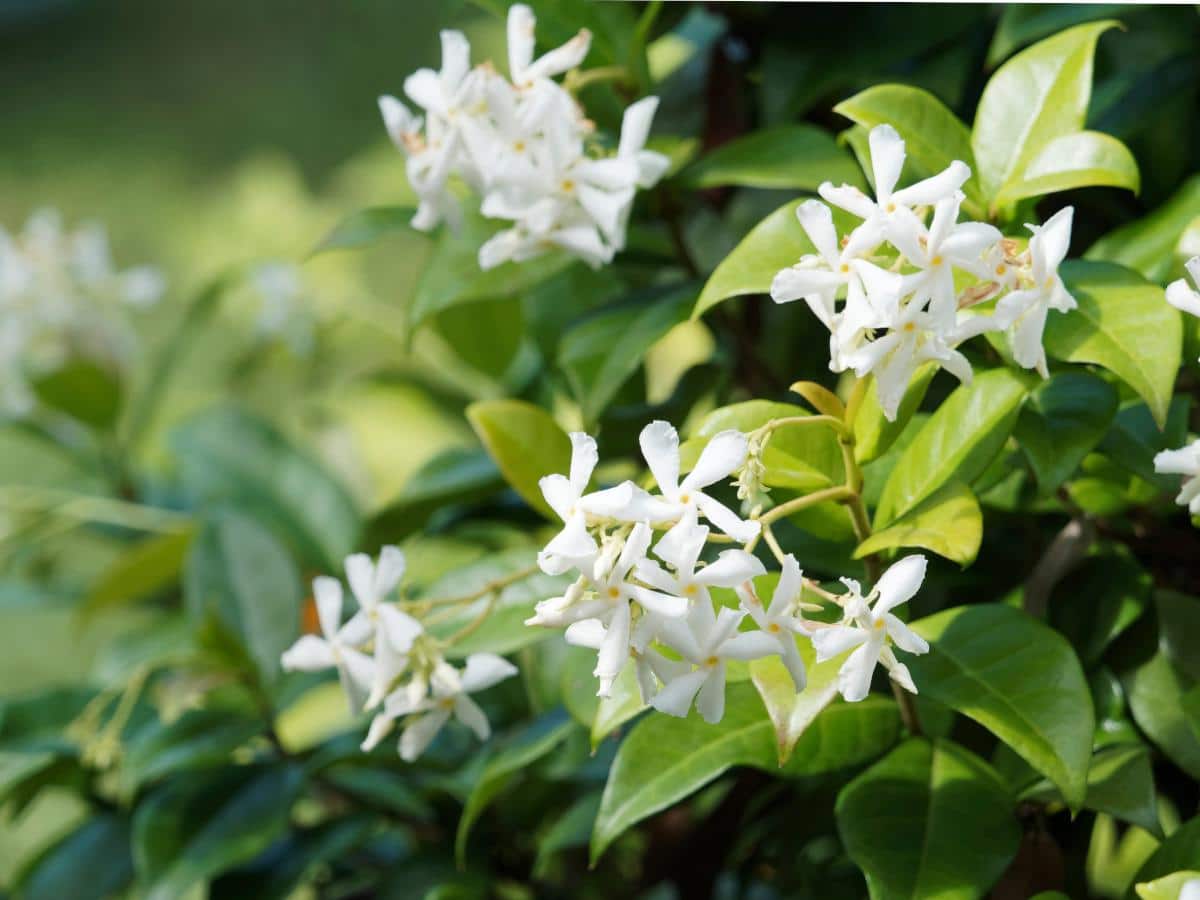
Its summer flowers give off a scent so close to true jasmine that the plant borrowed the name, carried above glossy leafage that stays on all year. Star jasmine (Trachelospermum jasminoides) will cover a wall to 16 feet, or spread as ground cover instead. Give it real warmth and the fragrance follows.
| Name | Trachelospermum jasminoides |
|---|---|
| Family | Apocynceae or dogbane |
| Type | climbing shrub |
| Height | 16 feet (5 m) |
| Exposure | full sun |
| Soil | well-drained |
| Foliage | evergreen |
| Flowering | summer to fall |
If you’re looking for advice on winter jasmine, often used for growing indoors, follow this link.
Planting, care or pruning must all follow good practices to increase the blooming.
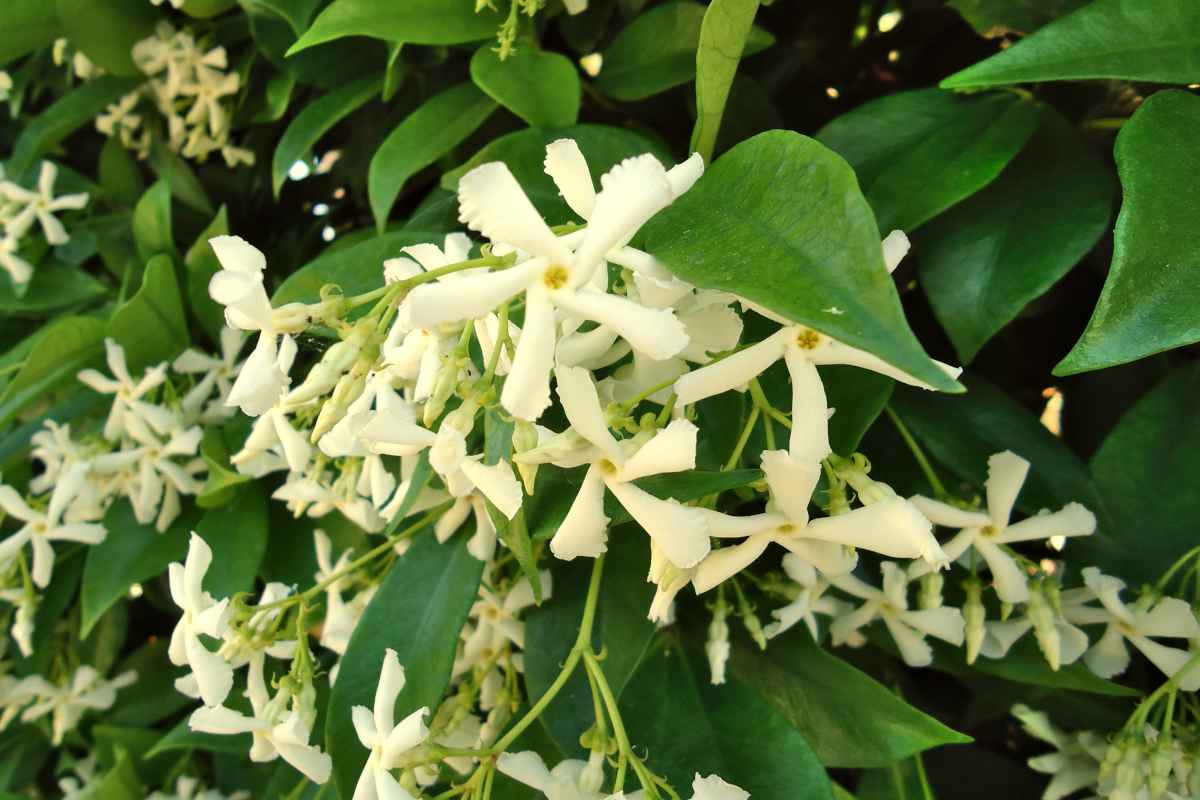
Star jasmine is planted either in fall or in spring.
Make the most of its smooth jasmine fragrance, and set it up near a passageway or a window so that you may benefit from it with all your senses, not only the eyes!
Prepare star jasmine cuttings. It is rather easy, and is most successful when performed in spring.
Rather straightforward, caring for star jasmine can even be left to minimum care once the plant is correctly settled in.
Caring for star jasmine

Star jasmine is a plant that doesn’t need much care, especially when properly settled in.
Drought within the first two years after planting is the only reason you’ll need to water it.
Add flower plant fertilizer in spring to enhance your star jasmine’s blooming.
Pruning star jasmine
Star jasmine asks for very little, but each task has its moment in the year. Here is what to do, when to do it, and what it brings.
| Task | When | What it does |
|---|---|---|
| Planting | Fall or spring | Avoid spells that are too hot or freezing |
| Cuttings | Spring | Easiest and most successful time to propagate |
| Pruning | End of winter or very start of spring | Not required, but an annual makeover enhances blooming |
| Feeding | Spring | Flower plant fertilizer enhances blooming |
| Watering | First two years, in drought only | Settled plants need no other watering |
Once the plant is correctly settled in, minimum care is genuinely enough.
Why isn’t your star jasmine blooming? Perhaps it’s too cold in your area. Star jasmine can only bloom well in places where it doesn’t get too cold. If it isn’t hot enough, you’ll get plenty of leaves but maybe never get flowers.
If after 2 years you haven’t yet had any flowers, this is probably the reason. Best unearth your plant and move it to a greenhouse or a lean-in, in a large pot.
Your vine might get covered in scale insects or tiny red spiders. In both cases, make sure to treat the plant early so the plant isn’t overrun.
If you want a named form, look for ‘Variegatum’, ‘Tricolor’ and ‘Madison’, each carrying the same evergreen leafage that lasts all year long and equally suited to covering a wall, spreading as ground cover, or staying small in a pot.
Star jasmine, native to Asia and sometimes called Indian jasmine, earned its name from the fragrance that smells a lot like jasmine that emanates from its blooming.
Its inflorescence is very beautiful and its evergreen leafage lasts all year long.
This very beautiful climbing shrub is easy to care for and maintaining it is a breeze.
It is perfectly suited to covering a wall, but also makes for great ground cover or pot arrangement material.
Note that if you grow it in a pot it will stay small.
At the beginning, attach your star jasmine to a lattice because it has trouble starting off, but afterwards it will wind around on its own.
Read also:
If you’re hoping for it to climb, help it out at the beginning because it isn’t quite good at attaching itself at the start.
I have a huge star jasmine creeper which was planted 34 years
some of it has failed
do these creepers have a life span ?
could it be just old and dying ?
some of it however look very healthy
The unhealthy dying part is not planted in the same hole as the healthy bit