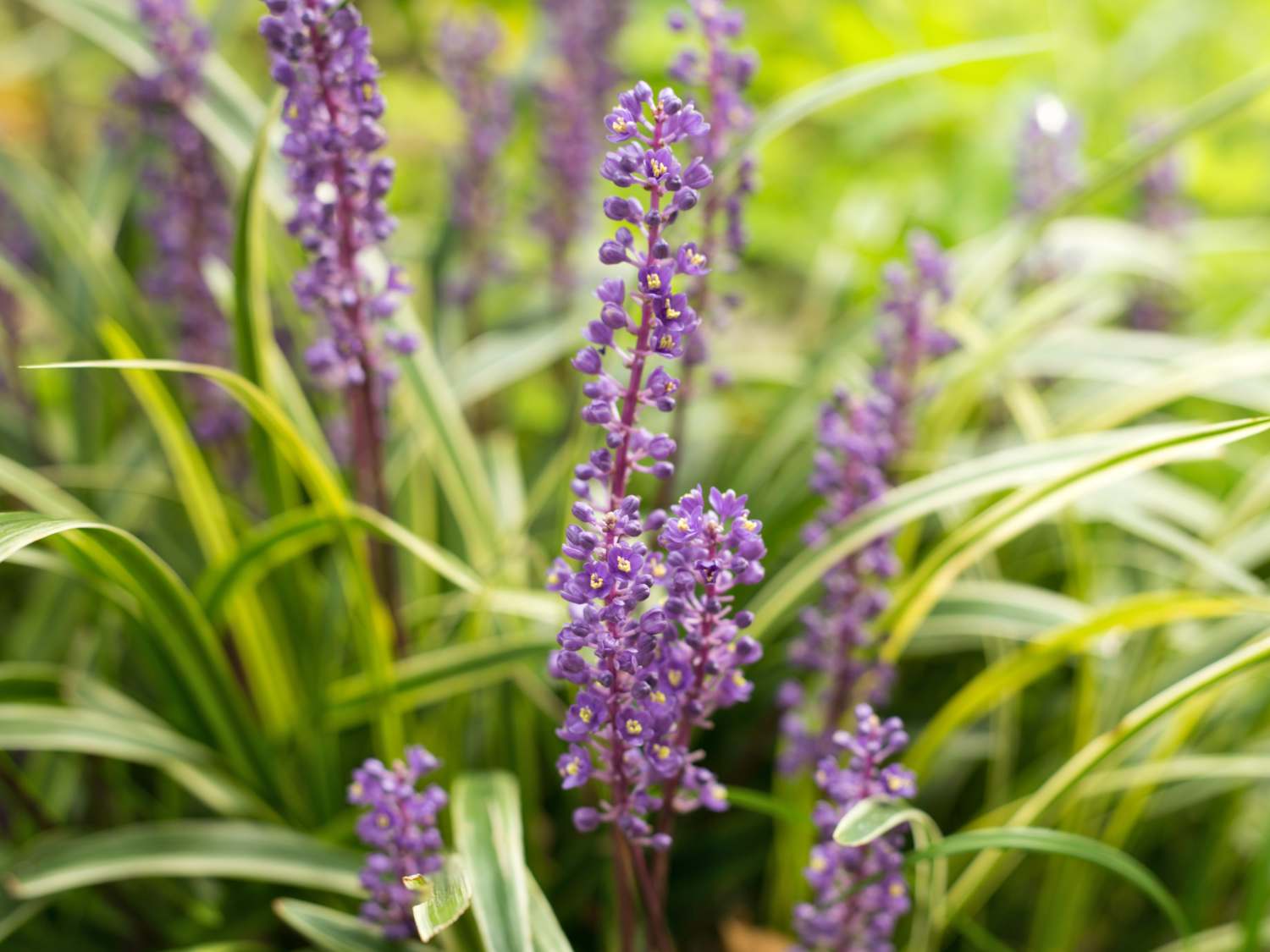
Ribbon-like leaves fan out in arched rosettes that read as grass until, in summer, spikes of purplish-mauve flowers rise from them like muscari. Lily turf (Liriope muscari) is a tough evergreen perennial for shaded beds and pots; give it neutral to slightly acidic, well-draining soil and it asks for almost nothing else.
Liriope muscari Key facts:
| Latin name | Liriope muscari, Liriope platyphylla |
|---|---|
| Family | Liliacea |
| Type | perennial, evergreen |
| Shape | arched clumps |
| Height | 12 to 16 inches (30 to 40 cm) |
| Plant density | 7 to 8 plants per 10.8 square feet (7 to 8 plants per m²) |
| Exposure | shade to partial shade |
| Soil | any, but prefers slightly acidic and well-draining |
| Flowering | summer, from midsummer to late summer |
With its ribbon-like leaves grouped in a rosette, giving it the appearance of grass, the Liriope muscari is a sturdy and evergreen perennial. In summer, its clusters of purplish-mauve flowers, reminiscent of the muscari, add a charming touch to your flower beds.

Fond of neutral to slightly acidic soils, Liriope muscari thrives in shaded or semi-shaded areas. To ensure healthy growth during the initial months, mix in some potting soil, compost, or well-decomposed manure with your garden soil.
If your soil tends to hold onto water, consider adding a drainage layer at the bottom. Pozzolana and vermiculite are top picks as they allow water to pass while retaining just the right amount of moisture for plants.

Taking care of Liriope is extremely easy.
The only task to take on is to cut the foliage back at the beginning of spring, around early spring.
This refreshes the plant and gets rid of wilted stems.

Want more Liriope muscari? Splitting up the clump is your best option.
For a better survival rate, do this in fall. Fall, winter and spring then gives the plant ample time to settle in before the dry summer days hit.
Liriope muscari rarely falls ill. But, like many plants, its young shoots sometimes attract slugs and snails.
Liriope muscari asks for very little, and what it does ask for falls at set moments of the year. Here is the full round of tasks, and when each one is due.
| Job | When | What to do |
|---|---|---|
| Prepare the planting spot | At planting | Mix potting soil, compost or well-rotted manure into the garden soil |
| Add drainage | At planting, on wet soil | Lay pozzolana or vermiculite at the bottom of the hole |
| Cut back the foliage | Early spring, around early spring | Shear off wilted stems to refresh the clump |
| Divide the clump | Fall | Lift with a digging fork, cut apart with a sharp spade, replant |
| Watch for pests | As young shoots appear | Protect the soft new growth from slugs and snails |
Beyond these few moments, the clump is best left alone.
Named forms of lily turf differ mainly in leaf colour and in the shade of the flower spikes, which decides whether the clump reads as a quiet green edging or as a bright ribbon of variegation. The table below sets out the forms most often found on sale.
| Variety | Foliage | Flower colour | Best use |
|---|---|---|---|
| ‘Monroe White’ | Plain dark green | White | Shaded beds, evening interest |
| ‘Big Blue’ | Plain deep green, broad | Violet-blue | Reliable all-purpose edging |
| ‘Variegata’ | Green with creamy-yellow margins | Mauve-purple | Lighting up dry shade |
| ‘Gold Banded’ | Arching green, gold-edged | Lavender | Pots and container edges |
You can grow Liriope muscari in pots. But something that truly makes it stand out is pairing it with other plants! Partner it up, and let its beauty pop.
Good companions, visually, include Ophiopogon planiscapus ‘Nigrescens’ or an Euonymus fortunei ‘Emerald’n Gold’ for a color contrast. Or, go with an Omphalodes cappadocica or Bergenia for some leafy variety.
In Liriope muscari, the purple flower spikes are followed by small blue-black berries, so leaving the stems standing after bloom preserves that fruit display instead of removing it by deadheading.
Liriope muscari and the green leaf variety of Ophiopogon planiscapus can look like twins. Keep your eyes on labels when buying your plants!