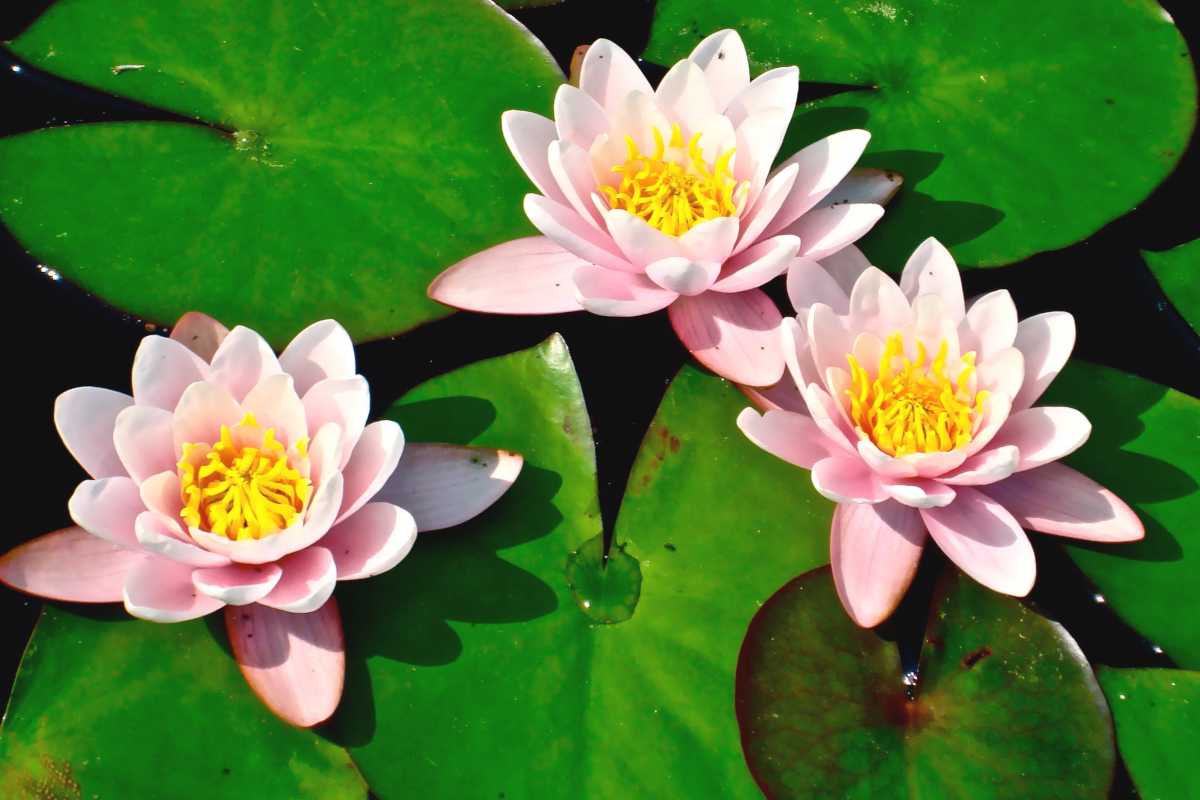
A single plant can carpet a square yard of water surface, and by summer it is covered in blooms: that is the water lily (Nymphaea x hybrida), a rhizomatous perennial native to Europe and North America. Give it full sun and at least six inches of water, and it will flower year after year untouched.
Water lily at a glance
Name
Nymphea x hybrida
Family
Nymphaeaceae
Type
aquatic plant, perennial
Height
4 to 6 inches (10 to 15 cm)
Exposure
full sun
Soil
with high levels of humus, heavy
Foliage
deciduous
Flowering
Summer
This easy-to-grow plant simply needs a small body of water for the water lily to grow.
Planting water lily
Planting is performed in spring and of course at the bottom of the body of water: 6 inches (15 cm) of water are enough for most species, although some may require a greater depth.
Put some heavy clay soil in a pot or tray for the plant to remain weighted to the bottom, and plant the water lily in it.
Spread rocks over the soil to keep it from floating back up.
Special baskets designed for planting water lilies can be found in horticulture stores, they help water circulate well without letting the soil disperse throughout the water basin.
There are even specific soil mix preparations for aquatic plants.
Once your basket is ready, immerse it in water. Ideally, let it rest about 24 inches (60 cm) deep.
When purchasing your water lily, check that its base is well developed underwater and that it seems quite vigorous, with a few buds that are about to open.
Regular care for water lily
Once properly settled in, your water lily won’t need any follow-up and will simply bloom year after year without even needing to touch it.
If it starts to turn invasive, simply pull out excess rhizomes regularly.
Of course, no need to water! Simply check that there is always enough water in the pond, minimum about 4 inches (10 cm).
Pull offyellowing pads and spent flowers at the base of their stalks, as decaying leaves foul the water and feed algae.
Keep the plant well away from a fountain or waterfall, because water lilies sulk and rot where the surface is constantly splashed.
Feed aquatic plants with slow-release fertiliser tablets or pellets pushed deep into the basket compost, since loose granules dissolve readily into the water and can release nutrients that encourage algae.
When a hardy waterlily’s blooms shrink and its leaves crowd and rise above the water surface, the plant is congested: lift the basket in spring and divide the rhizome.
Diseases and parasites that attack water lilies
Apart from ducks and the occasional muskrat that sometimes eat the rhizomes, only very few diseases have been seen to deplete the plant.
Indeed, it is a very hardy and resilient plant, and stress is perhaps the only factor that can endanger your water lily.
Water lily aphids (Rhopalosiphum nymphaeae) cluster on floating leaves and flower buds, and a common control is to hose them into the water, where fish may eat some, though results vary.
China mark moth caterpillars cut neat oval pieces from the leaf edges and glue them into little floating cases, so pick off the damaged leaves and the cases with them.
Hardy water lilies worth looking for
Hardy water lilies are sold by planting depth as much as by colour: match the variety to how deep your pond or container actually is. The vigorous reds and whites need a proper pond, while the smallest kinds are happy in a tub on a terrace.
Hardy water lilies worth looking for
Variety
Flower colour
Planting depth
Best for
‘Attraction’
Deep red with white-tipped petals
45–90 cm
Large ponds
‘Escarboucle’
Vivid crimson
45–75 cm
Medium to large ponds
‘Marliacea Chromatella’
Soft canary yellow
30–75 cm
Medium ponds, mottled leaves
‘Froebelii’
Deep burgundy red
20–45 cm
Small ponds
‘Pygmaea Helvola’
Small yellow
15–30 cm
Tubs, barrels, containers
‘Charlene Strawn’
Fragrant yellow, star-shaped
30–60 cm
Medium ponds
Learn more about water lily
Water lily is a plant native to Europe and North America which is simply sumptuous when in full bloom.
It is beautiful, and the fact that it grows in water entirely gives it an edge over other plants.
An aquatic plant with a rhizome, this perennial can make your pond its home for a very long time.
It is also possible to grow water lily in pots, large water drums or garden boxes that don’t let water drain on a terrace or balcony.
A single water lily plant can cover up to a square yard (meter) of water surface.
Water lily will thus settle right into your pond without any extra care at all.
Smart tip about water lily
You can wrap the pot or tray underwater with garden fleece to keep the soil at the bottom!
Written by Gaspard Lorthiois | Loves helping out, especially when it comes to growing things. Worked in herbal medicine, runs a farm, and dabbles in tech. Master's degree and engineer.