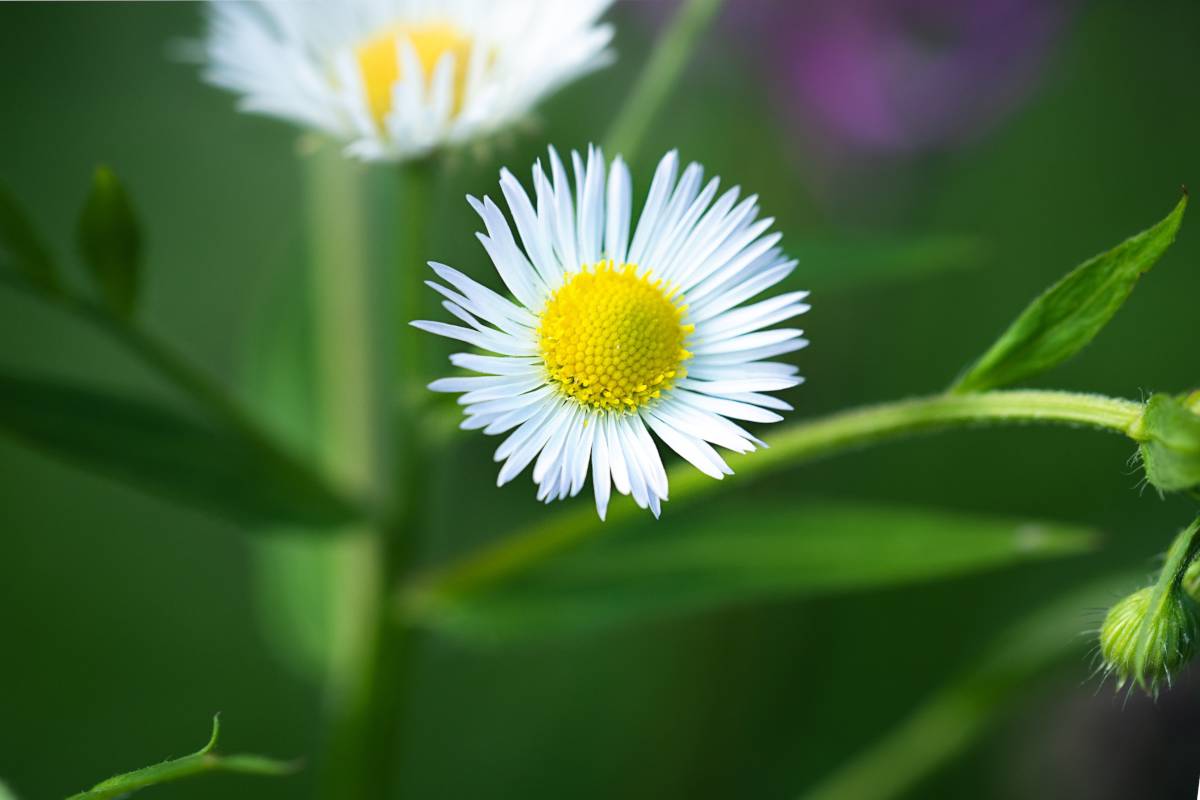
Its blooming looks exactly like that of lawn daisies, only much taller — a low haze of little flowers spilling over beds, edges and rocky ground. Fleabane (Erigeron karvinskianus) is best known for flowering from spring to fall; give it a nice sunny spot in ordinary, rather light soil and the display constantly renews itself.
| Name | Fleabane |
|---|---|
| Family | Asteraceae |
| Type | perennial |
| Height | 8 to 16 inches (20 to 40 cm) depending on variety |
| Exposure | full sun |
| Soil | ordinary, rather light |
| Flowering | May to October |
Ease of care, planting and the attention you give it will especially boost blooming.
In spring or fall preferably, locate a nice sunny spot to plant your fleabane, it can really support the blooming.
In summer, planting can still be proceeded to, but take care to water more regularly.
Just like the aster, ordinary soil mixed with a bit of soil mix is perfect.
Avoid compact and heavy soils that would retain water instead of releasing it to the plant.
To nicely cover a surface, plant around 8 or 9 flowers to a square yard (1 m²).
In order to multiply your fleabane, divide the bunch in spring every 3 or so years.
Very easy to grow, fleabane only needs very little care.
During planting, water when the soil has dried to help the root system get set up.
In fall, after the blooming or at the beginning of spring, cut back the crown as short as possible.
This step aims at snipping all stems down to a height of about 4 inches (10 cm) from the crown head, to stimulate the growth of fleabane while promoting the next flowering.
Fleabane asks for very little, but the few tasks it does need are tied to particular moments of the year. Here is what each season calls for, at a glance.
| Season | Task | What it involves |
|---|---|---|
| Spring or fall | Planting (best time) | Choose a nice sunny spot, which really supports the blooming |
| Summer | Planting (possible) | Still feasible, but water more regularly |
| Spring, every 3 years or so | Propagation | Divide the bunch to multiply your plants |
| Fall after blooming, or early spring | Cutting back | Snip all stems down to about 4 inches (10 cm) from the crown head |
| May to October | Flowering and deadheading | Remove wilted flowers regularly to trigger new ones |
Keep to this simple rhythm and the blooming renews itself from spring right through to fall.
A plant for flower beds, edges or rocky land, fleabane is spectacular from spring to fall thanks to its generous blooming which constantly renews itself.
This easy perennial hails from North America and adapts very well to any temperate climate. Even though some species like karvinskianus aren’t so hardy and need a relatively hot climate to thrive, most species are hardy.
The fleabane or erigeron genus has over 200 denominations, some of which are grown as annuals. The blooming looks exactly like that of lawn daisies, but it’s much taller.
The most famous species are Erigeron karvinskianus, glabratus, alpinus, uniflorus, dimity, paolii or violetta.