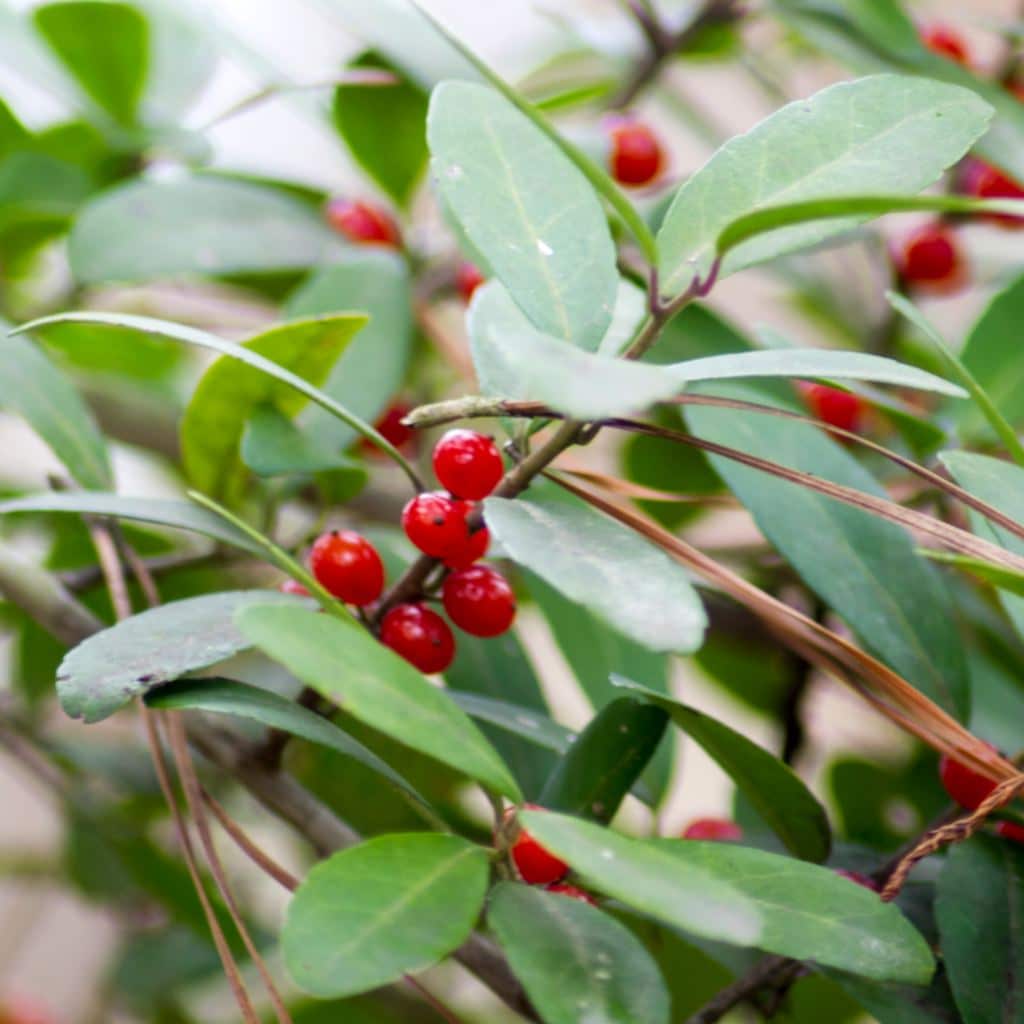
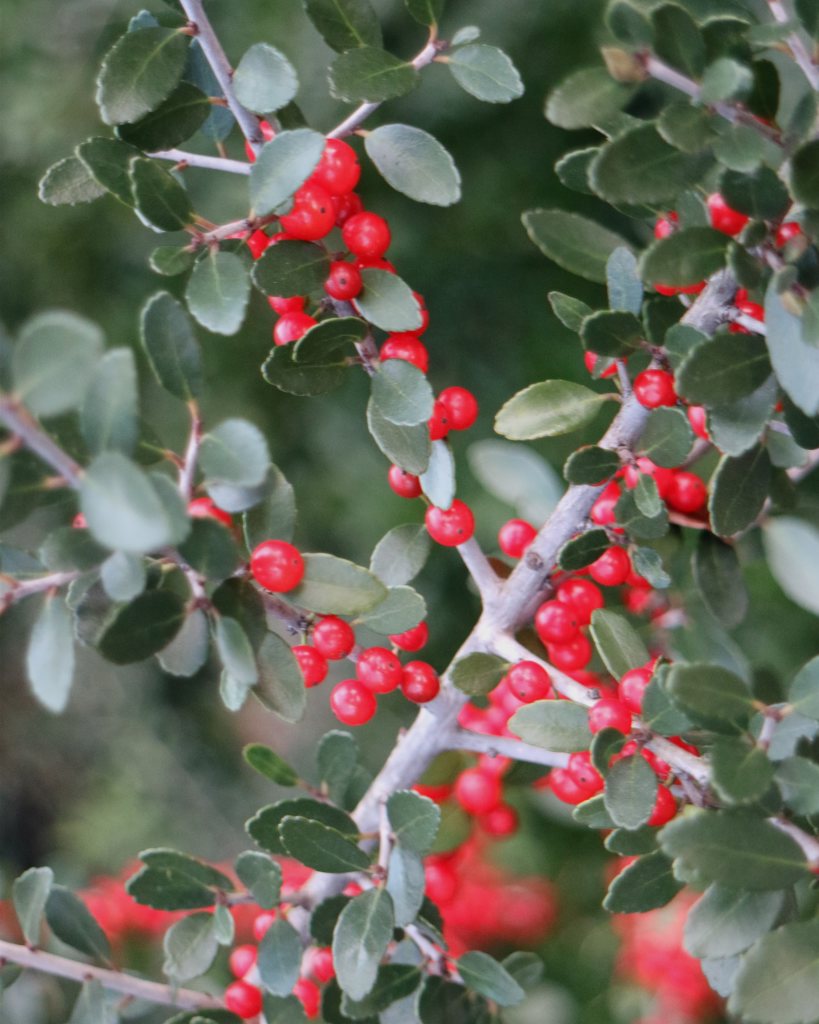
Dark, close-set leaves against pale bark, crisp red berries and a naturally round, mounding habit: dwarf yaupon (Ilex vomitoria) is an evergreen shrub at home in low hedges, containers and even bonsai pots. Give it the regular pruning it asks for and it will stay small and cute for decades.
Dwarf yaupon at a glance
Name
Ilex vomitoria sp.
Family
Ilex (holly)
Type
evergreen
Exposure
part to full sun
Soil
not important
Height
up to four feet (1+ meter)
Read our tips on how to plant and care for it both in an open garden and in garden boxes.
Planting dwarf yaupon
How to plant dwarf yaupon in the ground
There’s no need to prepare the soil because dwarf yaupon isn’t a very demanding shrub. It grows slowly and is able to pull nutrients out even from poor soil.
Follow our tips on how to plant shrubs and your dwarf yaupon will settle in in no time.
Check that there’s a drainage hole at the bottom for excess water to drain out
Use either simple garden soil or garden soil mixed in with all-purpose soil mix
How to care for dwarf yaupon
For dwarf yaupon, only the most basic care is required:
Water newly planted dwarf yaupon during the first year.
In case of severe drought, provide water at spaced intervals (weekly instead of daily).
Use mulch if your area is prone to drought so you don’t need to worry.
No need to fertilize your dwarf yaupon shrub unless it’s in a pot.
Regular shrub plant fertilizer will do for dwarf yaupon in containers.
No need to fertilize over the first year after repotting.
Water more frequently since plants grown in pots need more water.
Repot dwarf yaupon grown in containers every 2 to 3 years.
Dwarf yaupon pruning and trimming
If your dwarf yaupon is in a garden box or planter, prune yearly to retain its small, tight shape.
the best season to prune is spring
trim again lightly at the beginning of fall to give the dwarf yaupon a sharp shape for the winter.
Dwarf yaupon is perfect for low-lying hedges.
Planting and pruning a low dwarf yaupon hedge
In Europe, boxwood is often used for low-lying hedges, but dwarf yaupon does a great job at it, too!
Select dwarf varieties. This ensures slow growth.
Space plants rather tightly, as per the table below:
Desired hedge height
Spacing
1 foot (30 cm)
8 inches (20 cm)
2 feet (60 cm)
1 ½ feet (45 cm)
3 feet (90 cm)
2 feet (60 cm)
In short, space your dwarf yaupon plants about 2/3ds of how tall you want your hedge to be.
If you want to have your hedge trimmed and shaped into rectangular shapes, you’ll have to prune twice a year at least. Indeed, dwarf yaupon naturally grows into round, mounding shapes.
Best is to consider letting it grow naturally. It will create a long, low hedge shaped in a half-circle, much like the long lines in a lavender field. In this case, you’ll only need to prune once a year to keep it from growing too large.
Only female dwarf yaupons bear berries, and they need a male plant nearby.
Cut out any vigorous upright shoot on a dwarf yaupon, whether it is a true reversion to the full-size species or simply rank growth, because it breaks the plant’s mounded outline.
Which dwarf yaupon cultivar to choose
The three cultivars described above differ mainly in whether they carry berries and in the shape they settle into. Use this table to match a plant to the effect you are after.
Which dwarf yaupon cultivar to choose
Cultivar
Berries
Habit
Good to know
‘Nana’
Crisp red berries
Round, mounding
One of the most common; deer take only the berries
‘Shillings’ (‘Stokes Dwarf’)
None – male cultivar
Cushion, wider than tall
Choose it where fallen berries are unwanted
‘Condeaux’
None – male cultivar
Dwarf, slow-growing
Often sold as “Bordeaux dwarf yaupon”
For a low hedge, stick to dwarf varieties whichever you pick, since that is what guarantees slow growth.
Learn more about Dwarf Yaupon
Dwarf yaupon is a desirable addition to any garden, big or small. Its wood is very hard, and mature twigs tend to break off easily. Don’t use potted dwarf yaupon for goal posts when playing with children! Read more:
Dwarf yaupon holds better to drought when the ground is covered with mulch.
Image credits (edits Gaspard Lorthiois):
CC BY 2.0: ilouque
CC BY-SA 2.0: Ryan Somma
Written by Gaspard Lorthiois | Loves helping out, especially when it comes to growing things. Worked in herbal medicine, runs a farm, and dabbles in tech. Master's degree and engineer.