
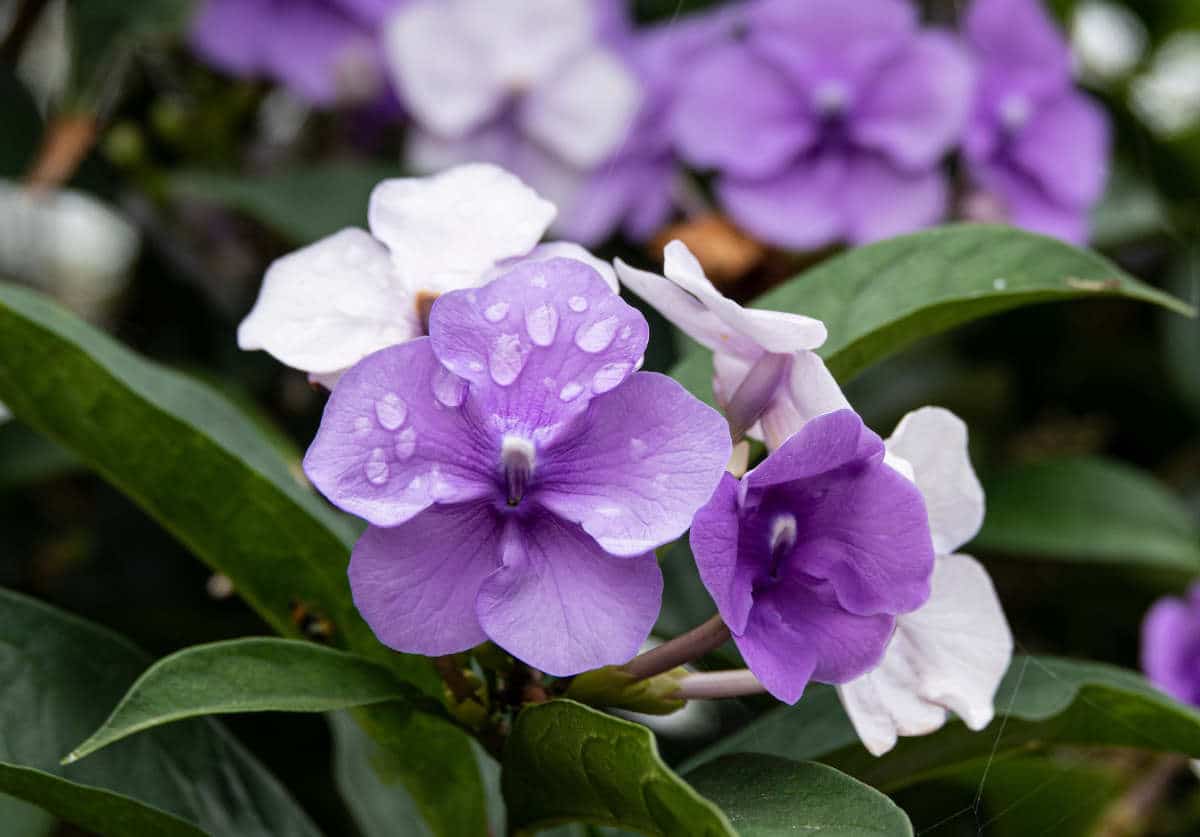
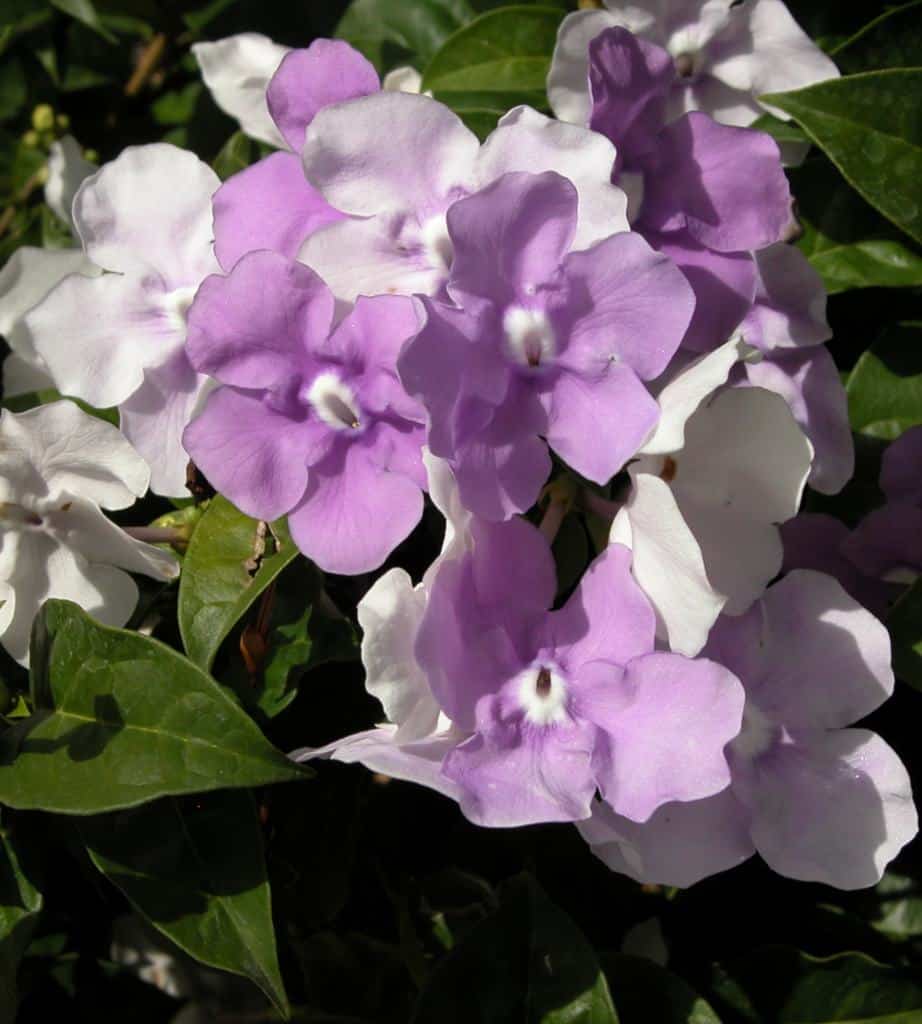
Each flower opens violet, fades to blue, then turns white in barely three days, which is how brunfelsia (Brunfelsia pauciflora) earned its nickname Yesterday, Today, Tomorrow. A summer-flowering Latin American shrub with handsome evergreen leafage, it does well in a pot, provided it winters somewhere bright where the temperature never drops below 50°F (10°C).
| Name | Brunfelsia pauciflora |
|---|---|
| Family | Solanaceae or nightshade |
| Type | shrub |
| Exposure | full sun, part sun |
| Soil | rich enough |
| Height | 20 to 40 inches (50 to 100 cm) |
| Foliage | evergreen or deciduous depending on the climate |
| Flowering | Summer |
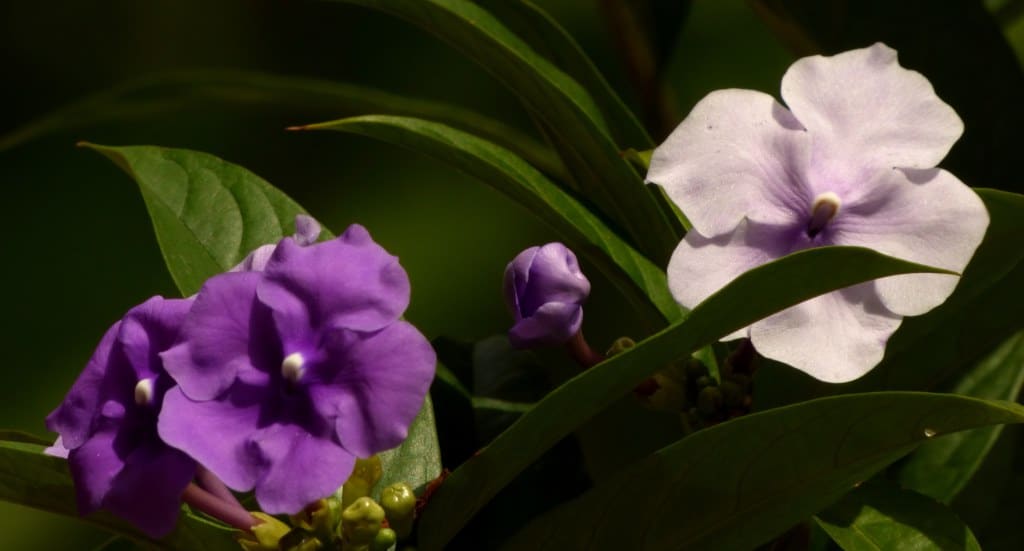
This amazing plant changes the colors of its flowers in three short days, shifting from violet to white. It also bears beautiful evergreen leafage.
It is a good idea to plant in spring, preferably in a pot so that you may bring it indoors.
Indeed, this shrub fears freezing, so you’ll have to set it up over the winter in a room where temperatures don’t drop below around 50°F (10°C).
It’s very difficult to grow it year-round inside a house or apartment because the air is much too dry indoors.
If you wish to reduce or reshape the shrub, wait for the blooming to end and cut the stems back by half.
In order to increase the blooming, you may add rose tree fertilizer once a week during the blooming season.
An annual repotting in spring is almost mandatory for all your Brunfelsia that are confined to pots.
Unless you live in a tropical region where the winter weather is very mild, you’ll have to find a way to protect your shrub in winter.
In fall, it is best to bring your brunfelsia inside, because it is vulnerable to the cold and would fare best in a well-lit spot where the temperature never drops below 50°F (10°C).
Water as little as possible over the winter.
It is important to water regularly, with lukewarm water. However, don’t water too much, but water regularly all summer long.
It’s always better to water in the evening so that water isn’t lost through evaporation.
The ideal setting for your brunfelsia is in a pot that is rested on a bed of gravel. The gravel or clay pebbles are stacked in a water retention plate which is always filled with water, while the pot stays in the dry.
This water around the clay marbles evaporates and gives the plant the moisture it requires. Here’s an example of clay marbles used to create air moisture.
Because this shrub is grown in a pot and cannot take frost, its care follows the seasons closely. Here is what each part of the year asks of you.
| Time of year | What to do | Why |
|---|---|---|
| Spring | Plant, and repot pot-grown plants once a year | A pot lets you carry the shrub back indoors later |
| Summer | Water regularly with lukewarm water, in the evening | Regular but moderate watering, with no loss through evaporation |
| Summer, during bloom | Feed with rose tree fertilizer once a week | To increase the blooming |
| After flowering | Cut the stems back by half | To reduce or reshape the shrub |
| Fall | Move the plant to a well-lit spot above 50°F (10°C) | The shrub is vulnerable to the cold and fears freezing |
| Winter | Water as little as possible | Growth slows and the plant is simply being kept frost-free |
Get the winter shelter right and the rest of the year is straightforward.
Your soil around the plant is probably too chalky. Provide heath or liquid iron sulfate as a remedy for this.
Aphids can be quite devastating and their leaves turn sticky and gooey. Here is a link with advice against aphids.
Red spider mites might be found hiding on the undersides of leaves and can also wreck havoc. Treat them with a mite-killer or special red spider mite spray.
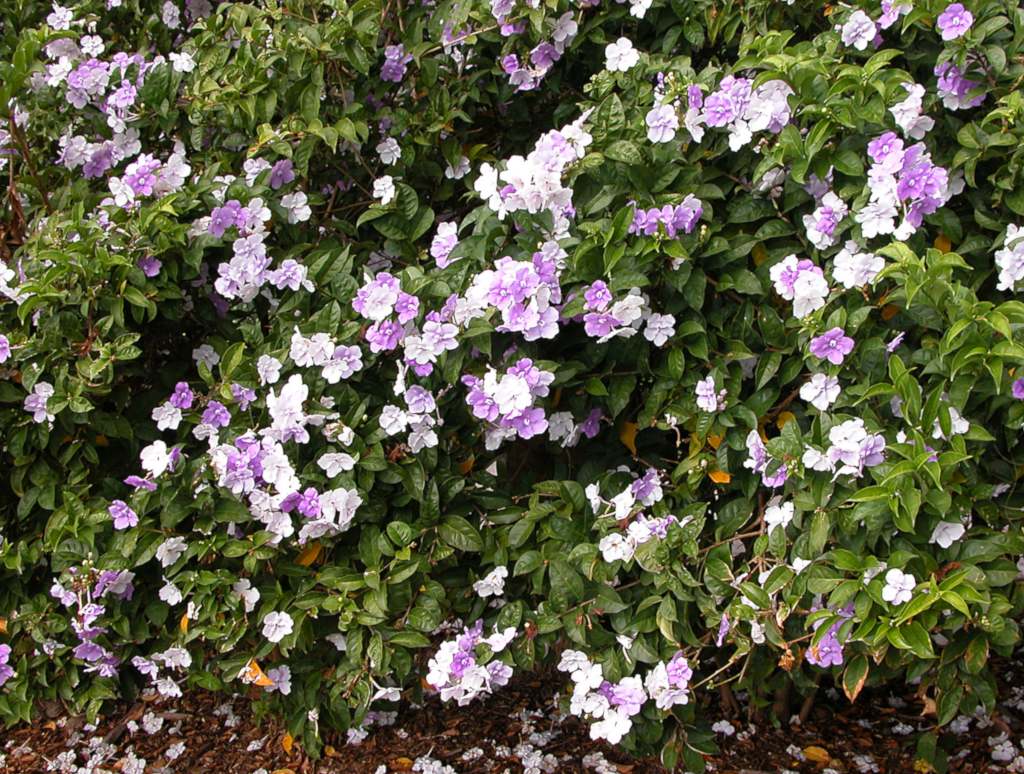
This very beautiful Latin American shrub owes its nickname to the changing colors of its flowers, which shift from violet or purple to blue to white in barely three days.
The genus comprises about thirty different species which are all native to tropical American and Antilles forests.
The scientific name of the plant relates to a famous German botanist, Otto Brunfels.
Every part of the Brunfelsia plant is poisonous, it must be handled with care.
Read also:
Adding organic fertilizer in spring will enhance its bloom.
Thanks a lot. I’ll do an inspection and take the necessary action.
Sure thing!
I live in the Western Cape, South Africa. My Brunfelsia is doing fine, except for some of the foliage curling. What could be the cause?
Thanks!
Hi Mantie, it could be one of several things. First, I’d suspect red spider mites: when they feed in large numbers, they drain leaves of their sap and the tissue collapses, curling the leaves. The same is true of thrips. Occasionally, scale insects produce the same result, too. Usually, all of the above also change the color of leaves: yellow for mites and scale insects, silvery-white for thrips.
Some species of butterflies have caterpillars that wrap themselves up in leaves for protection when they’re forming their cocoon. This is easy to check for.
If there are no bugs present, large or small, then possibly a disease is infecting the plant. Fungal diseases have a variety of consequences. Curling occurs in some cases, much like peach leaf curl, but for Brunfelsia not much is documented yet.
Normally, lack or excess water shouldn’t lead to curling, so that can be ruled out.