A strip of ground under high tree canopy or along the shaded side of a wall gets a few hours of sun and then falls into soft shade for the rest of the day. Soil there is often dry at the surface, criss-crossed with roots, and bare patches invite weeds and wash away in heavy rain. A good scheme knits the whole area together with overlapping mounds and spreading mats, so leaves touch leaves by midsummer and flowers rise just above that continuous green floor.
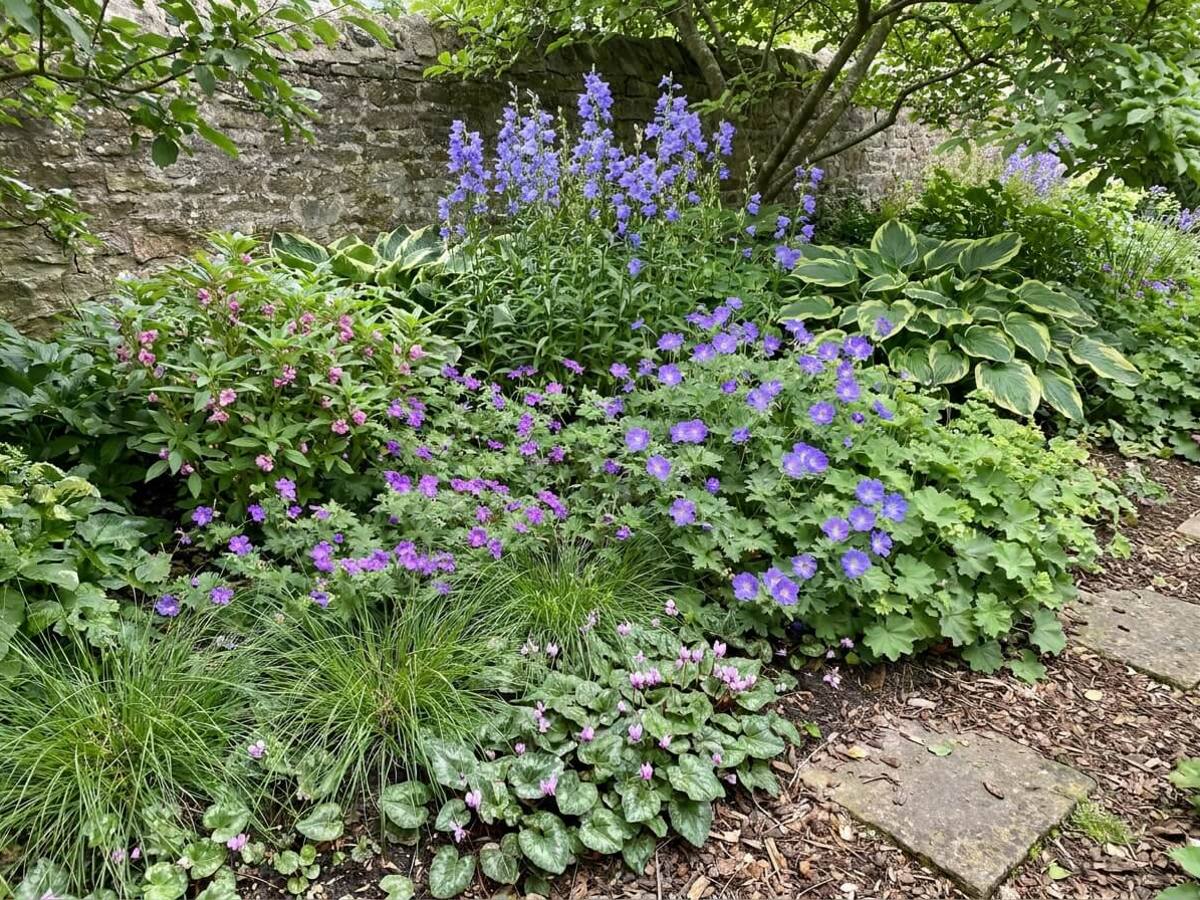
From back to front: Bellflower, Hosta, Garden balsam, Perennial geranium, Geranium Rozanne, Lady’s mantle, Sedge, Ivy leaf cyclamen.
At the back of the border, Bellflower gives you the vertical note the scheme needs, sending up spires and open bells in blue, violet or white through the heart of summer. It copes with dappled light far better than most summer flowers and keeps blooming as the shade deepens. Planted behind the lower mounds, it reads as a haze of colour floating above them rather than a block, and its narrow footprint means it never crowds its neighbours out.
Hosta supplies the architecture: broad, ribbed, overlapping leaves that hold the back and middle of the scheme steady all season. Blue-green, chartreuse or cream-margined foliage lights up the dimmest corner, and the pale flower stems in summer are a quiet bonus rather than the main event. Set against the fine spires behind it, Hosta provides the contrast of scale that stops a shade planting looking like undifferentiated green.
Garden balsam is your filler for the middle layer, flowering non-stop from early summer until the first cold nights. The waxy pink, red and white blooms sit tight against the stems, so the effect is of colour scattered through the greenery rather than bouquets on top of it. Drop it into the gaps between the bigger clumps in the first year or two, while the perennials are still bulking up, and it will hide every patch of bare soil.
Perennial geranium is the workhorse of the carpet, forming low domes of deeply cut leaves that spread sideways and smother weed seedlings. Flowers come in waves through summer in pink, mauve and purple, and a shear-over after the first flush brings fresh leaves and more buds. It leans happily into the base of the taller plants, hiding their bare ankles and softening every join in the scheme.
Geranium Rozanne earns its place towards the front for sheer flowering length, throwing violet-blue saucers with pale centres from early summer well into autumn. The stems travel rather than clump, threading through whatever stands next to them, which is exactly what welds a group of separate plants into one carpet. Let it run forward over the edge of the bed and backwards into its neighbours, and resist the urge to tidy it.
Lady’s mantle takes the front edge, where you can appreciate the pleated, slightly felted leaves that hold beads of rain and dew all morning. Its froth of tiny lime-green flowers in early and midsummer is the perfect foil for every pink, blue and violet behind it. Planted shoulder to shoulder along the path or lawn edge, Lady’s mantle draws a soft, unbroken line and keeps the soil beneath it cool.
Sedge brings the one texture nothing else here offers: thin, arching, evergreen blades that catch the slightest movement of air. Tucked in small groups towards the front, it breaks up the run of rounded leaves and keeps the planting looking furnished in winter when the perennials have retreated. It asks for very little and holds its shape beside the spreaders without being swallowed.
Ivy leaf cyclamen works at ground level, underneath and between everything else, and takes over precisely when the summer flowers fade. Slender pink or white blooms appear in late summer and autumn, followed by marbled, silver-patterned leaves that carpet the soil through winter. Because it goes dormant in high summer, it never competes with the main display, and it thrives in the dry shade at the base of trees and walls.
Work in drifts, not rows. Set Bellflower along the back in groups of three, about 40 cm apart, with two or three clumps of Hosta in front of them spaced 60 cm apart so the leaves just meet by midsummer. Fill the middle with Perennial geranium at 45 cm spacing, in odd-numbered groups of three or five, and slot Garden balsam into any gap wider than a hand’s width. Bring Geranium Rozanne forward at 50 cm spacing where it can spill, then edge the front with Lady’s mantle at 40 cm apart, interrupted every couple of metres by a trio of Sedge for contrast. Finally, push Ivy leaf cyclamen tubers into the pockets of soil between the front-row plants and under the Hosta, a dozen or so per square metre, where nothing else wants to root.
In spring the scheme is all foliage: Hosta spears unfurling, Lady’s mantle pleats opening, Sedge already green from winter. Early summer brings the lime froth of Lady’s mantle and the first flowers on Perennial geranium, followed by Bellflower spires and the long run of Geranium Rozanne and Garden balsam, which carries colour to the first frosts. Late summer and autumn belong to Ivy leaf cyclamen, flowering at ankle height as everything above it begins to tire. Through winter the bed is quiet rather than empty, with Sedge holding its arching blades and the marbled leaves of Ivy leaf cyclamen covering the ground until the Hosta returns.