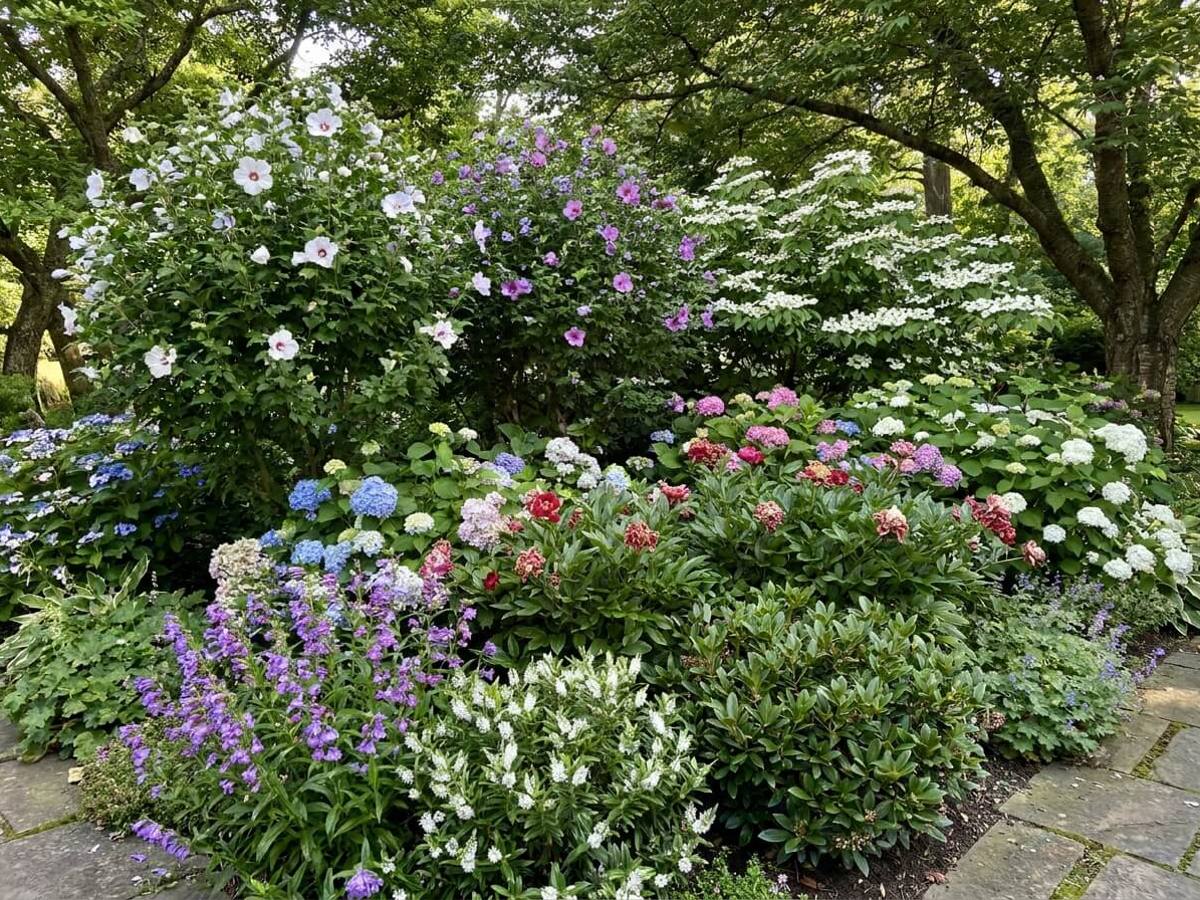
A bed that sits in partial shade — a few hours of morning or late-afternoon sun, dappled light for the rest — is one of the trickiest spots to plant for summer. Sun-lovers sulk and go leggy, while deep-shade plants scorch on the brighter edge, and the whole thing can slide into a flat green mass by July. The answer is to build the scheme in layers, with shrubs carrying the structure and the summer flowers, and lower plants supplying colour at knee height where the light is softest.
From back to front: Hibiscus Althea, Viburnum plicatum, Hydrangea, Peony, Beardtongue, Hebe, Skimmia.
This is the tallest thing in the bed and the one doing the heaviest lifting in high summer, throwing out wide open flowers from July right through to the first cold nights. Hibiscus Althea tolerates a half-shaded position well, though it will lean gently towards the brighter side, so give it the sunniest corner of the back row. Its upright, rather stiff habit makes a good foil for the rounded shrubs in front of it, and it leafs out late, which means spring bulbs and early growth below are never swamped.
Set at the back alongside the previous shrub, Viburnum plicatum brings a tiered, horizontal branch structure that reads as architecture even when nothing is flowering. Its white spring blooms sit along the branches in flat layers, and the foliage colours before falling in autumn. Partial shade suits it far better than baking sun, and its broad, spreading outline softens the vertical lines of its neighbour.
The middle layer belongs to Hydrangea, which is exactly the plant this light level was made for: full sun burns the flower heads, deep shade stops them forming, and dappled light gives you big, long-lasting blooms from midsummer onwards. The flower heads hold their shape for months and dry on the plant into autumn. Its coarse, rounded leaves give the bed weight and contrast with the finer foliage at the front.
Planted just in front of the shrub layer, Peony opens before the main summer display gets going, so the bed is not empty in late spring. The deeply cut foliage stays handsome once flowering is over and makes a solid, glossy mound all summer. Keep it on the lighter side of the bed and do not let the shrubs behind grow over it — it resents being crowded and flowers less in dense shade.
For a long run of colour at mid-height, Beardtongue sends up slim spires of tubular flowers through summer and into early autumn. The narrow spikes are a useful vertical note among all the rounded shapes, and the fine foliage lightens the bed. It copes with a half-shaded site provided the soil drains freely, so keep it away from the damper ground the other plants prefer.
Towards the front edge, Hebe forms a neat evergreen dome that holds the scheme together when the perennials die back. It flowers through summer in short spikes that pick up the colour higher in the bed. The tight, even foliage is a calm surface against the busier flowers behind it, and it needs almost no attention beyond a light trim after flowering.
At the very front and in the shadiest corner, Skimmia is the plant that keeps the bed furnished in the months when nothing is in bloom. Its glossy evergreen leaves, clustered flower buds and winter berries carry the scene from autumn through to spring. It genuinely prefers shade, so put it where the other plants would struggle, and it will never outgrow its place.
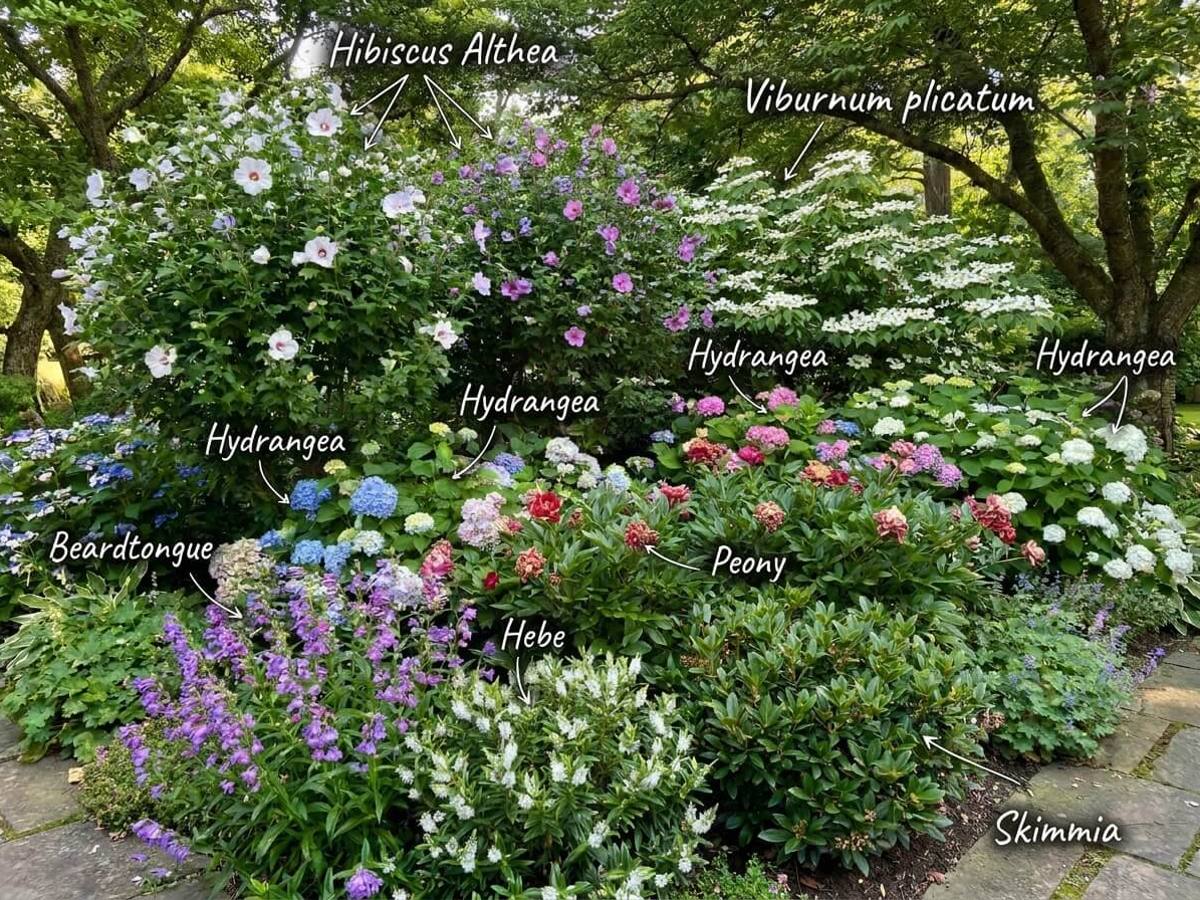
Work in three bands. Put Hibiscus Althea in the brightest back corner and Viburnum plicatum about 2 m away from it along the back line, so each has room to spread. Plant three Hydrangea in a loose triangle across the middle band, roughly 1.2 m apart, with Peony in a group of three set 80 cm apart just in front of the gap between the two back shrubs. Drift five to seven Beardtongue along the mid-front, 40 cm apart, on the free-draining side; finish with three Hebe at 60 cm spacing on the sunnier front corner and two or three Skimmia at 60 cm in the shadiest front corner, where they will catch the eye from the path.
In spring, Viburnum plicatum flowers along its tiers while Peony pushes up its red shoots, and Skimmia is still in bud. Early summer brings the Peony blooms, then Hydrangea and Hebe take over, with Beardtongue spiring up between them and Hibiscus Althea opening from July until autumn. By late autumn the Hydrangea heads have dried to parchment and the Viburnum plicatum leaves have turned; through winter the bed is carried entirely by the evergreen mounds of Hebe and the berried Skimmia at the front, with the bare branch framework behind them giving the whole thing shape until growth starts again.