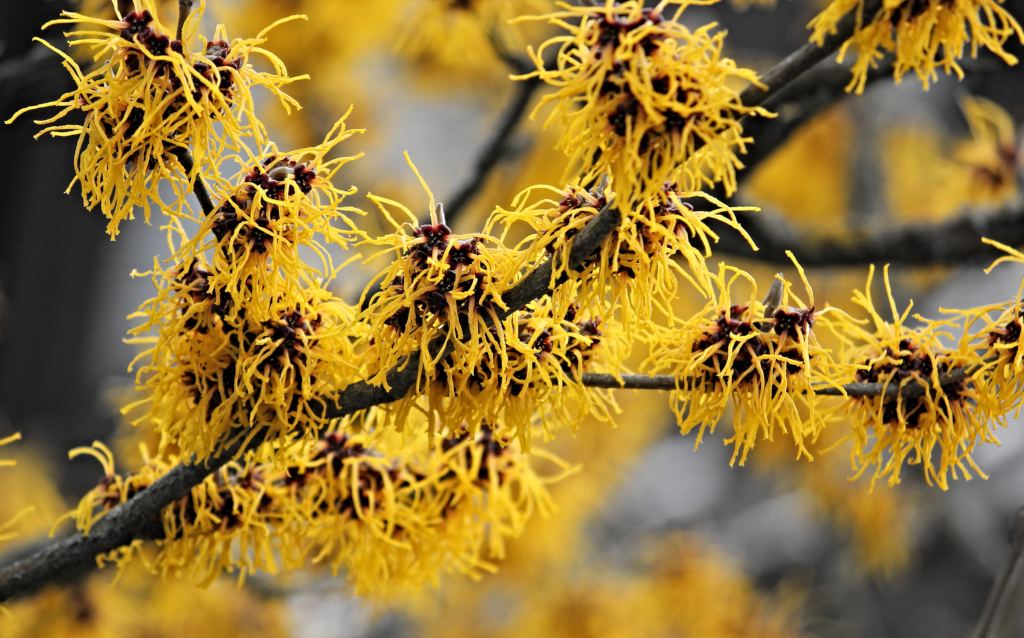
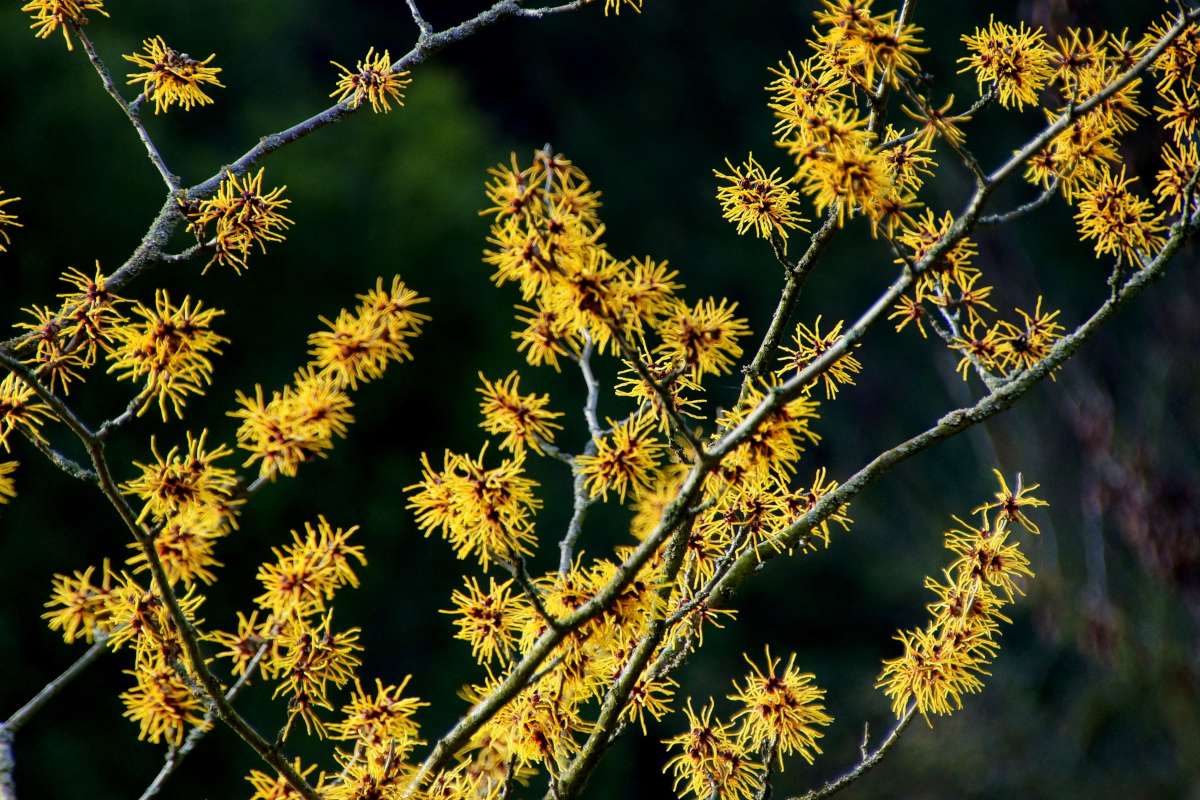
Lemon-yellow flowers open on bare branches at the very midwinter, long before the deep green leaves return. Witch-hazel (Hamamelis), sometimes called the tree with golden stars for its strange, spidery winter blooms, is counted among the finest of all winter-blooming shrubs, slow-growing and small enough for a tiny garden: give it acidic soil, shelter from cold wind and all the winter light you can, and the flowering lasts longer still. In autumn the same shrub is draped in amazing hues.
| Name | Hamamelis |
|---|---|
| Family | Hamamelidaceae |
| Type | shrub |
| Height | 6 ½ to 16 feet (2 to 5 meters) |
| Planting distance | 10 to 13 feet (3 to 4 meters) |
| Exposure | full sun, part sun |
| Soil | rather rich, rather acidic, never dry in summer |
| Foliage | deciduous |
| Flowering | midwinter to early spring |
Pruning and caring are practices that will enhance blooming and growth.
The planting of witch-hazel is preferably performed in fall to promote root development before winter.
For plants purchased in pots or containers, you can plant in other seasons than fall as long as both hot and cold spells are avoided.
Witch-hazel is always offered for sale with its clump of soil, or in a container, because it doesn’t cope very well with bare-root transplanting. Remember this if ever you need to move your witch-hazel from one spot to another yourself.
If you’re lucky to have a terrace that can welcome a large pot, you’ll be able to grow witch-hazel in a container, because its slow growth makes it a good candidate to growing in such spaces.
Note also that witch hazel is particularly hardy to the cold, and so growing it in pots is all the more possible.
Caring for it is easy and its hardiness makes it almost invulnerable to most diseases as it does to insect attacks or parasites.
Most garden witch-hazels are grafted onto Hamamelis virginiana rootstock, so cut away any suckers rising from below the graft union before they outgrow the cultivar.
Growth is slow, which is exactly what makes this shrub so easy to place:
Watering is needed on a regular basis for witch-hazel when it’s hot and during the 2 first years after planting.
In winter, if it really doesn’t rain and the ground is dry, water when it isn’t freezing to ensure you’ll have proper blooming.
Witch-hazel asks for very little, but the few tasks it does need each have their own moment. Here is what to do, when, and why it matters.
| Task | When | Why it matters |
|---|---|---|
| Planting | Preferably in fall | Roots settle in before winter |
| Pruning | Once blooming has ended, and only if needed | Growth is slow, so the shrub rarely needs shaping |
| Watering in summer | In the evening, when hot | Less water is lost to evaporation |
| Watering in winter | During the daytime, never when freezing | Dry ground in winter spoils the blooming |
| Mulching | Pine bark mulch | Acidifies the soil and keeps moisture in |
| Spreading permanent mulch | mid-spring to late spring, 2 to 4 inches (5 to 10 cm) thick over the whole drip zone | A blend of peat and garden compost ensures proper growth and helps the shrub cope with strong summer heat |
Beyond these few gestures, the shrub looks after itself.
Almost every witch-hazel on sale is a named cultivar of the Hamamelis × intermedia group, and they differ far more in flower colour, scent and timing than the plain species suggests. The table below sets out the varieties most often found in garden centres and mainstream catalogues, so you can match one to the spot you have in mind.
| Variety | Flower colour | Scent | Flowering period | Autumn leaf colour |
|---|---|---|---|---|
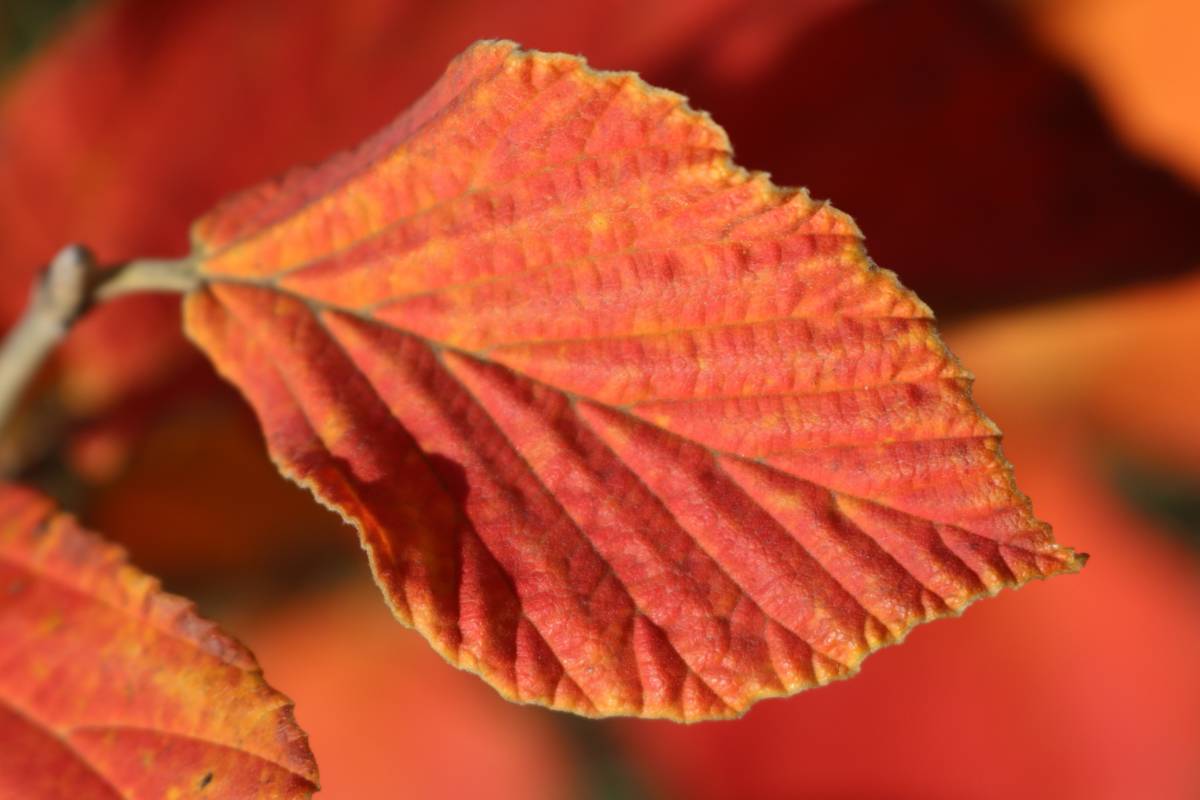
| ‘Barmstedt Gold’ | Deep golden yellow | Strong | Mid to late winter | Yellow |
| ‘Pallida’ | Sulphur-yellow | Strong, sweet | Mid-winter | Butter-yellow |
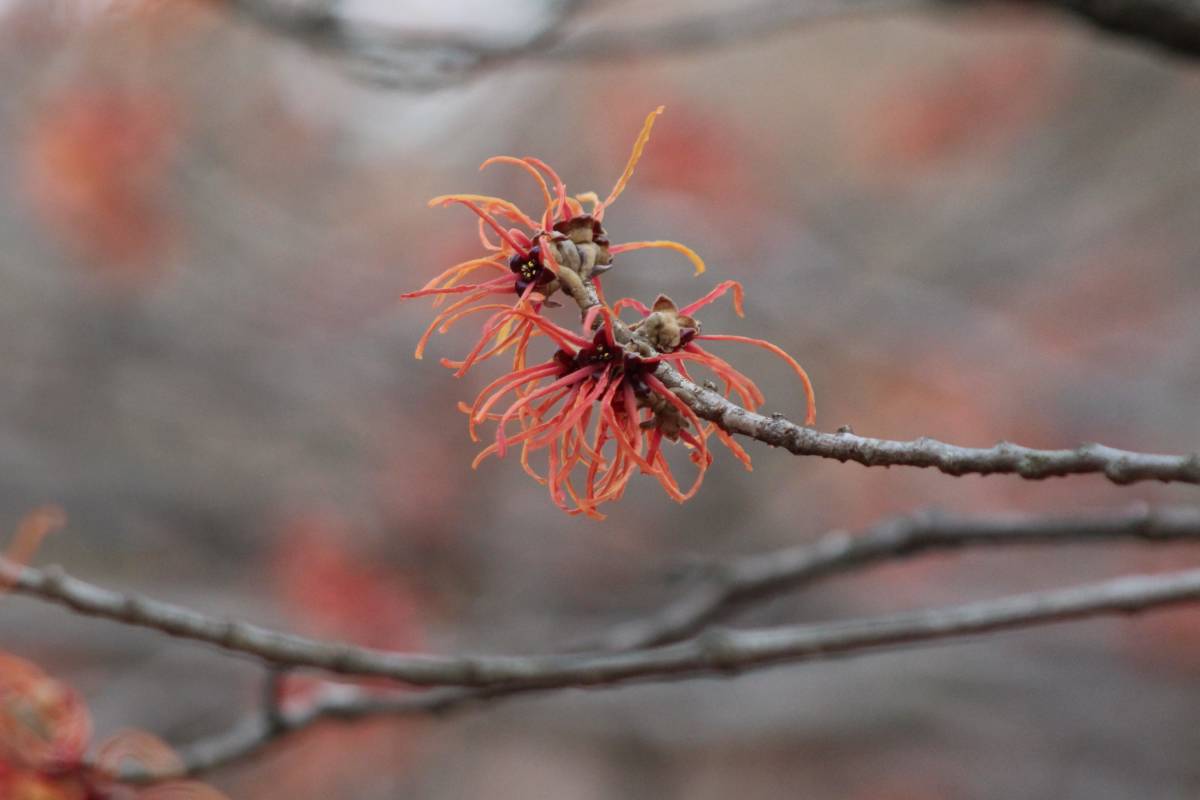
| ‘Jelena’ | Coppery orange | Faint | Mid-winter | Orange to scarlet |
| ‘Diane’ | Dark red | Faint | Mid to late winter | Red and orange |
| ‘Angelly’ | Light lemon-yellow | Light | Late winter | Yellow |
| ‘Orange Beauty’ | Orange-yellow | Strong | Early to mid-winter | Yellow-orange |
| ‘Aphrodite’ | Deep orange to orange-red | Sweet, moderate | Mid to late winter | Orange |
| ‘Ruby Glow’ | Coppery red | Light | Mid to late winter | Orange-red |
| ‘Primavera’ | Pale primrose-yellow | Strong | Late winter | Yellow |
| ‘Arnold Promise’ | Bright clear yellow | Strong, sweet | Late winter | Orange and red |
| ‘Westerstede’ | Clear yellow | Light | Late winter | Yellow |
| ‘Feuerzauber’ | Orange-red | Light | Mid-winter | Orange-red |
| ‘Vesna’ | Orange-yellow, red base | Strong | Late winter | Orange |
| ‘Wisley Supreme’ | Soft yellow | Very strong | Early to mid-winter | Golden yellow |
| ‘Sandra’ | Small, deep yellow | Light, spicy | Late winter | Scarlet and purple |
Since this tree appreciates acidic soil, feel free to pair it with heath plants with evergreen leafage such as camellia, azalea, rhododendron and heather.
It will also grow in perfect harmony with the Chinese fringe flower that also blooms in winter.
Set companions well away from the trunk and disturb that soil as little as possible, since digging close to any established shrub can sever surface roots; top-dress with mulch rather than cultivating.
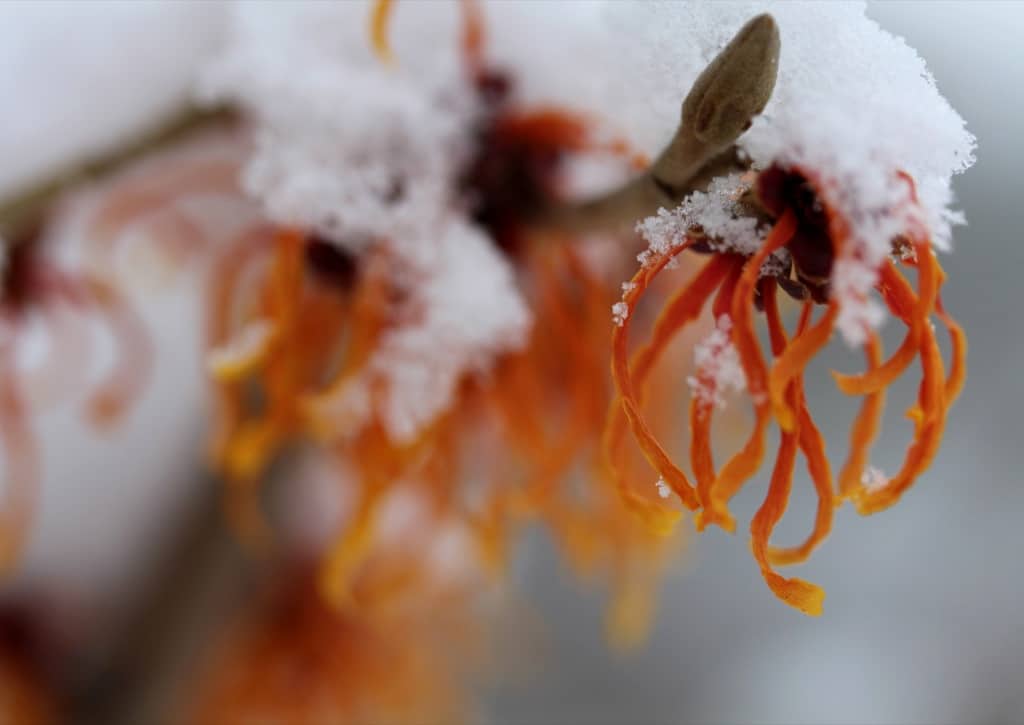
Magical and mysterious, witch-hazel flowers are remarkable thanks to their uniqueness and especially because they appear right in the middle of winter.
When the witch-hazel loses its leaves in fall, it then grows magnificent flowers with lemon-yellow colors in midwinter.
These flowers will then be replaced with superb deep green leaves.
Easy to care for and simple to grow, this shrub is particularly appealing when planted as a standalone, but it can also become part of a mixed hedge.
Witch-hazel is perfectly suited to growing in a small garden because of two things. First, its growth is very slow, and second, even when it has become a mature tree it is still quite small.
Lastly, let us note that it is quite invulnerable to diseases and parasites which makes it an easy tree to care for.
Witch-hazel is an ingredient widely used in many pharmaceutical preparations thanks to its soothing properties on skin, especially dermatitis, and its influence on blood flow, varicose veins and hemorrhoids.
Mulch prepared from pine bark is a good idea.
The natural acidity this bark bequeaths favors witch-hazel growth and retains moisture.